Remote Patient Monitoring (RPM) for Geriatric Telemedicine
Updated on July, 2026.
Aging populations are reshaping the economics and architecture of healthcare. Traditional models—built around hospital visits, episodic consultations and reactive treatment—struggle under the weight of chronic disease, mobility limitations, and rising care costs. For geriatric care, where continuity matters more than intensity, this approach is fundamentally misaligned.
Remote Patient Monitoring (RPM) emerges not as an incremental upgrade, but as a structural shift.
It replaces fragmented snapshots of health with continuous physiological intelligence—a live stream of biometric data that transforms how clinicians understand, predict, and manage disease. Instead of waiting for symptoms to escalate into emergencies, care teams operate with early signals, subtle deviations, and trend-based insights. The result is a transition from intervention to anticipation.
For elderly patients, this shift carries deeper implications. Independence is preserved longer. Hospital dependence is reduced. Care becomes ambient—embedded into daily life rather than imposed through disruption.
→ Explore the full ecosystem: Telemedicine

At the system level, RPM redefines scalability. A single clinician, supported by intelligent monitoring systems, can oversee dozens—or hundreds—of patients without diluting care quality. Healthcare delivery evolves from location-bound to network-driven, from human-limited to data-augmented.
Within the broader framework of geriatric telemedicine, RPM is not merely a component—it is the operational core. Teleconsultations provide interaction; RPM provides awareness. Together, they form a closed-loop care model where data informs decisions, and decisions are continuously validated by data.
This section explores RPM not as a tool, but as an infrastructure—covering its clinical applications, device ecosystems, cost structures, risks, and its accelerating role in the Geriatric Healthcare systems of 2026 and beyond.

Quick Picks
- What is Remote Patient Monitoring
- Who Needs RPM
- Conditions Treated
- RPM Devices & Systems
- Benefits of RPM
- RPM in 2026 (Trends & Tech)
- Cost Expectations
- Risks & Limitations
- Telehealth vs Telemedicine vs RPM (Comparison)
- Implementation Strategy
Remote Patient Monitoring (RPM) for Geriatric Telemedicine

What It Is
Remote Patient Monitoring (RPM) is a clinical care model where patient health data—such as heart rate, blood pressure, glucose levels, oxygen saturation—is collected outside traditional healthcare settings and transmitted to providers in real time.
Instead of episodic clinic visits, RPM creates continuous, data-driven care loops, allowing clinicians to intervene early, adjust treatments, and reduce hospitalizations.
Read our complete section on what remote patient monitoring is.

At its core, RPM transforms healthcare from reactive → predictive → preventive.
Who Needs It
RPM is not for everyone—it is most effective where continuous monitoring impacts outcomes.
High-Value Patient Segments
- Seniors with chronic diseases
- Post-hospital discharge patients
- Mobility-limited elderly
- Patients in rural or underserved regions
- Individuals requiring medication adherence tracking
Care Stakeholders
- Family caregivers needing real-time visibility
- Geriatricians managing multiple comorbidities
- Telehealth providers scaling care delivery
Conditions Treated
RPM is heavily optimized for chronic disease management, which dominates global healthcare demand.
Core Conditions
- Hypertension (remote blood pressure monitoring)
- Diabetes (continuous glucose monitoring)
- Heart disease (cardiac telemetry, arrhythmia detection)
- COPD & asthma (oxygen saturation monitoring)
- Obesity & metabolic syndrome
Extended Use Cases
- Post-surgical recovery monitoring
- Dementia & Alzheimer’s (activity + safety tracking)
- Sleep disorders
- Fall detection & mobility tracking
Below are compact, ready-to-paste sub-sections you can place under your Remote Patient Monitoring (RPM) pillar. Each is written to work as an SEO-friendly mini-guide while still staying medically practical and structured.
How to Monitor Blood Pressure at Home
Home blood pressure monitoring is one of the most important components of remote patient care, especially for elderly individuals and those with cardiovascular risk. It helps detect hypertension early, track medication effectiveness, and reduce hospital visits.
To measure correctly, patients should use a validated automatic upper-arm cuff rather than wrist devices, as they are more accurate. Readings should be taken at the same time each day, ideally in a calm state after resting for at least five minutes. The arm should be supported at heart level, with feet flat on the floor and back straight.
For reliable tracking, two to three readings should be taken one minute apart, and the average should be recorded. Avoid caffeine, smoking, or physical activity at least 30 minutes before measurement. Consistent logging allows caregivers and clinicians to identify trends rather than relying on isolated readings.
Glucose Monitoring for Seniors
Glucose monitoring in seniors is essential for managing diabetes safely and preventing complications such as hypoglycemia or hyperglycemia. Regular monitoring helps adjust diet, medication, and insulin therapy effectively.
Most seniors use a finger-prick glucometer or continuous glucose monitoring (CGM) systems, depending on their condition and physician recommendation. Finger-prick tests are typically done before meals and sometimes before bedtime, while CGMs provide real-time readings throughout the day.
Proper technique is important: hands should be clean and dry, and test strips should not be expired. Recording readings consistently helps healthcare providers understand patterns, especially post-meal spikes or overnight drops. Caregivers should also watch for symptoms such as dizziness, confusion, or excessive fatigue, which may indicate abnormal glucose levels.
Oxygen Saturation Monitoring in Elderly Patients
Oxygen saturation monitoring is a key part of RPM for patients with respiratory or cardiac conditions such as COPD, pneumonia recovery, or heart failure. It helps detect early signs of oxygen deprivation before symptoms become severe.
A pulse oximeter is typically used by placing it on a fingertip while the patient is at rest. Readings should be taken after a few minutes of stillness, ensuring warm fingers and no nail polish or artificial nails that could interfere with accuracy.
Normal oxygen saturation usually ranges from 95% to 100%, though slightly lower values may be acceptable in some chronic lung conditions as advised by a physician. Repeated low readings or sudden drops require prompt medical attention. Consistent daily tracking is more useful than single measurements for clinical decision-making.
Weight and Fluid Tracking in Heart Failure Patients
Daily weight monitoring is a critical indicator in patients with heart failure, as sudden weight gain often signals fluid retention before visible symptoms appear. This makes it a powerful early warning tool in remote patient monitoring systems.
Patients should weigh themselves every morning after waking up, using the same scale, wearing similar light clothing, and before eating or drinking. Any sudden increase of 1–2 kg within a short period may indicate fluid buildup and should be reported to a healthcare provider.
In addition to weight, monitoring signs of fluid retention such as swelling in the legs, shortness of breath, or abdominal bloating is important. Consistent tracking allows timely adjustment of diuretics or treatment plans, helping prevent hospitalization.
RPM Devices & Systems
Remote patient monitoring works best when the right device is matched to the right clinical risk. In elder care, the goal is not to fill the home with gadgets. The goal is to create a reliable health signal that helps caregivers, nurses, physicians, and family members understand what is changing before a small issue becomes a larger medical problem.
Modern RPM devices and systems for seniors can monitor blood pressure, glucose, oxygen saturation, heart rate, body weight, physical activity, sleep patterns, medication adherence, fall risk, and daily routine changes. Some systems are simple and device-based. Others are more advanced, combining wearable sensors, clinical-grade monitors, smart home tools, telehealth dashboards, AI-driven alerts, and Electronic Health Record integration.
A remote glucose monitoring system being used for elder care service is a strong example. A senior with diabetes may use a continuous glucose monitor or connected glucometer at home, while the care team reviews glucose trends through a dashboard. Instead of waiting for a clinic visit, the provider can see recurring morning highs, post-meal spikes, missed readings, possible hypoglycemia risk, or changes after medication adjustment. When glucose monitoring is combined with blood pressure, weight, oxygen saturation, activity, and medication data, the care picture becomes much more complete.
That is the real value of RPM systems for elderly care: they turn home health data into earlier recognition, better chronic disease management, and safer aging in place.
1. Wearables for Remote Patient Monitoring
Wearables are often the most familiar RPM devices because many seniors and families already recognize smartwatches, fitness bands, and health-tracking wrist devices. In remote patient monitoring, wearables can help track daily movement, heart rate, sleep rhythm, oxygen trends, fall risk, and sometimes ECG-style heart rhythm signals.
For older adults, wearables are useful because they can collect information passively. A person may forget to write down symptoms or manually log activity, but a wearable can still show whether movement declined, sleep became fragmented, resting heart rate increased, or daily routine changed.
Smartwatches for Heart Rate, ECG and SpO2 Monitoring
Smartwatches used in elderly RPM systems may support heart rate tracking, irregular rhythm notifications, ECG recording, oxygen saturation trends, activity monitoring, and fall detection features. These tools can be helpful for seniors with cardiovascular risk, post-hospital recovery needs, or unexplained fatigue.
The strongest use case is trend awareness. A smartwatch should not be treated as a replacement for a medical evaluation, but it can show patterns that deserve attention. For example, a rising resting heart rate, reduced activity, and poor sleep over several days may suggest that something has changed, even before the person clearly describes feeling unwell.
Fitness Bands for Activity and Sleep Tracking
Fitness bands are usually simpler than smartwatches, but they can still be valuable in senior home monitoring. They may track steps, sleep duration, sleep interruption, activity minutes, and sometimes heart rate.
In geriatric care, activity data is more than a wellness metric. Reduced movement can reflect pain, weakness, depression, dehydration, medication side effects, infection, fear of falling, or early functional decline. Sleep disruption can also reveal discomfort, nighttime breathing issues, anxiety, urinary frequency, medication timing problems, or caregiver burden.
A fitness band becomes more useful when its data is viewed alongside clinical readings. Low activity alone may not explain much. Low activity combined with rising blood pressure, poor sleep, missed medication, and caregiver concern may tell a more serious story.
2. Clinical-Grade RPM Devices
Clinical-grade RPM devices are the foundation of remote patient monitoring for chronic disease management. These devices collect the health readings most often used by clinicians to guide care decisions: blood pressure, glucose, oxygen saturation, weight, pulse, and sometimes temperature or heart rhythm.
For elderly care, device quality matters. The readings must be reliable, the device must be easy to use, and the data should transmit automatically whenever possible. A senior-friendly RPM device should reduce effort, not create confusion.
Connected Blood Pressure Monitors
Connected blood pressure monitors are one of the most important RPM devices for seniors. They are commonly used for hypertension management, medication adjustment, stroke risk reduction, cardiovascular monitoring, and post-discharge follow-up.
A connected blood pressure monitor can send readings directly to a dashboard, allowing the care team to see patterns over time. This is far more useful than a single office reading. Some seniors have higher blood pressure in clinical settings, while others may appear controlled during a visit but show elevated readings at home.
Blood pressure RPM can help identify:
| Blood Pressure Pattern | What It May Suggest |
|---|---|
| Repeated morning elevation | Medication timing issue or uncontrolled hypertension |
| Low readings with dizziness | Possible overtreatment, dehydration, or medication side effect |
| Large day-to-day swings | Stress, pain, inconsistent medication use, or measurement error |
| High blood pressure with headache or symptoms | Need for clinical review |
| Missed readings | Device difficulty, forgetfulness, illness, or adherence issue |
For seniors with hypertension, connected blood pressure monitoring can support more precise care because the care team sees real-life patterns instead of isolated numbers.
Remote Glucose Monitoring Systems for Seniors
Remote glucose monitoring systems are essential for many older adults living with diabetes. These systems may include connected glucometers or continuous glucose monitoring systems, depending on the person’s treatment plan and clinical need.
A remote glucose monitoring system can help caregivers and physicians understand whether glucose levels are stable, rising, falling, or responding poorly to meals, medications, stress, illness, or reduced activity. This is especially important in elder care because both high glucose and low glucose can be dangerous.
For seniors, the concern is not only diabetes control. It is safety. Hypoglycemia may increase fall risk, confusion, weakness, sweating, anxiety, or fainting. Persistent hyperglycemia may contribute to dehydration, infection risk, fatigue, poor wound healing, and hospital visits.
Remote glucose monitoring may help track:
| Glucose Monitoring Signal | Elder Care Relevance |
|---|---|
| Fasting glucose | Shows overnight and morning control |
| Post-meal glucose | Reveals diet and medication response |
| Repeated high readings | May suggest poor control, infection, missed medication, or diet change |
| Possible low glucose episodes | Important for fall prevention and medication safety |
| Missed readings | May indicate usability problems, cognitive issues, or caregiver support needs |
| Glucose trend after medication change | Helps clinicians adjust therapy more safely |
Remote glucose monitoring becomes even stronger when combined with blood pressure, weight, oxygen saturation, activity, and medication adherence data. That combination gives the care team a more complete view of cardiometabolic health.
Pulse Oximeters for Oxygen Saturation Monitoring
Pulse oximeters measure oxygen saturation and pulse rate. In remote patient monitoring for seniors, they are often used for people with COPD, heart failure, pneumonia recovery, respiratory illness, sleep-related concerns, or cardiopulmonary weakness.
A single oxygen reading can sometimes be misleading because cold hands, movement, poor circulation, or improper finger placement can affect accuracy. The stronger value comes from repeated patterns. If oxygen saturation trends lower over time, especially with shortness of breath, fatigue, elevated heart rate, or reduced activity, the reading becomes more clinically meaningful.
Pulse oximeter RPM is especially useful when paired with symptom check-ins. A number alone is not enough. The care team needs to know whether the person feels breathless, dizzy, tired, confused, or weaker than usual.
Digital Weight Scales for Heart Failure and Fluid Tracking
Connected digital weight scales are highly valuable in elderly heart failure monitoring. A small weight change may not seem important to a healthy person, but in heart failure care, rapid weight gain can suggest fluid retention.
Daily weight monitoring helps identify early fluid shifts before swelling, breathlessness, or emergency symptoms become severe. For seniors with heart failure, kidney disease, edema, or diuretic medication plans, a connected scale can become one of the most important home monitoring tools.
A smart RPM scale may support:
| Weight Trend | Possible Meaning |
|---|---|
| Rapid weight gain over 1–3 days | Fluid retention risk |
| Gradual weight loss | Poor intake, frailty, dehydration, or illness |
| Missed daily weights | Adherence issue, device problem, or functional decline |
| Weight gain plus shortness of breath | Higher concern for heart failure worsening |
| Weight loss plus dizziness | Possible dehydration or medication effect |
The scale is simple, but the interpretation can be powerful when connected to a care dashboard.
3. Smart Home Health Systems
Smart home health systems expand RPM beyond traditional vital signs. They help monitor safety, behavior, daily routine, medication use, movement, and environmental risk inside the home.
This category is especially important for seniors who live alone, have mild cognitive impairment, are at risk of falling, or need support from distant family caregivers. Smart home monitoring can help reveal what vital signs may miss: whether the person is moving normally, taking medications, leaving the bed at night, spending too long in one room, or experiencing unusual routine changes.
Fall Detection Sensors
Falls are one of the major risks in elderly care. A fall may lead to fracture, hospitalization, fear of walking, loss of independence, or long periods on the floor before help arrives.
Fall detection sensors may be wearable or home-based. Wearable fall detection can be built into smartwatches, pendants, or emergency response devices. Home-based fall detection may use motion sensors, radar-style sensing, pressure sensors, or other non-contact tools.
The best fall detection systems do not only respond after a fall. More advanced systems may help identify fall risk patterns, such as reduced activity, slower movement, nighttime wandering, frequent bed exits, or changes in gait.
AI-Powered Monitoring Cameras
AI-powered monitoring cameras can detect movement patterns, inactivity, fall-like events, wandering behavior, or unusual activity in the home. In elder care, they may be used in higher-risk situations where safety monitoring is necessary.
However, cameras require careful ethical judgment. Not every senior wants visual monitoring inside the home. Privacy, dignity, consent, and data security must be treated seriously.
In many situations, non-camera sensors may be more acceptable. A motion sensor, bed sensor, or fall detection wearable may provide enough information without making the person feel watched. When AI-powered cameras are used, they should be placed thoughtfully, explained clearly, and limited to real care needs.
For more advanced applications, the dedicated page on AI-based elderly monitoring systems can explore how pattern recognition, routine detection, and intelligent alerts are shaping the next generation of senior RPM.
Medication Adherence Systems
Medication adherence systems help track whether a person takes medications on time. These may include smart pill dispensers, reminder devices, medication apps, connected pill bottles, caregiver alerts, or pharmacy-supported packaging.
Medication adherence is a major issue in geriatric care because older adults often manage multiple prescriptions. Missed doses, double doses, wrong timing, and confusion between medications can affect blood pressure, glucose, heart rhythm, dizziness, sleep, appetite, and fall risk.
A medication adherence system may help identify:
| Medication Signal | Why It Matters |
|---|---|
| Missed dose | May explain worsening blood pressure, glucose, pain, or symptoms |
| Late dose | May affect readings at certain times of day |
| Repeated non-adherence | May suggest cognitive strain, cost issues, side effects, or confusion |
| Double dose risk | Important for fall prevention and medication safety |
| Caregiver alert | Allows family or care team to intervene earlier |
Medication data becomes especially powerful when combined with clinical readings. If blood pressure rises on days when medication is missed, the care team gains a clearer explanation.
4. Software Platforms for RPM Systems
Devices collect the data, but software platforms make the data usable. Without a good software layer, RPM becomes a pile of numbers. With the right platform, readings become trends, alerts, tasks, reports, and care decisions.
Software is where advanced RPM systems separate themselves from basic home monitoring. A basic device may show a reading. An RPM platform helps caregivers and physicians understand what the reading means, whether it is changing, and what should happen next.
Telehealth Dashboards
Telehealth dashboards organize patient data for clinicians, caregivers, and care coordinators. A strong dashboard should show current readings, trend lines, alerts, missed readings, medication notes, symptoms, and care-team actions.
In elderly care, dashboard design must be practical. Physicians do not need visual clutter. Nurses need triage clarity. Family caregivers need plain-language status. Seniors need simple instructions, not alarming graphs.
An effective RPM dashboard may include:
| Dashboard Feature | Purpose |
|---|---|
| Patient overview | Shows current status at a glance |
| Vital sign trends | Reveals direction, not only today’s number |
| Alert priority | Helps care teams focus on urgent issues |
| Missed reading tracker | Identifies adherence or usability problems |
| Medication notes | Explains changes in readings |
| Symptom check-ins | Adds human context |
| Caregiver comments | Captures daily observations |
| Clinician action log | Shows what was reviewed or changed |
The dedicated page on smart dashboards for caregivers and physicians can support this topic further by explaining how dashboard design improves communication and decision-making in senior RPM.
AI-Driven Alerts and Predictive Analytics
AI-driven alerts and predictive analytics are becoming important in advanced RPM systems because they help identify risk patterns before the situation becomes obvious. Instead of alerting only when one number crosses a fixed threshold, advanced systems may look at combinations of readings.
For example, a senior with heart failure may show small weight gain, slightly reduced activity, higher resting heart rate, and mild breathlessness. Individually, these changes may not look dramatic. Together, they may suggest early deterioration.
Predictive analytics may help with:
| Predictive RPM Function | Example |
|---|---|
| Risk scoring | Identifying which patients need review first |
| Pattern detection | Seeing gradual decline across several days |
| Alert prioritization | Separating urgent signals from normal variation |
| Personalized baselines | Comparing a senior to their own normal range |
| Caregiver summaries | Explaining changes in simple language |
| Workflow support | Helping the care team decide who needs follow-up |
The purpose is not to replace clinicians. The purpose is to reduce blind spots and make the care team faster, clearer, and more focused.
Electronic Health Record Integration
Electronic Health Record integration connects RPM data with the broader medical record. This is important because remote monitoring should not sit outside the care system. If blood pressure, glucose, oxygen, weight, symptoms, and alerts are separated from the clinical record, care becomes fragmented.
EHR integration can help clinicians view RPM readings alongside diagnoses, medication lists, lab results, visit notes, allergies, hospital history, and care plans. This improves continuity.
For example, a physician reviewing blood pressure trends should also see recent medication changes, kidney function concerns, diabetes status, fall history, and prior cardiovascular risk. An EHR-connected RPM system supports better clinical reasoning because it places home data inside the full patient story.
RPM Devices and Systems Comparison Table
| RPM Category | Common Tools | Best For | Main Elder Care Value |
|---|---|---|---|
| Wearables | Smartwatches, fitness bands, wearable sensors | Activity, heart rate, sleep, fall risk, routine tracking | Passive daily insight without heavy manual effort |
| Clinical-grade devices | Blood pressure monitors, glucose monitors, pulse oximeters, digital scales | Chronic disease management | More reliable physiologic readings for care decisions |
| Smart home health systems | Fall sensors, medication systems, monitoring cameras, motion sensors | Safety, adherence, living-alone support | Detects risks that vital signs may miss |
| Software platforms | Telehealth dashboards, AI alerts, EHR integration | Care coordination and clinical review | Turns readings into trends, alerts, and action plans |
How These RPM Systems Work Together
The most effective RPM model is layered. A connected blood pressure monitor may track hypertension. A remote glucose monitoring system may support diabetes care. A pulse oximeter may watch respiratory status. A digital scale may help with heart failure. Wearables may reveal activity decline. Medication systems may explain why readings changed. Dashboards bring everything together.
When these systems operate separately, the care team sees fragments. When they operate together, the home becomes a structured source of clinical insight.
A simple example:
| Home Signal | Possible Meaning |
|---|---|
| Weight rising | Possible fluid retention |
| Oxygen slightly lower | Possible cardiopulmonary stress |
| Activity decreasing | Possible fatigue, illness, or weakness |
| Medication reminder missed | Possible adherence problem |
| Caregiver notes swelling | Clinical concern becomes stronger |
This is why Advanced RPM Systems matter. The future of remote patient monitoring is not only device collection. It is connected interpretation across the entire care journey.
Best RPM Device Strategy for Elderly Care
The best RPM device strategy for elderly care is condition-first, not technology-first.
A senior with hypertension may need a connected blood pressure monitor and simple dashboard. A person with diabetes may need remote glucose monitoring and medication tracking. A person with heart failure may need a weight scale, blood pressure monitor, pulse oximeter, and symptom survey. A person living alone with frailty may need fall detection, medication adherence tools, and caregiver alerts.
The strongest RPM setup follows five rules:
| Rule | Why It Matters |
|---|---|
| Match devices to diagnosis | Prevents unnecessary complexity |
| Make setup senior-friendly | Improves long-term use |
| Automate transmission | Reduces manual logging errors |
| Use dashboards wisely | Prevents data overload |
| Create an action pathway | Ensures alerts lead to care |
Remote patient monitoring is most valuable when every reading has a purpose and every alert has a response plan.
Benefits of Remote Patient Monitoring
1. Clinical Outcomes
- Early detection of complications
- Reduced hospital readmissions
- Better chronic disease control
2. Patient Experience
- Care from home (reduced travel burden)
- Increased independence for seniors
- Improved adherence to treatment plans
3. Economic Benefits
- Lower hospitalization costs
- Reduced emergency visits
- Scalable healthcare delivery
4. Provider Efficiency
- Data-driven decision making
- Automated alerts reduce manual workload
- Ability to manage more patients simultaneously
RPM in 2026
RPM is evolving rapidly into a core infrastructure layer of healthcare.
Key Developments
1. AI-Powered Predictive Monitoring
Algorithms now forecast health deterioration before symptoms appear.
2. Passive Monitoring Systems
No active input required—devices track behavior automatically.
3. Integration with Smart Homes
RPM merges with IoT ecosystems for holistic elderly care.
4. Reimbursement Expansion
Insurance systems globally are increasingly covering RPM services.
5. 5G + Edge Computing
Real-time data transmission with minimal latency enables faster interventions.
Cost Expectations
Average RPM Cost Breakdown
| Component | Monthly Cost (USD) |
|---|---|
| Devices | $20 – $150 |
| Monitoring Service | $50 – $200 |
| Software Platform | $30 – $100 |
| Total Estimated | $100 – $400 |
Cost Drivers
- Device sophistication
- Frequency of monitoring
- Level of clinical involvement
- Geographic healthcare pricing
ROI Perspective
- Reduced hospital admissions
- Lower long-term treatment costs
- Increased patient retention for providers
Risks & Limitations
No system is flawless—RPM introduces new dependencies.
Clinical Risks
- Data inaccuracies or device malfunction
- Over-reliance on automated alerts
Technical Risks
- Connectivity issues
- Cybersecurity vulnerabilities
Human Factors
- Elderly discomfort with technology
- Device misuse or non-compliance
Regulatory Challenges
- Data privacy laws (HIPAA, GDPR equivalents)
- Licensing limitations across regions
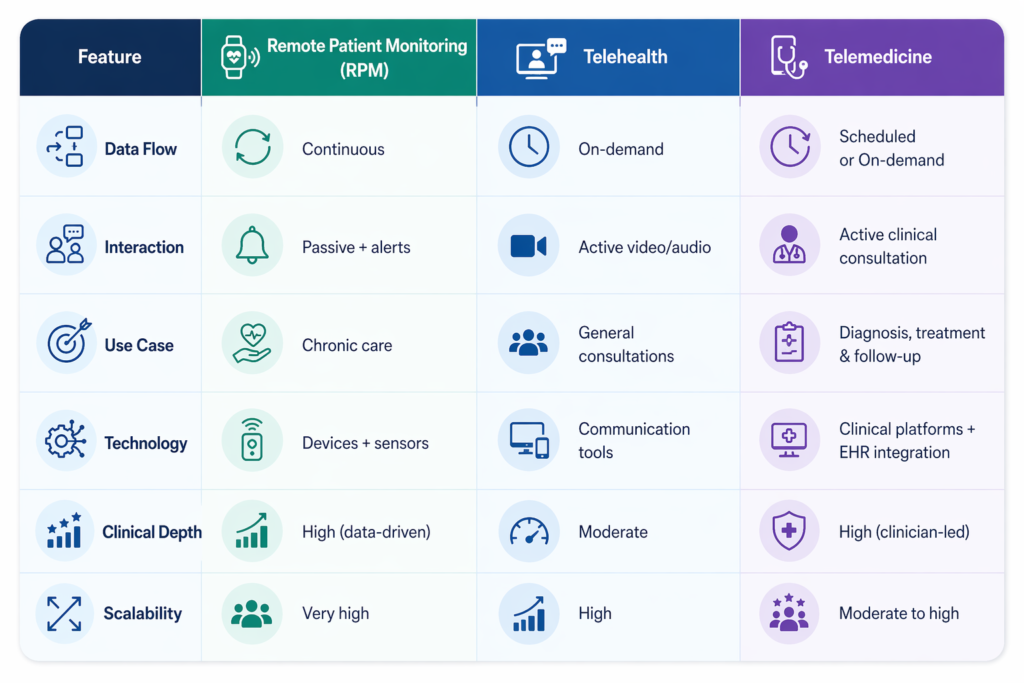
Telehealth vs Telemedicine vs Remote Patient Monitoring

Core Differences
RPM (Remote Patient Monitoring)
→ Continuous, real-time or near real-time physiological data tracking from patients outside clinical settings.
Telehealth
→ Broad umbrella covering all remote healthcare services, both clinical and non-clinical.
Telemedicine
→ Subset of telehealth focused strictly on clinical diagnosis, treatment, and doctor–patient interaction.
Comparison Chart
1. Functional Scope
RPM
- Passive + active data collection (heart rate, glucose, oxygen saturation)
- Works in the background
- Device-driven ecosystem (wearables, IoT medical devices)
Telemedicine
- Direct clinical interaction
- Doctor evaluates symptoms, prescribes treatment
- Focused on illness episodes
Telehealth
- Includes telemedicine + education + admin + wellness
- Covers:
- Remote therapy
- Health coaching
- Medical training
- Patient portals
2. Time Orientation
- RPM: Continuous (24/7 monitoring, longitudinal data streams)
- Telemedicine: Episodic (appointment-based interactions)
- Telehealth: Hybrid (both continuous and episodic depending on service)
3. Data vs Interaction
- RPM:
Data-centric
→ Sensors → Cloud → AI → Alerts → Clinician review - Telemedicine:
Interaction-centric
→ Video/audio consultation → Diagnosis → Prescription - Telehealth:
Ecosystem-centric
→ Combines data + interaction + support systems
4. Technology Stack
RPM
- Wearables (e.g., ECG patches, smartwatches)
- IoT medical devices
- AI analytics platforms
- Cloud dashboards for clinicians
Telemedicine
- Video conferencing platforms
- EHR integration
- e-Prescription systems
Telehealth
- Includes everything above +
- Mobile health apps
- Patient engagement platforms
- Learning systems
5. Use Cases
RPM
- Chronic disease management (diabetes, hypertension)
- Post-surgical monitoring
- Elderly care (especially relevant for platforms like TeleGeriatric)
Telemedicine
- Acute illness consultations
- Follow-ups
- Specialist access (e.g., dermatology, psychiatry)
Telehealth
- Preventive care
- Mental health therapy
- Nutrition counseling
- Health education programs
6. Clinical Depth
- RPM: Indirect clinical insight (data interpretation required)
- Telemedicine: Direct clinical decision-making
- Telehealth: Variable (can be clinical or non-clinical)
When to Use What
- Use Remote Patient Monitoring (RPM) for continuous tracking of chronic conditions and long-term health data
- Use Telehealth for general consultations, triage, and non-clinical interactions
- Use Telemedicine for diagnosis, treatment decisions, and structured clinical follow-ups
- Best outcomes come from integrating all three into a unified care model
FAQs
How does remote patient monitoring improve chronic disease management in elderly patients?
Remote Patient Monitoring (RPM) improves chronic disease management by replacing occasional clinic visits with continuous health tracking. For elderly patients, this is especially important because conditions like hypertension, diabetes, and heart failure fluctuate daily rather than at appointment intervals.
Instead of relying on memory or sporadic measurements, RPM systems continuously collect real-time data and detect early deviations from normal ranges. This allows healthcare providers to intervene before complications escalate.
Key impact areas:
| Condition | RPM Contribution | Outcome Improvement |
|---|---|---|
| Hypertension | Daily BP tracking | Reduced stroke risk |
| Diabetes | Continuous glucose monitoring | Fewer hypoglycemic events |
| Heart failure | Weight + fluid tracking | Lower hospital readmissions |
RPM essentially shifts chronic care from reactive treatment → predictive intervention → preventive stabilization.
What is the best way for seniors to use RPM devices safely at home without errors?
Seniors can use RPM devices safely when the process is simplified, standardized, and supported by caregiver oversight. The key is consistency rather than technical complexity.
Devices should be placed in fixed locations, and measurements should be taken at the same time daily. Most errors occur due to improper posture, incorrect timing, or skipped calibration.
Safe usage checklist:
| Device Type | Common Error | Correct Practice |
|---|---|---|
| Blood pressure monitor | Talking during measurement | Sit still for 5 minutes |
| Glucometer | Dirty hands | Wash & dry hands first |
| Pulse oximeter | Cold fingers | Warm hands before use |
| Smart scale | Different times of day | Weigh in morning only |
Caregivers often act as a “data stabilizer,” ensuring readings remain consistent and clinically usable.
How accurate are remote patient monitoring devices compared to hospital-based measurements?
Modern RPM devices are highly accurate when medical-grade equipment is used and properly calibrated. However, accuracy depends more on usage behavior than device capability.
Hospital devices still maintain a slight edge due to controlled environments and trained professionals, but the gap has narrowed significantly due to IoT medical advancements.
Accuracy comparison chart:
| Measurement Type | Hospital Accuracy | RPM Device Accuracy |
|---|---|---|
| Blood pressure | Very high | High (±3–5 mmHg variance) |
| Glucose | Very high | High (CGM trend accuracy strong) |
| Oxygen saturation | Very high | High (±2% variance typical) |
| Weight | Very high | Very high |
RPM is not meant to replace hospitals—it is designed to detect trends, not absolute perfection.
Can remote patient monitoring reduce hospital admissions in elderly care?
Yes, RPM significantly reduces hospital admissions by detecting early warning signs before conditions become severe enough to require emergency care.
For elderly patients, hospital admissions often occur due to delayed detection of gradual deterioration—especially in heart failure, COPD, and diabetes complications.
Preventive impact model:
| Stage | Without RPM | With RPM |
|---|---|---|
| Early symptom change | Not detected | Detected immediately |
| Clinical response | Delayed | Proactive adjustment |
| Emergency risk | High | Significantly reduced |
Studies across telehealth systems show RPM can reduce readmissions by 20%–45% depending on condition severity and adherence level.
What are the biggest challenges when implementing RPM in geriatric telemedicine?
The biggest challenges are not technological—they are behavioral, infrastructural, and clinical workflow-related.
Elderly users often struggle with device adherence, while healthcare systems struggle with data overload and integration.
Challenge breakdown:
| Category | Challenge | Impact |
|---|---|---|
| Human | Low tech literacy | Data inconsistency |
| Clinical | Alert fatigue | Delayed response |
| Technical | Connectivity issues | Data gaps |
| System | EHR integration limits | Fragmented care |
Successful RPM deployment requires simplifying the user experience and automating clinical interpretation through AI-assisted dashboards.
People Also Ask (PAA)
How does remote patient monitoring work for elderly patients with multiple chronic conditions?
Remote Patient Monitoring works by continuously collecting biometric data from multiple devices and consolidating it into a single clinical dashboard. For elderly patients with multiple conditions, RPM acts as a unified monitoring layer across cardiovascular, metabolic, and respiratory systems.
Instead of isolated readings, RPM systems correlate data patterns—for example, linking rising weight with worsening oxygen levels in heart failure patients.
Multi-condition RPM integration:
| Condition Group | Monitored Metrics | Clinical Insight |
|---|---|---|
| Cardiac | BP, weight, ECG | Fluid overload detection |
| Metabolic | Glucose levels | Insulin adjustment needs |
| Respiratory | SpO2 levels | Oxygen therapy decisions |
This integrated view is what makes RPM especially powerful in geriatric medicine.
What devices are most commonly used in geriatric remote patient monitoring programs?
The most commonly used RPM devices are selected based on chronic disease prevalence in elderly populations. These devices prioritize simplicity, accuracy, and minimal maintenance.
Core RPM device ecosystem:
| Device Type | Function | Usage Frequency |
|---|---|---|
| Blood pressure monitor | Hypertension tracking | Daily |
| Glucometer / CGM | Diabetes management | Daily/continuous |
| Pulse oximeter | Respiratory monitoring | Daily |
| Smart scale | Fluid retention tracking | Daily |
These devices form the “minimum viable monitoring stack” in most geriatric RPM programs.
How does remote patient monitoring support early detection of heart failure worsening?
RPM detects early heart failure deterioration primarily through weight fluctuation trends and oxygen saturation decline rather than single measurements.
A sudden increase in body weight often indicates fluid retention before visible swelling occurs. When combined with reduced oxygen levels, it becomes a strong predictive signal.
Early warning indicators:
| Signal | Meaning | Action Threshold |
|---|---|---|
| +1–2 kg weight gain | Fluid retention | Notify clinician |
| SpO2 drop < 92% | Oxygen imbalance | Urgent review |
| Increased fatigue reports | Functional decline | Medication reassessment |
This early detection loop is one of the strongest clinical benefits of RPM in elderly cardiac care.
What is the role of caregivers in remote patient monitoring for seniors?
Caregivers act as the operational layer of RPM in geriatric settings. While devices collect data, caregivers ensure the data is accurate, consistent, and clinically meaningful.
They also serve as communication bridges between patients and healthcare providers.
Caregiver responsibilities:
| Role | Function |
|---|---|
| Data validation | Ensuring correct readings |
| Routine enforcement | Maintaining measurement schedules |
| Alert escalation | Reporting abnormal values |
| Emotional support | Reducing patient anxiety |
Without caregiver involvement, RPM adherence rates drop significantly in elderly populations.
How is artificial intelligence improving remote patient monitoring in geriatric telemedicine?
Artificial intelligence enhances RPM by transforming raw biometric data into predictive health insights. Instead of simply reporting numbers, AI systems detect patterns, anomalies, and risk trajectories.
This is especially valuable in geriatric care, where multiple conditions overlap and symptoms evolve gradually.
AI-enhanced RPM functions:
| AI Function | Clinical Benefit |
|---|---|
| Predictive analytics | Early disease detection |
| Pattern recognition | Identifying multi-condition interactions |
| Alert filtering | Reducing false alarms |
| Risk scoring | Prioritizing urgent patients |
AI effectively shifts RPM from a monitoring system → decision support system.