Smart Home Hospitals for Aging in Place: The Future of Senior Care, Remote Monitoring & Safer Home-Based Telemedicine
Amazon Affiliate Disclosure: TeleGeriatric may earn a commission from qualifying purchases when readers buy products through affiliate links. Product mentions and buying guidance are written around senior safety, usability, care relevance, and practical value.
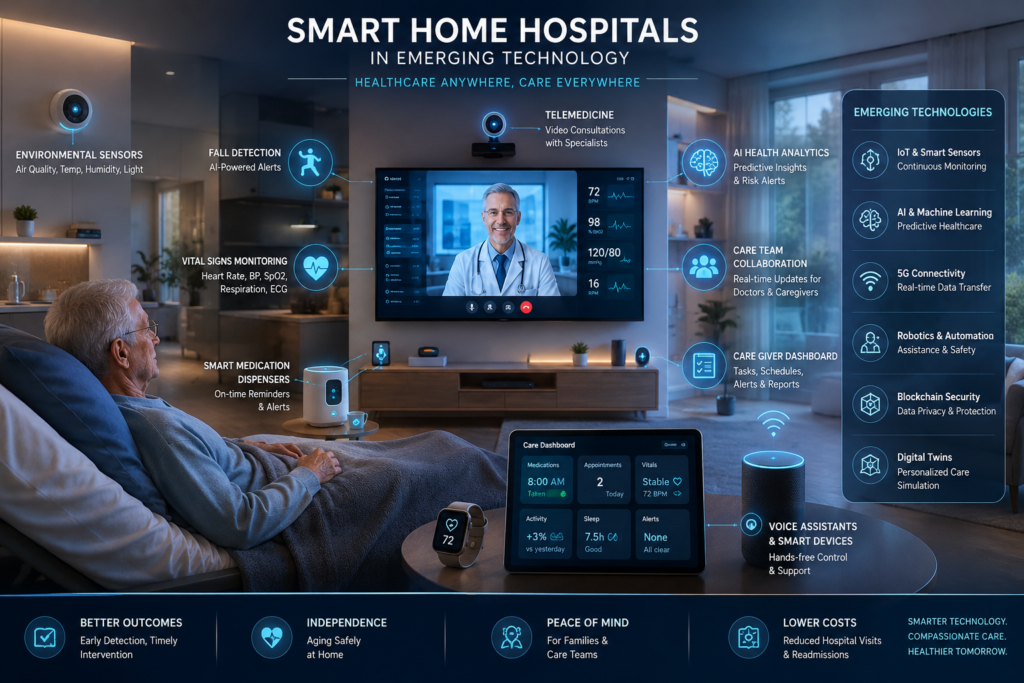
Smart home hospitals for aging in place are changing the way families think about elderly care. For decades, the home and the hospital were treated as separate worlds. The home was where older adults lived, while the hospital was where serious medical care happened. Today, that boundary is becoming softer, smarter, and more connected as part of the broader evolution of emerging systems in geriatric care, where digital health technologies are reshaping how older adults receive support.
A modern smart home hospital does not mean turning a bedroom into an intensive care unit. It means building a home environment where health data, safety sensors, telemedicine, caregiver alerts, medication systems, and clinical oversight work together. The result is a home that can support independence while giving families and care teams better visibility into risk.
For families exploring safer senior care at home, TeleGeriatric helps connect smart monitoring, geriatric telemedicine, and practical aging-in-place support into one more understandable care direction.
The promise is simple but powerful:
An older adult should not have to lose independence just because their care needs become more complex.
Quick Jump
- What This Guide Is For
- What Smart Home Hospitals for Aging-in-Place Mean
- Who Needs Smart Home Healthcare for Seniors
- Benefits of Smart Home Hospitals for Senior Care
- The Smart Home Hospital Framework
- Smart Home Hospital vs Nursing Home
- Core Technologies Inside a Smart Home Hospital
- Best Use Cases for Aging-in-Place
- Smart Buying Checklist
- Room-by-Room Smart Home Hospital Setup
- Risks, Privacy and Safety Safeguards
- Upcoming Trends and Latest Tech
- Editorial Insights
- FAQs
What This Guide Is For
This guide is for families, caregivers, older adults, home care providers, senior living planners, and telemedicine buyers who want to understand smart home hospitals for aging-in-place before investing in devices, monitoring services, home upgrades, or connected care systems.
It is especially useful if you are comparing:
- Smart home healthcare for seniors
- Remote patient monitoring systems
- Medical alert devices
- Fall detection devices
- Smart medication dispensers
- Smart home sensors for elderly care
- Hospital-at-home support tools
- Aging in place smart home technology
- Telemedicine devices for elderly patients
- Home safety systems for seniors
- Caregiver monitoring dashboards
- Connected chronic disease care tools
The purpose is not to make every senior’s home look like a clinic. The purpose is to explain how the right combination of home technology, telemedicine, safety design, caregiver response, and medical oversight can support safer aging at home.
A smart home hospital should answer four practical questions:
- Is the older adult safe right now?
- Is their health pattern stable or changing?
- Who needs to be notified?
- What action should happen next?
When a system cannot answer those questions, it may be smart technology, but it is not yet smart care.
What Smart Home Hospitals for Aging-in-Place Mean
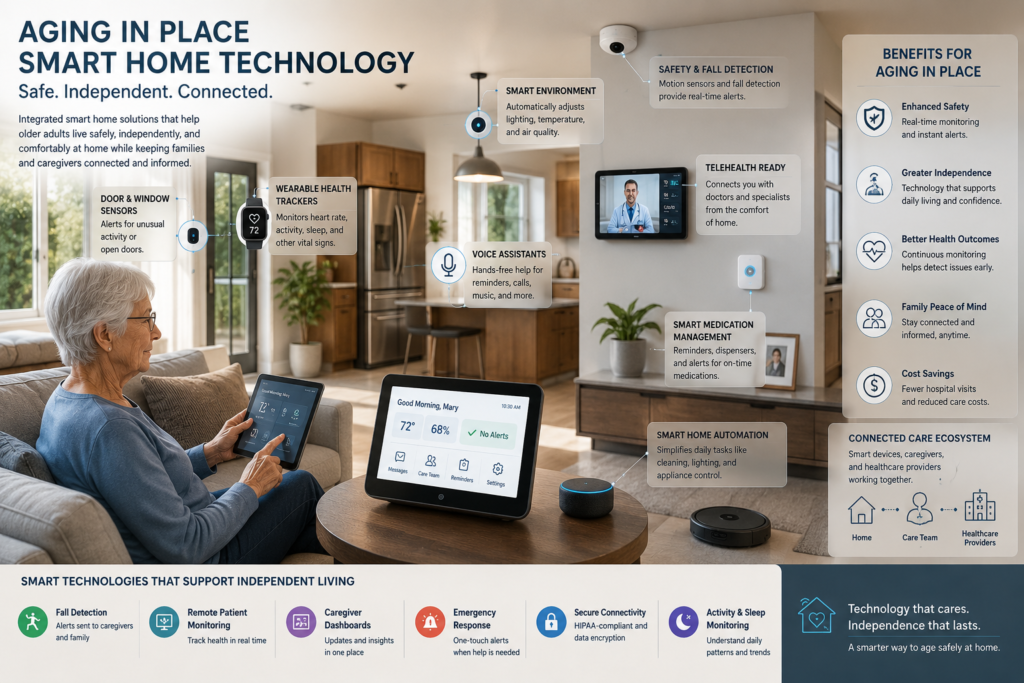
Smart home hospitals for aging-in-place are home environments equipped with connected health devices, safety sensors, communication tools, medication systems, remote monitoring, and care coordination features that help older adults receive more support without leaving home.
They sit between three worlds:
- The traditional home
- The telemedicine clinic
- The hospital-at-home model
A smart home hospital is not the same as emergency inpatient care at home, and it is not simply a house filled with gadgets. It is a care-ready home environment where technology supports daily safety, chronic disease management, caregiver awareness, and clinical decision-making.
Simple Definition
A smart home hospital for aging-in-place is a senior’s home designed with connected medical, safety, monitoring, and communication systems that help the person live independently while allowing caregivers and clinicians to detect risk earlier.
What Makes It Different From a Normal Smart Home?
A normal smart home may include lights, cameras, thermostats, locks, speakers, and entertainment automation.
A smart home hospital focuses on health, safety, function, and care continuity.
It may include:
- Blood pressure monitoring
- Glucose tracking
- Pulse oximetry
- Fall detection
- Motion sensors
- Bed sensors
- Medication adherence systems
- Smart scales
- Emergency response tools
- Telemedicine access
- Caregiver dashboards
- Door and stove safety alerts
- Bathroom safety monitoring
- Voice-based reminders
- Environmental monitoring
- Clinical escalation pathways
The difference is intent. A smart home is built for convenience. A smart home hospital is built for safer care.
Who Needs Smart Home Healthcare for Seniors
Smart home healthcare for seniors is most useful when an older adult wants to remain at home but needs more structure, safety, or monitoring than a traditional home provides.
1. Seniors Living Alone
Older adults living alone may be independent but vulnerable to delayed help. A fall, medication error, sudden dizziness, confusion episode, or nighttime emergency can become more serious when no one is nearby.
A smart home hospital setup can provide background safety support without requiring constant family calls.
2. Seniors With Chronic Conditions
Older adults with chronic conditions often need regular monitoring, not occasional attention.
Examples include:
- Hypertension
- Diabetes
- Heart failure
- COPD
- Kidney disease
- Frailty
- Arthritis
- Cognitive impairment
- Sleep disorders
- Post-stroke disability
A connected home setup can help collect meaningful health patterns between appointments.
3. Families Managing Long-Distance Care
Adult children often live far from aging parents. They may receive reassuring phone calls while missing signs of decline: reduced movement, missed medication, poor sleep, wandering, weight change, or unusual home activity.
Smart home hospital systems can help caregivers see changes sooner.
4. Post-Hospital Elderly Patients
After discharge, the home becomes the recovery environment. This is a high-risk period for older adults because medication changes, weakness, poor appetite, falls, confusion, and readmission risk often rise.
A smart home hospital setup can help monitor recovery and support earlier telemedicine follow-up.
5. Seniors Who Want to Avoid Premature Facility Placement
Not every older adult who needs support needs a nursing home. Some need better home safety, remote monitoring, medication structure, caregiver coordination, and telemedicine access.
A smart home hospital model may help extend safe independence when it is clinically appropriate.
6. Home Care Agencies and Geriatric Telemedicine Teams
For care providers, smart home systems can improve visibility between visits. Instead of relying only on scheduled check-ins, providers can review trends and respond when something changes.
For readers studying broader care delivery models, TeleGeriatric’s Homepage explains how virtual care, monitoring, and connected systems fit into modern elderly care.
Benefits of Smart Home Hospitals for Senior Care
Smart home hospitals for aging-in-place are valuable when they reduce uncertainty, improve response time, and help seniors remain safely independent.
1. Earlier Detection of Risk
Many senior-care problems build slowly before they become emergencies.
Examples:
- A senior walks less for several days before a fall
- Blood pressure becomes unstable before symptoms are reported
- Weight changes before heart failure worsens
- Medication timing becomes inconsistent before confusion is noticed
- Nighttime movement increases before wandering becomes obvious
- Sleep declines before fatigue and imbalance appear
A connected home can help detect these patterns earlier.
2. Safer Aging-in-Place
Aging-in-place is not just about staying at home. It is about staying at home safely.
A smart home hospital can support:
- Fall prevention
- Faster emergency response
- Medication reminders
- Safer bathroom routines
- Better lighting
- Stove safety
- Door monitoring
- Remote caregiver awareness
- Telemedicine access
- Chronic disease tracking
The home becomes more supportive without becoming institutional.
3. Better Caregiver Confidence
Caregivers often live with an exhausting question: “Is everything okay?”
Smart home healthcare for seniors can reduce that uncertainty by showing patterns, alerts, and routine changes.
Instead of relying on guesswork, families can see whether activity, sleep, medication, weight, or vital signs are changing.
4. Better Telemedicine Visits
A video visit is more useful when the clinician can review recent data.
For example:
- Blood pressure trend
- Weight trend
- Medication adherence
- sleep quality
- Activity level
- Fall alerts
- Oxygen readings
- Glucose changes
- Caregiver notes
This turns a telemedicine visit from a simple conversation into a more informed care review.
5. Reduced Avoidable Emergencies
No technology can prevent every emergency. But smart systems can help reduce avoidable delays.
A fall detected quickly, a medication problem noticed earlier, or a worsening vital sign trend reviewed sooner may prevent a smaller problem from becoming a major crisis.
6. More Personalized Senior Care
A smart home hospital can learn the older adult’s routine.
One person may normally wake at 6 a.m., walk frequently, and take medication at breakfast. Another may sleep later, move slowly, and need evening reminders.
Personalized monitoring matters because older adults do not age on a single template.
The Smart Home Hospital Framework
A useful smart home hospital can be understood through seven layers.
Layer 1: Safety Infrastructure
This includes the physical and environmental setup that reduces preventable risk.
Examples:
- Grab bars
- Non-slip flooring
- Better lighting
- Clear walking paths
- Bedside lighting
- Bathroom safety supports
- Stair safety
- Stove shutoff tools
- Emergency call access
Technology works better when the home is physically safer.
Layer 2: Connected Medical Devices
These devices collect health data that may support chronic care and telemedicine.
Examples:
- Blood pressure monitor
- Glucose monitor
- Pulse oximeter
- Smart scale
- ECG monitor
- Thermometer
- Medication dispenser
- Wearable tracker
These are the medical signal layer.
Layer 3: Passive Home Sensors
Passive sensors can help track routine without requiring the older adult to press buttons.
Examples:
- Motion sensors
- Door sensors
- Bed sensors
- Bathroom activity sensors
- Kitchen activity sensors
- Environmental sensors
- Stove usage sensors
For many older adults, passive monitoring is easier than wearable-dependent monitoring.
Layer 4: Communication Access
A smart home hospital needs fast, simple communication.
Examples:
- Telemedicine tablet
- Voice assistant
- Emergency call button
- Caregiver app
- Video check-in device
- Smart speaker
- Hearing-friendly communication tools
If a senior cannot easily communicate, the system is incomplete.
Layer 5: Caregiver Dashboard
A dashboard should not overwhelm families with endless charts. It should show what changed and what matters.
A useful dashboard may include:
- Activity trend
- Medication status
- Recent alerts
- Vital sign changes
- Fall events
- sleep trend
- Device battery status
- Caregiver tasks
- Escalation options
Layer 6: Clinical Review Pathway
A smart home hospital should connect to care.
This may involve:
- Telemedicine visits
- Nurse monitoring
- Medication review
- Chronic disease care
- Geriatric assessment
- Physical therapy referral
- Nutrition support
- In-person escalation when needed
Data without a care pathway creates anxiety. Data with action creates value.
Layer 7: Predictive and Personalized Intelligence
The most advanced systems move beyond alerts and into pattern recognition. They can identify rising risk from combinations of signals.
Readers can explore TeleGeriatric’s Predictive AI guide to understand how early-warning models can support proactive geriatric care.
Smart Home Hospital vs Nursing Home
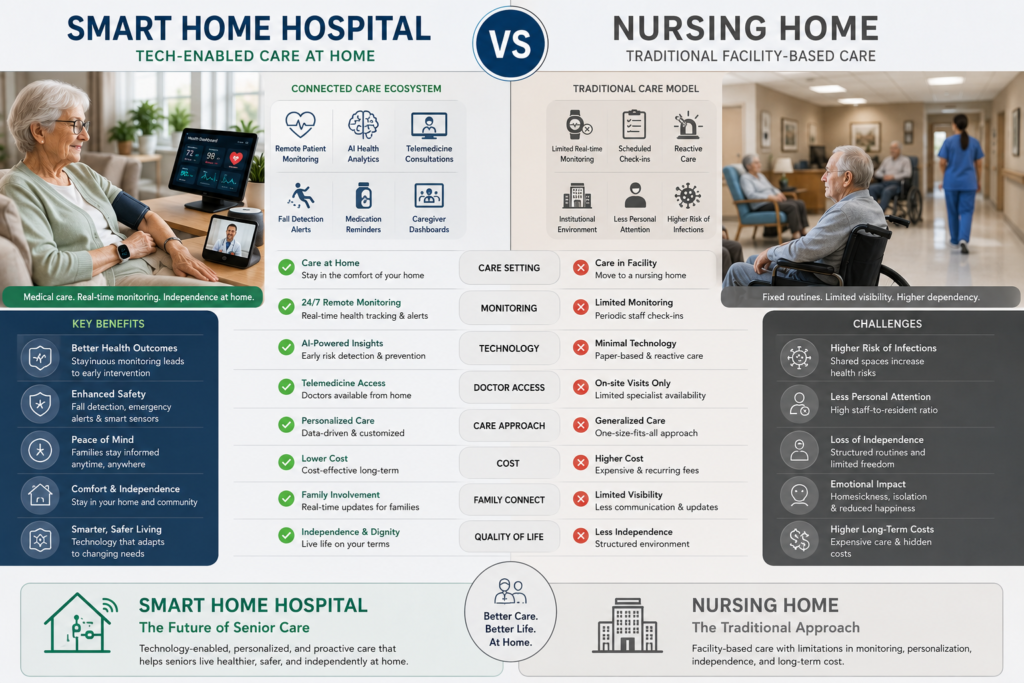
Smart home hospital vs nursing home is an important comparison, but it should not be framed as a competition in every case. Some seniors need facility-level care. Others may remain safely at home with the right support.
| Category | Smart Home Hospital | Nursing Home |
|---|---|---|
| Main Setting | Senior’s own home | Residential care facility |
| Best For | Seniors who can remain home with support | Seniors needing continuous hands-on care |
| Independence | Higher when clinically appropriate | More structured and supervised |
| Medical Monitoring | Device-based and remote | Staff-based and in-person |
| Daily Care | Family, home care, telemedicine, sensors | Facility staff |
| Cost Structure | Devices, subscriptions, home care, telemedicine | Facility residence and care fees |
| Emotional Benefit | Familiar environment and routine | More immediate staff availability |
| Limitation | Not suitable for severe unsafe conditions | Less privacy and home independence |
| Best Decision Factor | Can risks be managed at home? | Does the senior need 24/7 physical care? |
Which Option Is Better?
The better option depends on the older adult’s needs.
A smart home hospital may be appropriate when:
- The senior wants to remain home
- Risks are moderate and manageable
- Caregiver support exists
- Telemedicine access is available
- Devices can be used reliably
- The home can be made safe
A nursing home may be more appropriate when:
- The senior needs frequent hands-on assistance
- Dementia-related wandering is severe
- Falls are repeated and dangerous
- Medication management is unsafe at home
- Caregiver support is unavailable
- The home environment cannot be adapted safely
The right decision is not based on technology alone. It is based on risk, function, dignity, support, and care needs.
Core Technologies Inside a Smart Home Hospital
Remote Patient Monitoring Devices
Remote patient monitoring devices collect health data and send it to caregivers or providers.
Common devices include:
- Blood pressure monitors
- Glucose monitors
- Pulse oximeters
- Smart scales
- ECG monitors
- Thermometers
These devices are especially useful for chronic disease tracking.
Wearables
Wearables can track:
- Heart rate
- Activity
- sleep
- falls
- walking patterns
- emergency button use
- location in some cases
For seniors who tolerate wearables well, they can provide rich daily data.
Fall Detection and Fall Prevention Tools
Fall tools may include:
- Wearable fall detection
- Radar-based monitoring
- Motion sensors
- Bed exit sensors
- Smart lighting
- Bathroom sensors
- Floor vibration sensors
- Emergency call systems
Fall prevention is more valuable than fall detection alone. The goal is to reduce risk before the event.
Medication Management Systems
Medication systems may include:
- Smart pill dispensers
- Dose reminders
- Locking medication boxes
- Refill reminders
- Caregiver alerts
- Pharmacy integration
Medication safety is one of the most practical use cases for smart home healthcare for seniors.
Smart Home Sensors
Smart home sensors may track movement and routine.
Examples:
- Front door opened at unusual hours
- No kitchen activity by late morning
- Bathroom visits increase overnight
- Bedroom inactivity lasts unusually long
- Living room movement drops sharply
These signals may help caregivers identify subtle changes.
Telemedicine Access Devices
Telemedicine access should be simple.
Examples:
- Senior-friendly tablet
- Large-screen video device
- Voice-assisted calling
- Remote-controlled setup by caregiver
- Hearing-compatible audio
- Easy appointment reminders
A good telemedicine device must match the senior’s comfort level.
Environmental Safety Systems
Environmental monitoring can support health and safety.
Examples:
- Temperature sensors
- Air quality sensors
- Carbon monoxide detectors
- Smoke detectors
- Stove shutoff tools
- Water leak sensors
- Lighting automation
- Door lock alerts
For frail seniors, the home environment itself becomes part of the care plan.
Best Use Cases for Aging-in-Place
1. Fall Risk and Mobility Support
A smart home hospital can help identify movement changes, nighttime activity, bed exits, and emergency events.
Useful tools may include:
- Wearables
- Motion sensors
- Smart lighting
- Bed sensors
- Bathroom safety sensors
- Emergency call buttons
The best setups focus on both detection and prevention.
2. Chronic Disease Monitoring
Seniors with chronic disease may need consistent monitoring.
Useful device combinations include:
| Condition | Helpful Home Devices | Why It Matters |
|---|---|---|
| Hypertension | Blood pressure monitor, medication dispenser | Tracks pressure and adherence |
| Diabetes | Glucose monitor, smart scale, medication alerts | Supports pattern review |
| Heart failure | Smart scale, BP monitor, pulse oximeter | Watches fluid and breathing-related signals |
| COPD | Pulse oximeter, symptom notes, telemedicine access | Helps monitor oxygen and respiratory changes |
| Frailty | Smart scale, activity tracker, nutrition notes | Tracks strength and weight trends |
| Cognitive decline | Motion sensors, medication dispenser, door alerts | Supports routine and safety |
3. Medication Safety
Medication problems are common in senior care because many older adults take multiple prescriptions.
A smart medication setup can help with:
- Timely dosing
- Missed dose alerts
- Refill awareness
- Caregiver notifications
- Reduced confusion
- Safer chronic disease management
4. Dementia and Wandering Risk
For seniors with memory concerns, smart home technology may support safety through:
- Door sensors
- Motion patterns
- Bed exit alerts
- Location-aware devices
- Medication locks
- Stove safety
- Caregiver alerts
Privacy and dignity must remain central. Monitoring should be proportionate to risk.
5. Post-Hospital Recovery
A smart home hospital setup can help after discharge by tracking:
- Weight
- Blood pressure
- oxygen
- medication adherence
- activity recovery
- sleep
- symptoms
- follow-up visits
This can help caregivers know whether recovery is moving in the right direction.
6. Caregiver Coordination
A connected home can help several people share responsibility.
For example:
- Daughter receives medication alerts
- Son reviews weekly activity trends
- Nurse monitors blood pressure
- Physician reviews telemedicine notes
- Home aide confirms meals and mobility
The technology becomes a coordination layer.
Room-by-Room Smart Home Hospital Setup
Bedroom
The bedroom is critical because sleep, bed exits, nighttime confusion, and fall risk often begin here.
Useful tools:
- Bed sensor
- Motion-activated lighting
- Emergency call button
- Smart speaker
- Nightstand medication reminder
- Temperature sensor
- Sleep tracking device
Bathroom
The bathroom is one of the highest-risk areas for falls.
Useful tools:
- Grab bars
- Non-slip flooring
- Motion lighting
- Door sensor
- Humidity sensor
- Emergency button
- Fall detection wearable
Kitchen
Kitchen activity can reveal nutrition, routine, and safety concerns.
Useful tools:
- Stove shutoff device
- Motion sensor
- Refrigerator activity sensor
- Medication reminder
- Smart speaker
- Water leak sensor
- Smoke detector
Living Room
The living room can support telemedicine and caregiver connection.
Useful tools:
- Senior-friendly tablet
- Video calling system
- Voice assistant
- Motion sensor
- Smart lighting
- Emergency alert device
Entryway
The entryway matters for wandering risk, visitor safety, and caregiver access.
Useful tools:
- Smart lock
- Door sensor
- Video doorbell
- Motion light
- Caregiver access code
- Exit alerts
Smart Buying Checklist
Before buying aging in place smart home technology, use this checklist.
| Buying Question | Why It Matters | Strong Answer |
|---|---|---|
| What risk are we solving first? | Prevents gadget overload | Falls, medication, chronic disease, wandering, recovery |
| Does the senior understand the system? | Adoption matters more than features | Simple, visible, caregiver-supported setup |
| Does it require daily charging? | Some seniors forget wearables | Low-maintenance or passive options |
| Who receives alerts? | Alerts need action | Family, caregiver, nurse, telemedicine team |
| Can alerts be customized? | Too many alerts cause fatigue | Adjustable sensitivity and severity |
| Does it protect privacy? | Home data is sensitive | Clear access controls and consent |
| Does it connect to care? | Data alone is not enough | Telemedicine, caregiver workflow, escalation |
| Is installation simple? | Complex setups fail | Plug-and-play or professional setup |
| Are devices compatible? | Fragmented systems create confusion | One dashboard or reliable integrations |
| What happens during power or internet failure? | Seniors need backup | Battery backup, cellular option, emergency plan |
Smart Home Hospital Maturity Levels
Not every smart home setup provides the same level of care support.
| Level | Description | Buyer Meaning |
|---|---|---|
| Level 1: Safety Home | Grab bars, lighting, emergency button | Basic aging-in-place support |
| Level 2: Connected Home | Sensors, smart locks, voice tools | Better awareness and convenience |
| Level 3: Health Monitoring Home | RPM devices and caregiver alerts | Useful for chronic care |
| Level 4: Telemedicine-Ready Home | Devices connected to virtual care | Stronger clinical value |
| Level 5: Predictive Smart Home Hospital | Pattern detection and risk alerts | More proactive support |
| Level 6: Hospital-at-Home Environment | Clinical monitoring, home visits, medical escalation | Higher-acuity home care when appropriate |
Most families do not need Level 6. Many need Level 2, 3, or 4. The best setup is the one that matches the senior’s actual risk.
Smart Home Hospital vs Basic Medical Alert System
A medical alert system is useful, but it is only one layer.
| Feature | Basic Medical Alert | Smart Home Hospital |
|---|---|---|
| Emergency Button | Yes | Yes |
| Fall Detection | Sometimes | Often included |
| Chronic Monitoring | Usually no | Yes |
| Medication Tracking | Usually no | Often available |
| Home Sensor Data | Limited | Yes |
| Telemedicine Support | Usually no | Often integrated |
| Caregiver Dashboard | Basic or limited | More complete |
| Pattern Recognition | Rare | Advanced systems may include it |
| Best Use | Emergency response | Ongoing safety and care coordination |
A basic alert system answers, “Can help be called?”
A smart home hospital answers, “Is the older adult becoming less safe or less stable?”
Risks, Privacy and Safety Safeguards
Smart home hospitals for aging-in-place must be designed carefully. More data does not automatically mean better care.
Privacy Concerns
Smart home systems may collect sensitive information about movement, sleep, bathroom activity, medication timing, door use, and daily routine.
Families should discuss:
- What is monitored
- Who can view the data
- Whether cameras are necessary
- How consent is handled
- How data is stored
- Whether access can be limited
- How alerts are shared
Camera-free and privacy-preserving options should be considered whenever possible.
Alert Fatigue
Too many alerts can overwhelm caregivers.
A useful system should prioritize:
- Emergency alerts
- Meaningful pattern changes
- Missed medication
- dangerous door activity
- fall events
- abnormal vital signs
Low-value alerts should be minimized.
Technology Abandonment
Many systems fail because they are too complex.
Common problems include:
- Devices not charged
- Apps too confusing
- Wi-Fi unreliable
- Seniors dislike wearing devices
- Alerts are not understood
- Family members stop checking dashboards
The best system is not the most advanced one. It is the one that remains usable after the first month.
False Confidence
A smart home hospital does not guarantee safety. It supports safety.
Families should still plan for:
- Emergency contacts
- Medication review
- home safety modifications
- regular clinical follow-up
- caregiver visits
- fall prevention
- nutrition support
- transportation
- social connection
Medical Boundaries
Home monitoring data should not replace professional evaluation. It should help guide when evaluation is needed.
Upcoming Trends and Latest Tech
Smart home hospitals for aging-in-place are moving from isolated gadgets toward integrated care ecosystems.
1. Invisible Monitoring
Future senior-care homes will use less visible technology.
Instead of asking seniors to interact with many devices, systems will rely more on passive sensors, smart environments, and background monitoring.
Examples:
- Radar-based fall detection
- Bed sensors
- motion pattern monitoring
- appliance activity monitoring
- smart lighting
- environmental sensing
The best future systems will feel less like surveillance and more like a safer home.
2. Hospital-at-Home Expansion
Hospital-at-home care is growing as healthcare systems look for ways to deliver selected hospital-level services in the home.
For older adults, this could mean more recovery support after acute illness, but it must be carefully matched to patient safety, caregiver availability, clinical oversight, and emergency response capacity.
3. Predictive Home Risk Scoring
Smart home hospitals will increasingly move from “alert after event” to “warn before event.”
For example:
- Fall risk rising
- Medication adherence declining
- sleep worsening
- activity dropping
- blood pressure variability increasing
- wandering risk increasing
- recovery slowing
This is where home sensors and predictive care begin to merge.
4. Digital Twin Integration
Future smart home hospitals may connect to patient-specific digital models that simulate health trends and care pathways.
For a deeper explanation of this model, TeleGeriatric’s Digital Twins Model page explores how digital twin systems can create personalized senior-care insight.
5. Voice-First Senior Interfaces
Older adults may not want to manage complicated apps. Voice-based systems can support:
- Medication reminders
- appointment reminders
- symptom logging
- caregiver calls
- emergency assistance
- wellness check-ins
- simple telemedicine access
Voice tools must be designed with hearing, cognition, privacy, and consent in mind.
6. Smarter Bathroom Safety
Bathroom technology will become more important because falls, dizziness, and nighttime movement often happen there.
Future systems may include:
- Non-camera fall detection
- humidity-aware alerts
- motion lighting
- toilet-use pattern monitoring
- water temperature safety
- emergency voice activation
7. Caregiver Command Centers
Family caregivers will need dashboards that simplify—not complicate—care.
A better caregiver dashboard will show:
- What changed
- Why it matters
- Who should respond
- What action is recommended
- Whether the trend is improving
8. Privacy-Preserving Home Intelligence
The next generation of aging in place smart home technology will need stronger privacy design.
Expect more demand for:
- Camera-free monitoring
- edge processing
- consent controls
- caregiver access levels
- visible privacy indicators
- local data options
- better explanation of data use
Strategic View: How to Build a Smart Home Hospital Without Overbuilding
A common mistake is buying too much at once.
A smarter approach is staged.
Stage 1: Safety First
Start with the risks that cause immediate harm.
Examples:
- Falls
- bathroom safety
- emergency response
- lighting
- medication confusion
Stage 2: Medical Monitoring
Add devices based on known conditions.
Examples:
- Blood pressure monitor for hypertension
- smart scale for heart failure risk
- glucose monitor for diabetes
- pulse oximeter for respiratory disease
Stage 3: Routine Awareness
Add passive sensors if daily routine is hard to assess.
Examples:
- Motion sensors
- door sensors
- bed sensors
- kitchen activity sensors
Stage 4: Care Coordination
Connect alerts to people.
Examples:
- Family app
- caregiver dashboard
- telemedicine visit
- nurse monitoring
- medication review
Stage 5: Predictive Support
Use advanced tools when there is enough data and a clear care pathway.
Examples:
- Fall risk trends
- hospitalization risk alerts
- medication adherence risk
- frailty monitoring
- recovery tracking
This staged approach prevents the home from becoming cluttered, confusing, and expensive.
FAQs
What are smart home hospitals for aging-in-place?
Smart home hospitals for aging-in-place are home environments equipped with connected health devices, safety sensors, telemedicine access, caregiver alerts, and remote monitoring systems to help older adults remain at home more safely. They are not full hospitals in the traditional sense. They are care-ready homes that support chronic disease monitoring, fall prevention, medication safety, emergency response, and caregiver coordination.
How do smart home hospitals help seniors live independently?
Smart home hospitals help seniors live independently by making the home safer, more responsive, and more connected to care. Motion sensors can detect activity changes, medical devices can track health readings, medication systems can reduce missed doses, and telemedicine tools can make clinical follow-up easier. The goal is to support independence while giving caregivers and clinicians earlier visibility into risk.
What devices are needed for smart home healthcare for seniors?
The right devices depend on the senior’s needs. Common options include blood pressure monitors, smart scales, pulse oximeters, glucose monitors, fall detection wearables, motion sensors, bed sensors, medication dispensers, emergency buttons, smart lighting, stove safety devices, and telemedicine tablets. A senior with hypertension may need different tools than someone with dementia or fall risk.
Is a smart home hospital better than a nursing home for elderly care?
A smart home hospital may be better for an older adult who can remain safely at home with monitoring, caregiver support, and telemedicine access. A nursing home may be better when the senior needs frequent hands-on help, severe dementia supervision, complex care, or 24/7 physical support. The decision should be based on risk, function, safety, caregiver availability, and medical needs.
How much smart home technology does an elderly person really need?
Most elderly people do not need every device. They need the right device set for their main risks. A practical starting point may include an emergency alert system, fall prevention tools, medication reminders, and one or two medical monitoring devices tied to existing conditions. More advanced sensors can be added later if risk increases or caregivers need better visibility.
People Also Ask
How do smart home hospitals help seniors after hospital discharge?
Smart home hospitals can help seniors after discharge by tracking recovery signs such as blood pressure, weight, oxygen levels, medication adherence, activity, sleep, and symptoms. This can help families and clinicians notice whether the older adult is returning to baseline or drifting toward complications. The strongest setups connect home data to telemedicine follow-up or nurse review.
What is the difference between smart home healthcare and hospital-at-home?
Smart home healthcare usually refers to home-based technology that supports safety, monitoring, and aging-in-place. Hospital-at-home is a more formal care model where selected patients receive hospital-level services at home under clinical supervision. Smart home technology may support hospital-at-home care, but not every smart home setup is hospital-at-home care.
Can smart home technology prevent falls in elderly adults?
Smart home technology can help reduce fall risk, but it cannot guarantee fall prevention. It may support safer movement through motion lighting, bed exit alerts, fall detection, bathroom safety tools, wearable alerts, and activity trend monitoring. Fall prevention still requires medication review, strength support, vision care, home modifications, footwear review, and clinical guidance.
Are smart home sensors for elderly care private?
Smart home sensors can be privacy-friendly when they use motion, door, bed, environmental, or radar-based detection instead of cameras. Privacy depends on the product design, data policy, access controls, and consent process. Families should choose the least intrusive system that solves the safety problem and should involve the older adult in decisions whenever possible.
What is the best smart home setup for aging-in-place?
The best smart home setup for aging-in-place starts with the older adult’s actual risks. For fall risk, prioritize lighting, bathroom safety, fall detection, and motion monitoring. For chronic disease, add connected medical devices. For memory concerns, add medication support and door alerts. For long-distance caregiving, add a caregiver dashboard and telemedicine access. The best setup is simple, reliable, and connected to real human response.
Editorial Insights
Smart home hospitals for aging-in-place are not about replacing human care with devices. They are about redesigning the home so older adults are not forced into a crisis before support arrives.
The old model waited for something to happen. A fall. A missed medication. A hospitalization. A phone call from a worried neighbor.
The new model watches for changing patterns: less movement, unstable vitals, missed doses, unusual nighttime activity, poor sleep, reduced kitchen use, slower recovery, or caregiver concern.
That shift matters.
Aging-in-place should not mean aging alone. It should mean living in a home that quietly supports safety, dignity, independence, and timely care.
The best smart home hospital is not the one with the most devices. It is the one that fits the older adult’s life, respects their privacy, reduces caregiver uncertainty, and connects meaningful data to clinical action.
To continue exploring safer senior care, remote monitoring, and home-based geriatric telemedicine, visit TeleGeriatric and build a more informed path toward connected aging support.