
Best Pulse Oximeters for Seniors in 2026: Fingertip, Bluetooth and Wearable Picks
Amazon Affiliate Disclosure
Telegeriatric.com participates in affiliate programs, including the Amazon Services LLC Associates Program. We may earn a commission when a reader purchases a qualifying product through an affiliate link. This does not increase the price paid by the reader.
Our product categories are based on senior usability, display readability, signal-quality features, comfort, respiratory-care relevance, caregiver usefulness, telemedicine compatibility and long-term value. Product availability, app compatibility, specifications and prices can change.
Medical and Editorial Notice
A consumer pulse oximeter estimates blood oxygen saturation. It does not diagnose pneumonia, COPD, heart failure, sleep apnea, pulmonary embolism or another medical condition.
The FDA distinguishes pulse oximeters intended for medical purposes from general-wellness and sporting products. Many consumer devices sold online have not been evaluated by the FDA for making clinical decisions or deciding whether medical intervention is required. Readings should therefore be interpreted alongside symptoms, the person’s normal baseline and instructions from a healthcare professional.
Updated: August 2026
The best pulse oximeters for seniors do more than display an oxygen percentage. They make the result easy to see, reduce uncertainty about whether the finger signal is stable, fit comfortably around older hands and produce information that can be explained clearly during a medical appointment.
That distinction matters. A technically advanced oxygen monitor may be a poor choice for an older adult who cannot read its screen, while an inexpensive fingertip model may be entirely appropriate for a person who only needs occasional spot checks. A caregiver supporting a parent from another city may need Bluetooth history. Someone investigating nighttime oxygen changes may need a wearable recorder rather than a five-second fingertip reading.
This guide evaluates four different approaches:
- The HOLFENRY Fingertip Pulse Oximeter for fast, readable home checks
- The Wellue O2Ring for continuous and overnight oxygen trends
- The Zacurate 500 Series for affordable, uncomplicated spot measurements
- The Innovo iP900BP-B for Bluetooth-connected fingertip monitoring
Each product has been assigned to the situation it fits best. The selections are based on published specifications, senior usability, display design, signal-quality information, caregiver usefulness and value rather than undisclosed hands-on laboratory testing.
For a broader look at the equipment used in virtual elder care, visit the Telegeriatric guide to Medical Devices.
Quick Picks: Best Pulse Oximeters for Seniors
| Senior-care need | Best product | Why it stands out | Jump to review |
|---|---|---|---|
| Best overall pulse oximeter for seniors | HOLFENRY Fingertip Pulse Oximeter | Large display, fast spot reading and perfusion index | Read review |
| Best wearable oxygen monitor | Wellue O2Ring | Continuous recording, vibration reminders and downloadable reports | Read review |
| Best affordable fingertip pulse oximeter | Zacurate 500 Series | Straightforward operation, included accessories and no required app | Read review |
| Best Bluetooth pulse oximeter for caregivers | Innovo iP900BP-B | App history, plethysmograph, perfusion index and multidirectional display | Read review |
Complete Page Navigation
| Section | Jump link |
|---|---|
| Best products at a glance | Comparison table |
| How the products were evaluated | Evaluation framework |
| What a pulse oximeter is for | Purpose and function |
| Who may need one | Senior use cases |
| Benefits of home oxygen monitoring | Practical benefits |
| Full product reviews | Detailed reviews |
| Bluetooth versus fingertip models | Format comparison |
| How to select the right model | Selection guide |
| How to use it correctly | Measurement technique |
| Understanding oxygen readings | SpO2 chart |
| Telemedicine and caregiver use | Connected care |
| Accuracy limitations | Risks and limitations |
| Pricing and value | Cost guide |
| Latest technology | Upcoming trends |
| Frequently asked questions | FAQ |
| People Also Ask | PAA |
| Editorial conclusion | Editorial insights |
Best Pulse Oximeters for Seniors: Comparison Table
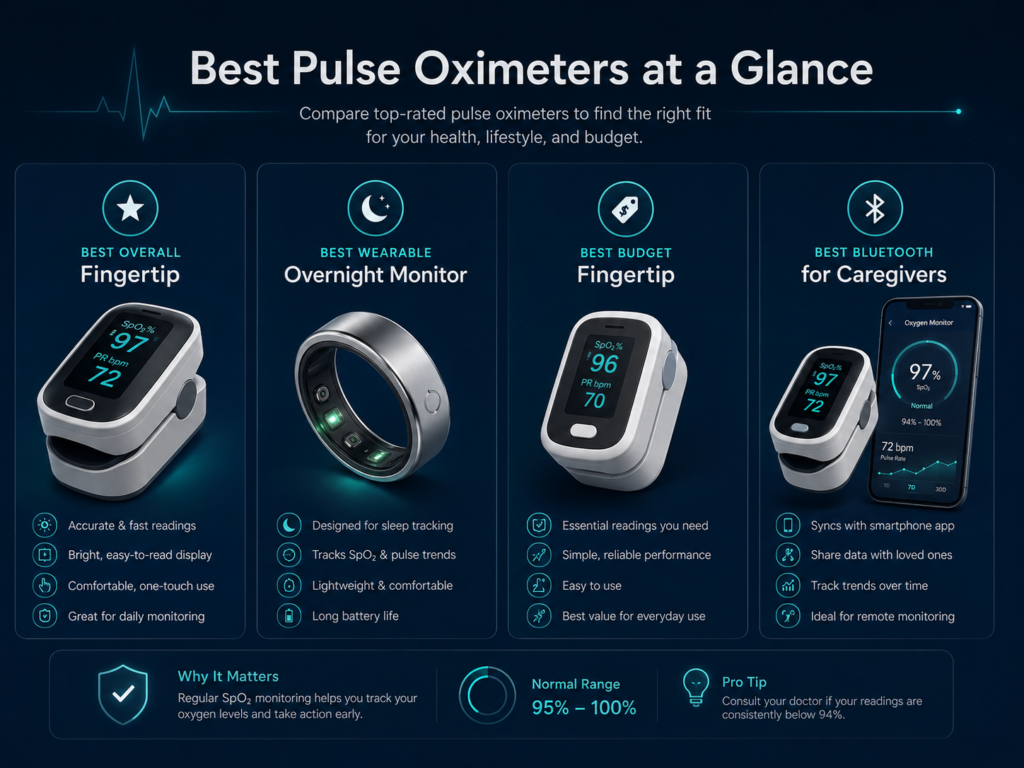
| Product | Best category | Measurement style | Display and signal information | Connectivity | Power | Most important limitation |
|---|---|---|---|---|---|---|
| HOLFENRY Fingertip Pulse Oximeter | Best overall for seniors | Fingertip spot check | Large display showing SpO2, heart rate and perfusion index | None emphasized | Replaceable batteries | No connected trend-reporting feature is emphasized |
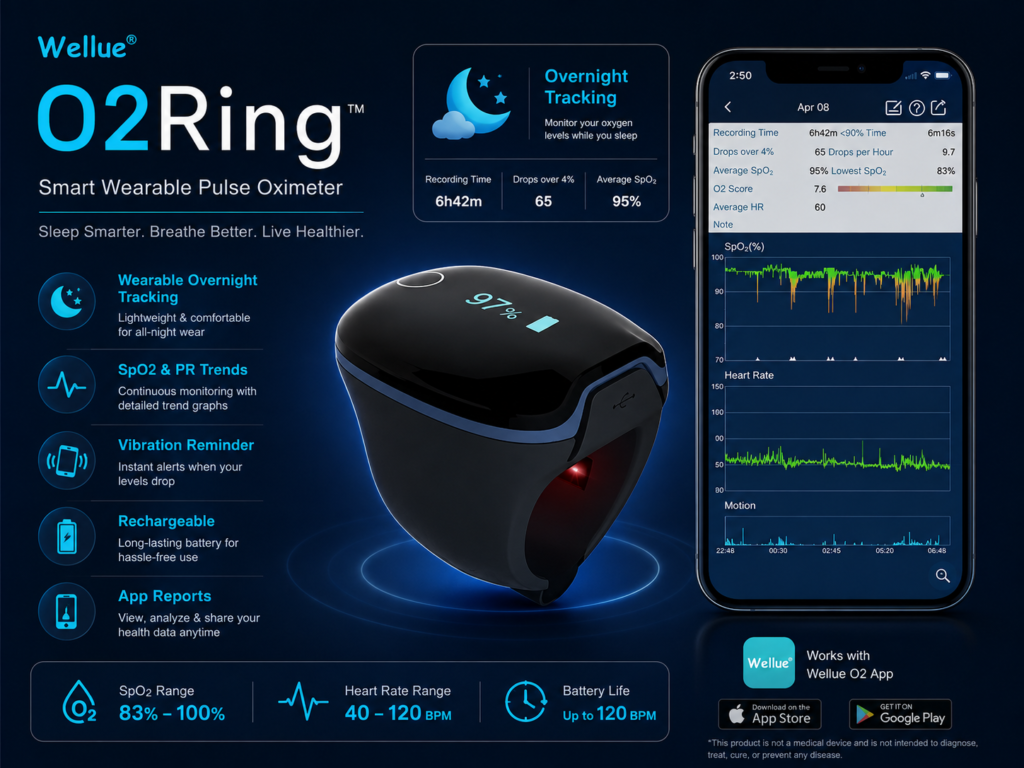
| Wellue O2Ring | Best wearable oxygen monitor | Continuous wearable recording | On-ring SpO2 and pulse display with low-oxygen vibration | Bluetooth app and computer reports | Rechargeable, up to 16 hours of typical use | Manufacturer labels it for general-wellness use rather than medical use |
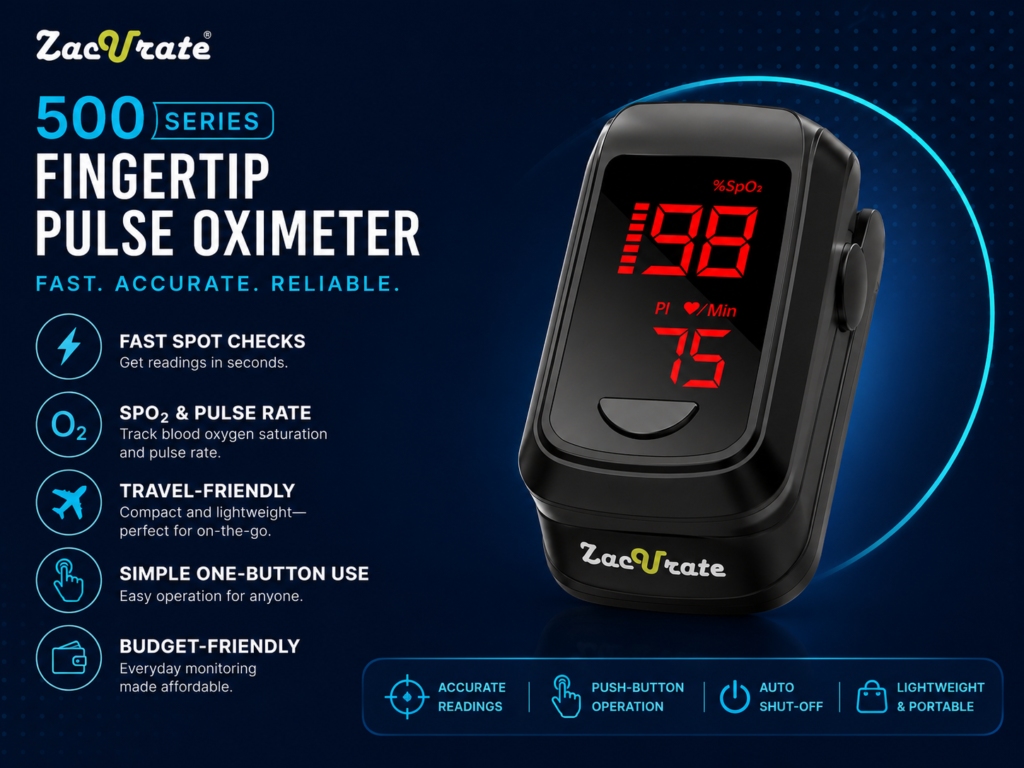
| Zacurate 500 Series | Best affordable option | Fingertip spot check | SpO2, pulse rate and pulse-strength information | None | Two AAA batteries | Does not save readings or support overnight recording |
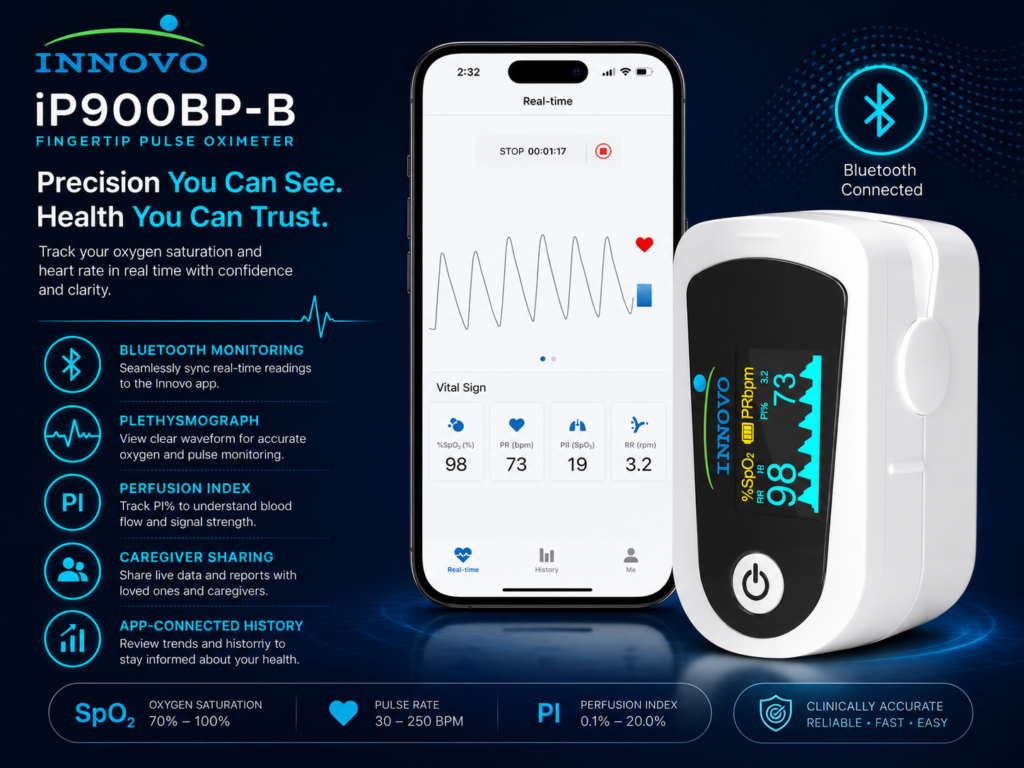
| Innovo iP900BP-B | Best Bluetooth fingertip model | Fingertip spot check with app recording | OLED screen, plethysmograph, perfusion index and six display orientations | Bluetooth mobile app | Two AAA batteries | App setup adds complexity compared with a basic model |
The HOLFENRY listing emphasizes a large display, SpO2, heart rate, perfusion index and a stated reading time of approximately five to eight seconds.
Wellue states that the O2Ring records oxygen level, pulse rate and movement, samples every second, stores several sessions, connects through Bluetooth and provides approximately 16 hours of typical battery life. The manufacturer also explicitly labels the device as a general-wellness product rather than a device intended for medical use.
Zacurate states that its 500DL Pro Series model measures SpO2 and pulse rate within approximately 10 seconds. The manufacturer lists a 70%–100% SpO2 range, a 30–250 beats-per-minute pulse range and a claimed deviation of plus or minus two percentage points. It does not store readings or support overnight recording.
Innovo’s iP900BP-B connects with the Beyond Oximeter app and can display a live SpO2 waveform, perfusion index and respiration-rate information. Its OLED screen supports six display orientations.
Senior-Use Feature Chart
Scores below indicate feature fit, not laboratory accuracy testing.
| Product | Display usability | Simple spot checks | Caregiver data sharing | Overnight tracking | Signal-quality feedback |
|---|---|---|---|---|---|
| HOLFENRY | 5/5 | 5/5 | 1/5 | 1/5 | 4/5 |
| Wellue O2Ring | 3/5 | 3/5 | 5/5 | 5/5 | 4/5 |
| Zacurate 500 Series | 4/5 | 5/5 | 1/5 | 1/5 | 3/5 |
| Innovo iP900BP-B | 4/5 | 4/5 | 5/5 | 1/5 | 5/5 |
Product-to-Need Match Chart
Simple daily reading       HOLFENRY          ██████████
Low-cost backup            Zacurate          ██████████
Caregiver app history      Innovo            ██████████
Overnight trend recording  Wellue O2Ring     ██████████
Low-vision usability       HOLFENRY          █████████░
Waveform interpretation    Innovo            █████████░
Travel portability         Zacurate          █████████░
Long-session comfort       Wellue O2Ring     █████████░
How We Evaluated the Best Oxygen Monitors for Home Use
The correct pulse oximeter is determined by the care situation, not by the longest feature list. Our editorial framework gives greater importance to features that affect whether an older adult can obtain a repeatable reading without unnecessary frustration.
Readability
SpO2, pulse rate and signal information should be distinguishable at a glance. Large numerals, high contrast and adjustable orientation are particularly valuable for people with reduced vision or limited neck and wrist mobility.
Measurement Confidence
A pulse waveform, pulse-strength bar or perfusion index can help a person recognize when the signal is weak or unstable. These features do not guarantee accuracy, but they offer more context than a flickering oxygen number alone.
Physical Usability
Arthritis, tremor, weakness, small fingers and cold hands can make seemingly simple health devices difficult to operate. Clip pressure, finger fit, button size and battery access therefore matter.
Caregiver Utility
A connected monitor may reduce handwritten logging and make it easier to discuss trends during a remote appointment. However, connectivity only adds value when pairing, syncing and report retrieval are manageable.
Intended Measurement Pattern
Spot checks and continuous measurements answer different questions. A fingertip pulse oximeter is designed primarily to capture a reading at a specific moment. A wearable model is designed to reveal what happened over a longer interval.
Labeling and Intended Use
Marketing language such as “accurate,” “professional” or “medical grade” should not be treated as proof that a device is FDA-cleared for medical decision-making. The intended-use statement and regulatory status matter more than promotional terminology. The FDA notes that general-wellness pulse oximeters are not evaluated by the agency before sale for clinical decision-making.
What Is a Pulse Oximeter For?
A pulse oximeter is a small optical device used to estimate oxygen saturation in the blood and measure pulse rate. A fingertip model shines red and infrared light through tissue and analyzes how the light is absorbed by oxygenated and deoxygenated hemoglobin.
The oxygen result appears as SpO2, expressed as a percentage. Most devices also show PR, or pulse rate. A third value may show signal strength, pulse waveform or PI, meaning perfusion index.
For older adults, a pulse oximeter is primarily useful for four purposes:
- Taking a spot measurement when respiratory symptoms appear
- Following a clinician-defined home-monitoring routine
- Recording trends during recovery from a respiratory condition
- Supplying more structured information during a virtual appointment
Pulse oximetry is painless and noninvasive, and an at-home monitor may be useful for a person with a serious or chronic lung condition. However, it provides an estimate rather than the direct blood-gas measurement obtained from an arterial blood sample.
A device becomes most useful when the reading is attached to context. A result of 93% after walking across a room is different from 93% after resting quietly. A result that matches a person’s clinician-defined baseline is different from an unexpected decline. The useful record therefore includes the time, symptoms, activity, pulse rate and whether supplemental oxygen was being used.
Oxygen readings can also improve an Online Consultation by giving the clinician a sequence of home observations rather than a single number recalled from memory.
Who Needs a Pulse Oximeter?
Not every older adult needs continuous oxygen monitoring. In people without respiratory symptoms or a clinician-defined reason to measure SpO2, repeated checking can create unnecessary concern without improving care.
A pulse oximeter becomes more relevant when a healthcare professional recommends home measurements or when a person is managing a condition that can affect oxygenation.
Seniors With COPD or Chronic Lung Disease
COPD can affect oxygen exchange, particularly during an exacerbation, respiratory infection, physical activity or sleep. A home pulse oximeter may help record changes, but the person’s individualized target range is more important than a generic internet threshold.
Some people with COPD normally have lower oxygen saturation than otherwise healthy adults. Oxygen flow should not be changed independently unless the care plan provides explicit instructions.
Seniors Recovering From Pneumonia or Respiratory Infection
Fatigue, cough and reduced exercise tolerance may persist after the acute stage of an infection. A clinician may recommend periodic oxygen measurements to add objective context to symptom reports.
An improving trend can support a recovery narrative. A falling trend, particularly when accompanied by worsening breathlessness, confusion or chest discomfort, may justify prompt clinical contact.
Seniors With Heart Failure
Heart failure often requires monitoring several signals at once. Oxygen saturation may add context, but weight changes, swelling, blood pressure, pulse, breathing difficulty and exercise tolerance may be equally important.
Families creating a broader cardiovascular monitoring routine can compare this guide with our review of the best blood pressure monitor.
Seniors Using Prescribed Supplemental Oxygen
A pulse oximeter may be included in a home oxygen plan, but the device does not determine the prescribed flow rate by itself. Changes should follow the clinician’s instructions.
MedlinePlus includes oxygen therapy among the situations in which pulse oximetry may be used, while advising that a healthcare professional guide the person on purchasing and using an at-home device.
Seniors With Sleep-Related Breathing Concerns
A wearable oxygen monitor can reveal repeated overnight drops that a daytime fingertip check would never capture. Nevertheless, consumer overnight oximetry cannot diagnose sleep apnea. Formal assessment may require a sleep study that records breathing, airflow and other physiological signals.
Seniors Recently Discharged From Hospital
Post-discharge monitoring can be useful when a care team wants short-term oxygen readings during recovery. In this context, clarity matters more than feature novelty. The person should understand when to measure, which symptoms to record and when to call.
Adult Children and Family Caregivers
A Bluetooth pulse oximeter may help when an adult child organizes readings for an elderly parent. It can reduce transcription errors and make appointment preparation easier.
Remote access should not create an expectation that the caregiver must watch the app continuously. A practical plan defines when readings are taken, who reviews them and what constitutes a meaningful change.
Older Adults Participating in Remote Monitoring
Pulse oximetry can be combined with blood pressure, weight, temperature and symptom questionnaires in a structured monitoring program. The value comes from the workflow around the device: scheduled measurement, reliable transmission, clinical review and a defined response pathway.
Families exploring connected home care can use the Telegeriatric Homepage as the starting point for related senior monitoring and virtual-care resources.
Benefits of Using a Pulse Oximeter for Seniors
It Adds Objective Context to Respiratory Symptoms
Breathlessness is subjective. Some older adults underreport it because they have adapted to limitations over time, while others become understandably anxious when breathing feels different. An SpO2 reading adds another piece of information.
The number should not overrule symptoms, but it can make a clinical conversation more precise.
It Helps Establish a Personal Baseline
The most informative comparison is often not between the person and a generic “normal” value. It is between today’s stable reading and that person’s usual stable reading under similar conditions.
Recording several clinician-approved resting measurements can help establish that baseline.
It Can Reveal Direction of Change
A single reading is vulnerable to technique and signal problems. A repeated pattern is more informative.
For example, three stable readings over several days may be reassuring in the correct clinical context. A progressive decline from the person’s usual range may deserve attention even when none of the individual readings appears dramatically abnormal.
It Supports More Focused Telemedicine Appointments
A useful log can answer questions such as:
- Was the person resting or walking?
- Was supplemental oxygen being used?
- Did the reading recover after rest?
- Was the pulse unusually fast?
- Were cough, fever, swelling or chest symptoms present?
- Did the change occur during the day or overnight?
This turns a virtual appointment from a vague recollection into a structured review.
It Can Help Caregivers Notice Measurement Problems
A waveform, perfusion index or signal-strength indicator can reveal that an unusual result may be caused by poor finger perfusion or movement. The caregiver can warm the hand, reposition the device and repeat the measurement before recording it.
It Is Compact and Noninvasive
Most fingertip models fit inside a medication drawer, travel bag or caregiver kit. They do not require needles or disposable testing strips.
Benefit-to-Feature Table
| Benefit | Helpful feature |
|---|---|
| Easier independent use | Large display and one-button operation |
| More confidence in signal stability | Plethysmograph, pulse-strength bar or perfusion index |
| Better caregiver documentation | Bluetooth history and exportable reports |
| Overnight pattern recognition | Wearable continuous recorder |
| Travel readiness | Compact body, lanyard and replaceable batteries |
| Reduced transcription errors | Automatic app syncing |
| Consistent routine | Fast startup and clear result layout |
Detailed Reviews: Four Best Pulse Oximeters for Seniors
HOLFENRY Fingertip Pulse Oximeter: Best Overall for Seniors
Best for: Older adults who want a large, readable pulse oximeter for straightforward home oxygen checks.
Category verdict: Best overall balance of simplicity, display visibility and signal information.
- 3-in-1 Fingertip Pulse Oximeter – Tracks blood oxygen saturation (SpO2), pulse rate, and perfusion index in one go. Gets…
- Large OLED Display, Easy-to-Read Numbers – Bright OLED screen with oversized digits you can read at a glance, even in di…
- One-Button Simplicity – No setup needed. Press once to measure. Auto shuts off after 8 seconds without a finger, saving …
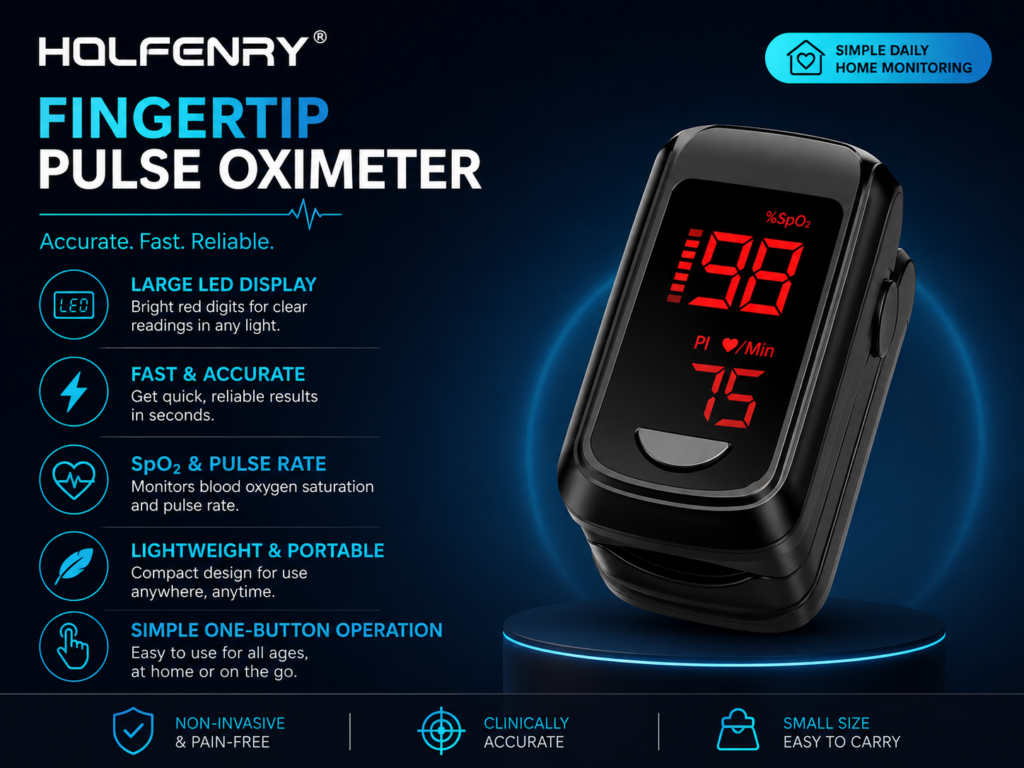
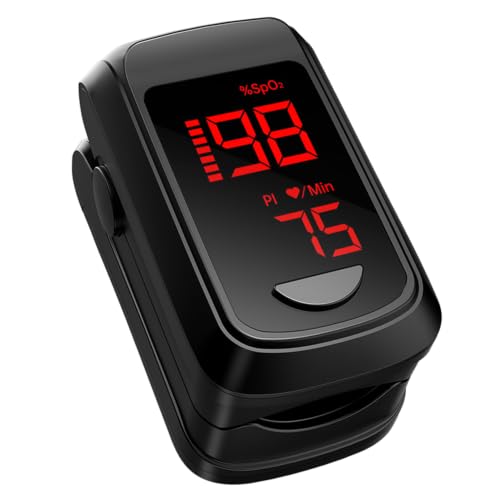
The HOLFENRY Fingertip Pulse Oximeter is the strongest general recommendation in this four-product group because it addresses the features that affect day-to-day senior use most directly. Its listing emphasizes a large display, SpO2, heart rate and perfusion index, with a stated reading time of approximately five to eight seconds. Batteries and a lanyard are included.
The inclusion of perfusion index is particularly relevant. PI reflects the strength of the pulsatile signal at the measurement site. It does not tell a person whether an oxygen result is medically safe, but it can help explain why a reading is unstable when circulation at the fingertip is weak.
Why It Fits Seniors
Large numerals reduce the need to rotate the hand repeatedly or bring the device close to the face. The fast spot-check format also suits a simple routine: sit, warm the hand, insert the finger, wait for a stable result and record the measurement.
There is no need to open an app before viewing the reading. That makes the HOLFENRY easier to introduce in a household where smartphone pairing would become a barrier.
Senior-Use Strengths
| Strength | Why it matters |
|---|---|
| Large display | Easier for reduced vision |
| Fast stated measurement | Less time holding the hand still |
| Perfusion index | Adds context about pulse-signal strength |
| Included batteries | Ready to use without charging |
| Included lanyard | Easier to store and less likely to be misplaced |
| Compact fingertip format | Suitable for home and travel |
Limitations
Its product positioning centers on spot checks rather than continuous recording or remote caregiver reports. A person who needs saved trends must write readings down or enter them into another health app.
A fast reading should also not be confused with an instantly reliable reading. The person should wait until the display stabilizes, especially when the initial values fluctuate.
Best Use Scenario
The HOLFENRY is best suited to an older adult who needs occasional or scheduled resting measurements and values readability more than advanced connectivity.
Wellue O2Ring: Best Wearable Pulse Oximeter for Overnight Trends
Best for: Longer recording sessions, overnight oxygen trend awareness and downloadable caregiver reports.
Category verdict: Best continuous wearable option, with an important general-wellness limitation.
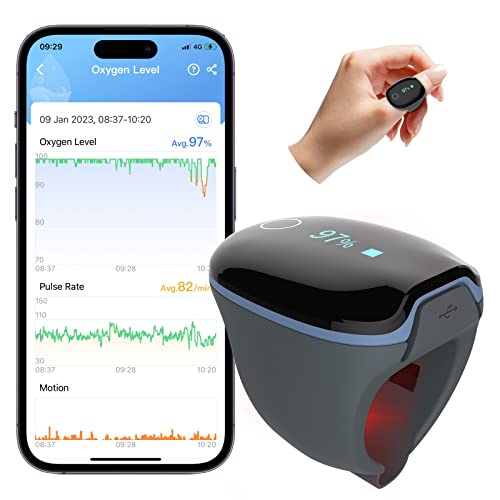
- COMFORTABLE SOFT RING SENSOR: The lightest, smallest ring sensor for continuous tracking, durable and adapt to most fing…
- DETAILED APP & PC REPORT: Free APP & PC software provides graphic report and trends of data, reviewing real-time data in…
- UNUSUAL DATA MARKING: If the SpO2 level is lower than the preset threshold and heart rate is lower or higher than the pr…
The Wellue O2Ring is fundamentally different from a fingertip spot-check monitor. It is designed to stay on the finger and record oxygen level, pulse rate and movement over an extended period.
Wellue lists one-second measurement intervals, Bluetooth syncing, local storage for four sessions of up to ten hours each and approximately 16 hours of typical battery life. Reports can be exported in PDF or CSV format, and adjustable vibration settings can alert the wearer when configured thresholds are reached.
Why It Fits Overnight Monitoring
A daytime fingertip measurement is a photograph. The O2Ring produces something closer to a timeline.
That timeline may reveal repeated dips, the duration of a low period and whether pulse changes occurred at the same time. This can be more useful for a clinician than a single morning measurement when the clinical question concerns nighttime patterns.
The Important Labeling Distinction
Wellue promotes the ring’s measurement technology and reports, but the manufacturer’s own product page also states that the O2Ring is for general-wellness use and is not intended for medical use.
That means it should be presented editorially as a trend-awareness tool, not as a device that independently diagnoses sleep apnea or determines whether oxygen treatment is needed.
This distinction is particularly important because the same product page uses medically suggestive marketing language. The intended-use disclaimer should take priority over promotional phrasing.
Senior-Use Strengths
| Strength | Why it matters |
|---|---|
| Continuous recording | Captures patterns missed by spot checks |
| Vibration reminder | Provides a private on-device alert |
| Rechargeable battery | Avoids frequent battery replacement |
| Bluetooth reports | Easier to review and share trends |
| Local storage | Recording does not require a constant internet connection |
| Motion recording | Adds context to oxygen and pulse changes |
| PDF and CSV export | Supports organized appointment preparation |
Limitations
The O2Ring costs substantially more than a basic fingertip model. It also introduces charging, app syncing, report interpretation and fit considerations.
The small wearable display is less suitable than a large fingertip screen for a senior with significant visual impairment. The device may therefore work best when a caregiver manages the reports.
Best Use Scenario
Choose the Wellue O2Ring when the primary goal is to understand oxygen trends over several hours, not merely to obtain a quick daytime reading.
Zacurate 500 Series: Best Affordable Fingertip Pulse Oximeter
Best for: Simple spot checks, travel kits and households that do not need Bluetooth.
Category verdict: Best budget-friendly, no-app option.

- ACCURATE AND RELIABLE – Accurately determines your SpO2 (blood oxygen saturation levels), pulse rate and pulse strength …
- FULL SPO2 VALUE – The ONLY LED pulse oximeter that can read and display SpO2 up to 100%.
- SPORTS/HEALTH ENTHUSIASTS – For sports enthusiasts like mountain climbers, skiers, bikers, and anyone needing to monitor…
The Zacurate 500 Series is designed around uncomplicated measurement. The manufacturer states that the 500DL Pro Series measures SpO2 and pulse rate within approximately 10 seconds, uses two AAA batteries and includes a one-year warranty with technical support.
The Amazon specification table lists a 70%–100% SpO2 measurement range, a 30–250 BPM pulse range and a claimed accuracy of plus or minus two percentage points.
Why It Fits Seniors
Not every home-monitoring routine needs an app. The Zacurate is a practical choice when the priority is to place a finger inside the chamber, obtain a result and put the device away.
The included silicone cover helps protect the body of the monitor, while the lanyard makes it easier to keep inside a designated monitoring kit.
Senior-Use Strengths
| Strength | Why it matters |
|---|---|
| Straightforward operation | Minimal learning curve |
| No app requirement | Suitable for people who avoid smartphones |
| Replaceable AAA batteries | Easy to keep powered during travel |
| Protective silicone cover | Adds protection during storage |
| Lanyard included | Reduces the chance of misplacement |
| Low purchase barrier | Practical as a backup device |
No Memory or Overnight Recording
Zacurate states that the device does not save previous readings and is not intended for overnight use. Once the finger is removed, the monitor turns off after a short interval.
Anyone using it for telemedicine should keep a written log or enter the result into a phone immediately after measurement.
Measurement Technique Matters
The manufacturer advises keeping the hand still, waiting for values to stabilize and checking pulse strength. It also notes that nail polish and artificial nails may interfere with readings.
Best Use Scenario
The Zacurate is appropriate for occasional resting measurements, a caregiver travel bag or a household that wants a basic backup monitor without software.
Innovo iP900BP-B: Best Bluetooth Pulse Oximeter for Caregivers
Best for: Families who want fingertip convenience plus app-based recording and waveform information.
Category verdict: Best connected fingertip pulse oximeter in this comparison.

- Accurate and Reliable – The Innovo iP900BP-B Finger Pulse Oximeter is a premium model with an improved LED and sensor, a…
- Wireless Bluetooth Connection – Connect with your iPhone or Android via Bluetooth using the ‘Beyond Oximeter’ App. Recor…
- Patented Multi-Directional Display – Choose from 6 layout options for easy viewing of blood oxygen and pulse. Switch dis…
The Innovo iP900BP-B combines the portability of a standard fingertip device with Bluetooth connectivity. Its OLED display offers six orientations, allowing the screen to face the senior, caregiver or clinician assisting with the measurement.
The Beyond Oximeter app can record live readings, display the SpO2 waveform, show perfusion index and record respiration-rate information.
Why the Plethysmograph Matters
The plethysmograph displays a pulse waveform. When the waveform becomes regular rather than erratic, the user has more evidence that the device is detecting a stable pulse signal.
This is useful for older adults with cold hands or weaker peripheral circulation because it gives the caregiver another way to judge whether the result should be recorded or repeated.
Why It Fits Caregiver-Supported Monitoring
A family caregiver can save readings rather than transcribing every number manually. During a telemedicine visit, the history can help answer whether a result was isolated or part of a pattern.
The device also retains an on-device display. The senior can therefore see the immediate number without depending entirely on the smartphone.
Senior-Use Strengths
| Strength | Why it matters |
|---|---|
| Six display orientations | Easier viewing from multiple positions |
| Bluetooth syncing | Supports organized reading history |
| Plethysmograph | Shows pulse-wave stability |
| Perfusion index | Adds signal-strength context |
| On-device OLED screen | Immediate reading without opening the app |
| App-based respiration information | Adds another trend for discussion with a clinician |
Limitations
Bluetooth setup, phone permissions and app updates can create friction. The Innovo is a better fit when a family member or caregiver can assist with setup.
It is still a spot-check fingertip device. It should not be treated as an overnight recorder merely because it connects to an app.
Best Use Scenario
Choose the Innovo when app history and signal visualization are genuinely useful, but a wearable overnight monitor would be excessive.
Suggested CTA: View Innovo Bluetooth Pulse Oximeter
Bluetooth vs Fingertip Pulse Oximeter for Elderly Adults
The comparison is not strictly Bluetooth versus fingertip because the Innovo is both. The more useful distinction is between a simple standalone spot-check monitor, a connected spot-check monitor and a continuous wearable recorder.
| Question | Standalone fingertip | Bluetooth fingertip | Wearable recorder |
|---|---|---|---|
| How long is it normally worn? | Seconds to a few minutes | Seconds to a few minutes | Several hours |
| Does it show the result immediately? | Yes | Yes | Yes, although the display may be smaller |
| Does it save history automatically? | Usually not | Usually through an app | Yes |
| Is it suitable for overnight trends? | No | Usually no | Yes |
| Is it easy for a nontechnical senior? | Usually easiest | Moderate | Moderate |
| Can caregivers review patterns? | Only through a manual log | Yes | Yes |
| Does it require charging? | Usually no | Usually no | Usually yes |
| Typical cost level | Low | Moderate | Higher |
| Best use | Routine spot checks | Telemedicine logs | Long-session trend awareness |
Choose a Standalone Fingertip Model When
The senior only needs occasional readings, prefers a simple device and is willing to keep a written log when necessary.
The HOLFENRY and Zacurate occupy this category.
Choose a Bluetooth Fingertip Model When
Readings must be organized across several days or shared during appointments, but the person does not need overnight recording.
The Innovo is the strongest fit here.
Choose a Wearable Model When
The question concerns what happens over time, particularly during sleep or a longer observation period.
The Wellue O2Ring is the relevant option, subject to its general-wellness intended-use limitation.
How to Choose the Best Pulse Oximeter for Seniors
1. Define the Measurement Question
Start by asking what the device is expected to reveal.
“Check my oxygen when I feel breathless” points toward a fingertip model.
“Keep a record for my respiratory appointment” points toward a Bluetooth model.
“See whether my oxygen changes during the night” points toward a wearable recorder.
A device selected without a defined question often produces data that nobody knows how to use.
2. Decide Whether the Senior Will Measure Independently
For independent use, prioritize a large screen, one-button operation and minimal software.
For caregiver-assisted use, Bluetooth, waveform information and reports may be more valuable.
3. Examine the Display Before Advanced Features
A senior should be able to distinguish SpO2 from pulse rate. The screen should not require memorizing tiny abbreviations or rotating the hand into an uncomfortable angle.
A multidirectional display can be useful, but oversized numerals may matter more.
4. Look for Signal-Quality Information
A pulse bar, plethysmograph or perfusion index can help identify weak signal conditions.
These indicators are especially useful when the senior has:
- Cold hands
- Reduced peripheral circulation
- Tremor
- Difficulty holding still
- Small or thin fingers
- An unexpected result that needs repeating
5. Match the Monitor to Finger Fit
A loose chamber may fail to align the optical sensor correctly. An excessively tight clip may be uncomfortable and discourage use.
For a wearable ring, check the manufacturer’s finger-circumference range before ordering. Wellue lists a supported circumference of approximately 55–80 millimeters for the O2Ring.
6. Consider Power Management
AAA-powered fingertip devices are convenient for travel and emergency kits. Rechargeable wearables are convenient for regular overnight use but become useless when forgotten on the charger.
A family should decide who replaces batteries or confirms that the device is charged.
7. Evaluate the App, Not Just the Sensor
For connected models, examine:
- Phone compatibility
- Whether an account is required
- Report export options
- Subscription requirements
- Ease of reconnecting after an update
- Whether the device still displays readings without the app
- Whether data can be deleted or shared selectively
An app that creates confusion can reduce adherence even when the hardware is excellent.
8. Understand Spot Check Versus Continuous Recording
A spot-check device should not be taped onto a finger overnight. It may shut off, move out of position or create pressure on the skin.
Use a monitor specifically designed for longer recording when overnight patterns are the goal.
9. Verify the Intended Use
The product listing should state whether the monitor is a general-wellness product, an athletic or aviation product, or a device intended for medical monitoring.
The FDA notes that many wellness pulse oximeters sold directly to consumers have not been evaluated for clinical decision-making.
10. Build the Response Plan Before Measuring
A monitoring plan should answer:
- What is the person’s usual resting range?
- How often should measurements be taken?
- Should the reading be repeated?
- Which symptoms require a call even when SpO2 looks normal?
- At what reading should the healthcare professional be contacted?
- When should emergency care be sought?
Without these answers, more measurements may create more uncertainty rather than better care.
Senior Selection Matrix
| Senior profile | Best format | Leading option |
|---|---|---|
| Low vision and simple routine | Large-display fingertip | HOLFENRY |
| Limited budget | Basic fingertip | Zacurate |
| Adult child organizing readings | Bluetooth fingertip | Innovo |
| Concern about overnight patterns | Wearable recorder | Wellue O2Ring |
| Frequent travel | Battery-powered fingertip | Zacurate or HOLFENRY |
| Difficulty judging signal stability | PI or waveform model | Innovo or HOLFENRY |
| No smartphone use | Standalone fingertip | HOLFENRY or Zacurate |
| Need downloadable reports | Connected device | Wellue or Innovo |
How Seniors Should Use a Fingertip Pulse Oximeter Correctly
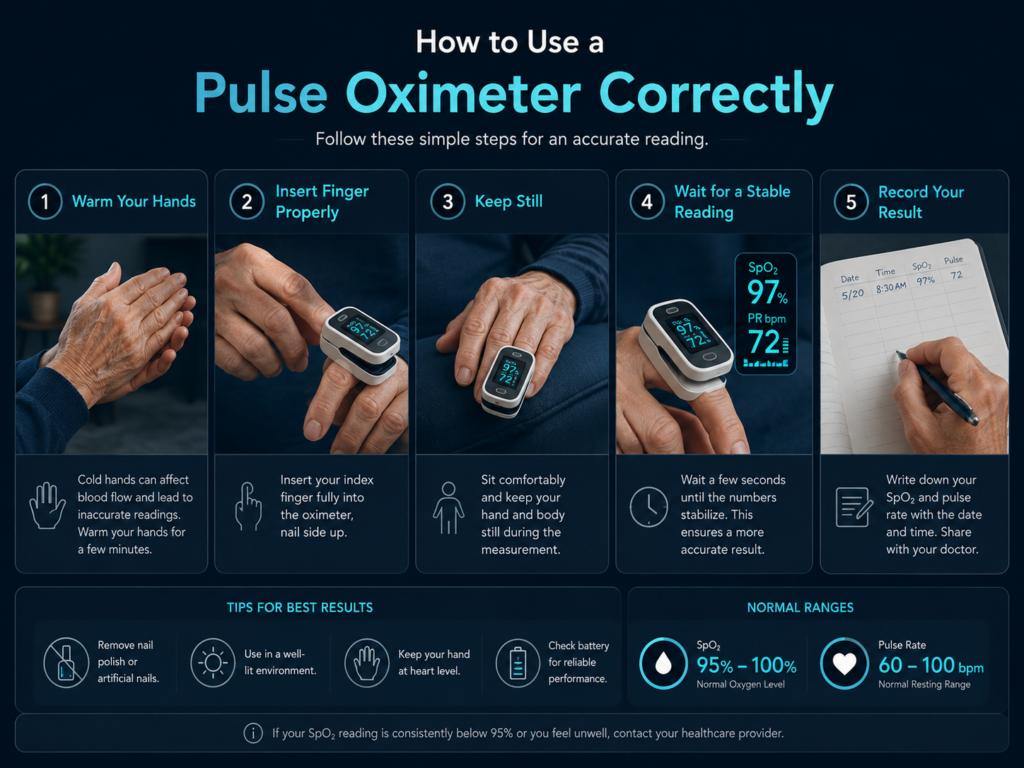
The quality of the measurement routine may influence the usefulness of the result as much as the feature list.
The FDA recommends following the manufacturer’s instructions, warming and relaxing the hand, removing nail polish, sitting still and waiting until the displayed number stops changing. It also recommends writing down the oxygen level with the date and time.
Before the Reading
Sit quietly for several minutes unless the care plan specifically calls for a measurement after walking or activity.
Warm cold fingers. Reduced circulation at the fingertip can weaken the optical signal.
Remove dark nail polish or use an unpolished finger. Artificial nails can also interfere.
Avoid taking the measurement while talking, shivering or repositioning the hand.
Position the Device Correctly
Insert the finger fully, with the nail generally facing the display unless the manufacturer instructs otherwise.
Keep the hand relaxed and below heart level.
Do not squeeze the device or press the finger against a hard surface.
Wait for Stability
The first displayed number may not be the measurement worth recording.
Wait for the SpO2 and pulse values to settle. When the device provides a waveform, PI value or pulse bar, confirm that the signal is reasonably stable.
Repeat an Unexpected Reading
When a result is very different from the senior’s usual range:
- Check whether the hand is cold.
- Confirm that the finger is inserted correctly.
- Remove sources of movement.
- Try another suitable finger.
- Allow the senior to rest.
- Repeat the measurement.
Do not keep repeating the test indefinitely when severe symptoms are present.
Record Context, Not Just the Percentage
A useful log includes:
| Log field | Example |
|---|---|
| Date and time | August 1, 8:30 a.m. |
| SpO2 | 94% |
| Pulse rate | 84 BPM |
| Activity | Seated after five minutes of rest |
| Symptoms | Mild cough, no chest pain |
| Oxygen use | Prescribed oxygen at usual setting |
| Repeat result | 95% after two minutes |
| Additional notes | Hand initially cold |
Avoid These Common Errors
Do not measure through dark nail polish when a reading appears questionable.
Do not interpret rapid fluctuations while the signal is still settling.
Do not use a spot-check monitor as an overnight device.
Do not compare readings taken under completely different conditions without noting those conditions.
Do not alter prescribed oxygen flow solely because of one consumer-device reading.
Do not delay urgent care when the senior looks severely unwell.
What Do Pulse Oximeter Readings Mean for Seniors?
For many healthy people, oxygen saturation generally falls between 95% and 100%. Levels can be lower in people with lung or heart conditions and in those living at higher elevations. MedlinePlus advises contacting a healthcare professional at 92% or lower and seeking immediate medical attention at 88% or lower, while also emphasizing that individual circumstances differ.
A senior with COPD or another chronic condition may have a personalized target that differs from a generic chart. The care team’s instructions should therefore override broad online ranges.
General SpO2 Interpretation Chart
| Reading or pattern | General interpretation | Appropriate response |
|---|---|---|
| 95%–100% | Common range for many healthy adults | Continue the prescribed routine and consider symptoms |
| Below the person’s normal baseline | May be important even when above 92% | Rest, repeat correctly and follow the care plan |
| 92% or lower | MedlinePlus advises contacting a healthcare professional | Repeat once under good conditions unless symptoms require immediate action |
| 88% or lower | MedlinePlus advises immediate medical attention | Seek urgent medical help |
| Rapidly falling readings | May indicate deterioration or measurement error | Recheck technique promptly and assess symptoms |
| Normal number with severe symptoms | Does not exclude a serious condition | Seek medical assessment based on symptoms |
The values in this chart are not individualized treatment targets.
Why the Reading May Differ From the Actual Oxygen Level
MedlinePlus states that pulse oximetry may read approximately two to four percentage points higher or lower than the actual blood oxygen level. Accuracy generally becomes more difficult at lower saturation levels.
A displayed result of 91% should therefore not be interpreted as a perfectly exact laboratory value.
Symptoms Can Matter More Than the Number
Concerning symptoms include:
- New or worsening shortness of breath
- Bluish discoloration of the face, lips or nails
- Chest pain or tightness
- Confusion or unusual drowsiness
- Rapid deterioration
- A racing pulse with respiratory distress
- Fainting or inability to speak normally because of breathlessness
The FDA stresses that pulse oximeter results should be considered with symptoms and other clinical information because some people with low oxygen may not show every expected symptom.
How Pulse Oximeters Support Telemedicine and Caregiver Monitoring
A pulse oximeter becomes a telemedicine tool when its readings are converted into organized, clinically interpretable information.
Before a Virtual Appointment
Collect readings at the times requested by the clinician. Avoid taking dozens of unstructured measurements immediately before the call.
Prepare a brief summary:
- Typical resting SpO2
- Lowest repeatable reading
- Whether readings fall after activity
- Pulse-rate pattern
- Symptoms occurring at the same time
- Supplemental oxygen use
- Recent fever, cough, weight change or swelling
- Medication changes
During the Appointment
Position the camera so the clinician can observe how the device is applied if measurement technique is uncertain.
A live reading can help reveal whether the person is moving, inserting the finger incompletely or recording the first unstable number.
Bluetooth Data and Caregiver Dashboards
Bluetooth can reduce handwritten errors and make longitudinal review easier. However, the clinician may not need every second of raw data.
A useful report emphasizes:
- Average trend
- Meaningful low periods
- Duration of changes
- Symptoms
- Activity
- Medication or oxygen context
The Three-Layer Home Monitoring Framework
| Layer | What it contains | Why it matters |
|---|---|---|
| Measurement | SpO2, pulse rate, PI or waveform | Provides the raw device result |
| Context | Symptoms, activity, time, oxygen use | Explains what was happening |
| Response | Repeat, contact clinician or seek urgent care | Converts data into action |
A device without context is incomplete. Context without a response plan creates uncertainty. All three layers are needed for responsible home monitoring.
Pulse Oximeter Accuracy, Risks and Limitations
Poor Circulation
Older adults may have reduced blood flow in the fingers. Cold skin, vascular disease and low perfusion can cause a weak or unstable signal.
Warm the hand and use a model with a pulse waveform, PI value or strength indicator when possible.
Movement and Tremor
Motion can interrupt the optical signal. A senior with tremor may need caregiver assistance, a supported hand position or several attempts.
The goal is not to force the finger motionless. It is to create a comfortable, reproducible position.
Nail Polish and Artificial Nails
Dark polish and artificial nails may interfere with the light passing through the finger. Removing polish or choosing another suitable finger may improve the reading.
Skin Pigmentation
The FDA states that scientific evidence suggests some performance differences between people with lighter and darker skin pigmentation. Its January 2025 draft guidance proposed broader, more representative performance testing for medical-purpose pulse oximeters. As of August 2026, the FDA continues to describe that document as draft guidance rather than final guidance.
A reading should not be dismissed solely because the senior looks comfortable, particularly when symptoms or the person’s usual baseline suggest deterioration.
Tobacco Use and Carbon Monoxide
Current tobacco use is among the factors the FDA identifies as potentially affecting pulse oximeter readings. Standard pulse oximeters also cannot reliably distinguish oxyhemoglobin from carboxyhemoglobin in the way a laboratory co-oximeter can.
False Reassurance
A normal-looking SpO2 result does not rule out every serious condition. Chest pain, confusion, severe breathlessness or rapidly worsening illness should be assessed based on the total clinical picture.
Overchecking and Anxiety
Frequent unscheduled measurement can cause a person to fixate on normal fluctuations.
The solution is not necessarily a more advanced monitor. It is a clear measurement schedule and action plan.
General-Wellness Versus Medical-Purpose Devices
The FDA notes that most general-wellness pulse oximeters have not been evaluated for making clinical decisions. A product may be useful for observing trends while still being inappropriate as the sole basis for treatment.
Accuracy-Limitation Table
| Limitation | Possible effect | Practical response |
|---|---|---|
| Cold finger | Low or unstable signal | Warm the hand and repeat |
| Tremor or movement | Fluctuating values | Support the hand and remain still |
| Nail polish | Light interference | Remove polish or change finger |
| Poor finger fit | Sensor misalignment | Reposition or choose a better-fitting model |
| Low perfusion | Weak waveform or PI | Warm hand and assess signal strength |
| Bright direct light | Optical interference | Shield the device |
| Skin-pigmentation performance differences | Possible measurement bias | Consider symptoms, baseline and repeat measurements |
| Low oxygen range | Reduced measurement precision | Seek clinical confirmation when indicated |
| General-wellness labeling | Not evaluated for clinical decisions | Do not use as the sole basis for intervention |
How Much Should a Senior Spend on a Pulse Oximeter?
The lowest-priced monitor is not automatically poor, and the most expensive monitor is not automatically appropriate.
Cost generally increases with recording duration, Bluetooth connectivity, downloadable reports, rechargeable power and more sophisticated signal displays.
| Price category | Typical feature level | Best use |
|---|---|---|
| Entry level | Basic SpO2 and pulse-rate spot checks | Occasional home checks or travel backup |
| Mid-range fingertip | Better display, PI, waveform or Bluetooth | Regular monitoring and caregiver logs |
| Premium wearable | Continuous recording, vibration and reports | Overnight or extended trend awareness |
| Clinical system | Validated sensor, care-platform integration and professional support | Structured healthcare programs |
When a Budget Model Is Enough
A simple monitor may be entirely adequate when the senior needs infrequent resting readings, can hold the hand still and does not require saved data.
The Zacurate fits this situation.
When Paying More Is Rational
Additional expense may be justified when:
- A caregiver needs automatic history
- The senior has difficulty judging whether the signal is stable
- Overnight trends are the central question
- Reports must be shared during appointments
- The device will be used frequently enough that comfort matters
Medicare and Insurance Considerations
Do not assume that a retail pulse oximeter will be reimbursed. Medicare’s national coverage rules focus primarily on qualifying home oxygen therapy and oxygen equipment for people who meet documented hypoxemia criteria. Coverage for a consumer monitor can depend on the plan, supplier, prescription and clinical circumstances.
Upcoming Trends and Latest Pulse Oximeter Technology
More Representative Accuracy Testing
The most consequential development is not a brighter screen or another app chart. It is the effort to improve validation across a broader range of skin pigmentation.
The FDA’s 2025 draft guidance proposed larger and more representative clinical studies, improved labeling and additional performance data for medical-purpose pulse oximeters. The agency also proposed a public resource identifying FDA-cleared devices that demonstrate comparable performance across skin pigmentations.
Better Low-Perfusion Performance
Older adults frequently have colder hands and weaker peripheral signals. Future devices are likely to place greater emphasis on algorithms that separate a genuine pulse from motion and low-perfusion noise.
For senior care, this may matter more than adding another wellness score.
Improved Signal-Quality Communication
A raw PI number is useful only when a person knows what it means. More senior-friendly devices may translate signal quality into plain guidance such as:
- Weak signal
- Keep hand still
- Warm finger
- Reposition sensor
- Reading stable
This can reduce the chance of recording a misleading first result.
Integrated Multi-Vital Monitoring
Future home-care systems will increasingly combine oxygen saturation with:
- Blood pressure
- Pulse
- Temperature
- Respiratory rate
- Weight
- Activity
- Symptom questionnaires
- Medication confirmation
The clinical value will come from relationships between these measurements rather than isolated device dashboards.
Smarter Alert Logic
A useful alert system must distinguish a meaningful oxygen decline from a one-second signal dropout caused by movement.
Future wearable monitors are likely to incorporate duration, signal quality, pulse changes and repeated episodes before generating a high-priority alert.
Caregiver and Clinician Dashboards
Bluetooth syncing is moving from simple phone storage toward shared dashboards. Better systems will allow role-based access so the senior, family caregiver and healthcare team see the information relevant to them without exposing unnecessary personal data.
Passive Data Transfer
For seniors who struggle with app pairing, future monitoring kits may use cellular hubs or automatic home gateways. The person would take the measurement normally, and the system would transmit it without requiring a smartphone workflow.
More Explicit Intended-Use Labeling
Regulatory attention is likely to make the distinction between wellness tracking, spot-check monitoring and medical-purpose continuous monitoring more visible.
That would help families understand whether a device is intended to generate personal trends or support clinical decisions.
Trend Forecast Table
| Technology direction | Senior-care value | Remaining concern |
|---|---|---|
| Broader skin-pigmentation validation | More equitable performance evidence | Implementation and labeling consistency |
| Low-perfusion algorithms | Better readings from cold or weakly perfused fingers | Performance still varies by device |
| Automatic caregiver syncing | Less manual transcription | Privacy and setup complexity |
| Multi-vital dashboards | More clinical context | Too many alerts can overwhelm families |
| Duration-aware alerts | Fewer false alarms | Algorithms must remain transparent |
| Cellular home hubs | Less dependence on smartphones | Cost and service support |
| Wearable continuous oximetry | Longer trend visibility | Consumer data can be overinterpreted |
| Simplified signal prompts | Better measurement technique | Must remain readable for low vision |
FAQs About Pulse Oximeters for Seniors
What is the best pulse oximeter for seniors?
The HOLFENRY Fingertip Pulse Oximeter is the best overall option in this comparison for a senior who wants fast spot checks, a large display and perfusion-index information without using an app. The Innovo iP900BP-B is better when a caregiver needs Bluetooth history, while the Wellue O2Ring is better for extended or overnight trend recording. The Zacurate 500 Series is the strongest low-cost choice for uncomplicated readings.
The correct option depends on whether the person needs a quick number, a saved history or continuous recording.
Which fingertip pulse oximeter is best for elderly home use?
A good fingertip pulse oximeter for elderly home use should have large numerals, simple controls, a comfortable finger chamber and a signal-quality indicator.
The HOLFENRY is best for screen readability and general simplicity. The Innovo is preferable when plethysmograph, PI and Bluetooth logs are important. The Zacurate is suitable when affordability and no-app operation take priority.
Whichever model is selected, readings should be taken with a warm, still hand and recorded only after the values stabilize.
Are home pulse oximeters accurate for seniors?
Home pulse oximeters can provide useful estimates, but no consumer fingertip monitor should be treated as perfectly exact. MedlinePlus notes that results may be approximately two to four percentage points above or below the actual oxygen level. Poor circulation, movement, cold skin, nail polish, tobacco use and skin pigmentation may also affect performance.
The most useful approach is to combine correct technique, repeatable trends, symptoms and clinician guidance.
What is the best pulse oximeter for seniors with COPD?
For COPD spot checks, choose a readable fingertip model with a signal-strength feature, such as the HOLFENRY or Innovo. The Innovo is particularly useful when the clinician wants saved readings and waveform information.
The Wellue O2Ring can show longer trends, but it is labeled as a general-wellness device and should not be used to diagnose nocturnal hypoxemia or alter oxygen therapy independently. The senior’s clinician should define the target SpO2 range because some people with COPD have an acceptable baseline below the general healthy range.
Is a Bluetooth pulse oximeter worth it for elderly parents?
A Bluetooth pulse oximeter is worth purchasing when it solves a specific documentation problem. It can help an adult child organize readings, reduce handwritten errors and prepare reports for telemedicine appointments.
It is not automatically better for a senior who dislikes smartphones or only measures occasionally. In that situation, a large standalone display and a simple paper log may be more dependable than an app.
The Innovo iP900BP-B offers the best Bluetooth fingertip balance among the products reviewed here.
FAQ Product Decision Chart
| Question | Best answer |
|---|---|
| Need the easiest overall device? | HOLFENRY |
| Need the lowest-cost straightforward model? | Zacurate |
| Need app-based fingertip history? | Innovo |
| Need overnight trend awareness? | Wellue O2Ring |
| Need a medical diagnosis? | None of these devices can provide one |
| Need to change prescribed oxygen? | Contact the clinician and follow the care plan |
People Also Ask About Pulse Oximeters for Elderly Adults
What oxygen level is too low for seniors?
There is no universal target for every senior. For many healthy adults, 95%–100% is common. MedlinePlus advises contacting a healthcare professional when an at-home reading is 92% or lower and seeking immediate medical attention at 88% or lower. A person with COPD or another lung condition may have an individualized range.
Severe breathlessness, chest pain, blue discoloration, confusion or rapid deterioration requires attention regardless of the displayed number.
Which finger should an elderly person use for a pulse oximeter?
Use a finger that is warm, clean, free of obstructive nail polish and able to fit securely inside the device. The index or middle finger is commonly used, although the manufacturer’s instructions should take priority.
The finger should be inserted fully, and the hand should remain relaxed and still. When a reading is unstable, try another suitable finger rather than repeatedly recording the fluctuating number.
Is a fingertip or wearable pulse oximeter better for seniors?
A fingertip pulse oximeter is better for quick resting measurements because it is affordable, portable and easy to understand.
A wearable pulse oximeter is better when the goal is to record oxygen over several hours or overnight. It costs more and produces more data, which can be useful but also easier to misinterpret.
The measurement question should determine the format.
Can a pulse oximeter detect pneumonia or a COPD flare-up?
No. A pulse oximeter cannot diagnose pneumonia or confirm a COPD exacerbation. It can show whether oxygen saturation and pulse are changing while symptoms are present.
Fever, cough, sputum changes, wheezing, breathlessness, chest discomfort, confusion and reduced activity remain clinically important. A normal-looking SpO2 reading does not rule out illness.
Why does a pulse oximeter reading change every few seconds?
The number may change because the sensor is still finding the pulse, the finger is moving, the hand is cold, circulation is weak or the device is not positioned correctly. Small physiological changes also occur naturally.
Wait for a steady display and stable pulse signal. If the value remains unusual, warm the hand, reposition the device and repeat the measurement. Do not keep troubleshooting at home when serious symptoms are present.
Editorial Insights
The best pulse oximeter for seniors is not necessarily the model with the most metrics. It is the monitor that an older adult or caregiver can use correctly, interpret cautiously and integrate into a defined care routine.
For most seniors, the HOLFENRY Fingertip Pulse Oximeter provides the strongest balance of large-display usability, fast readings and signal-strength context.
The Zacurate 500 Series is the better choice when affordability and simple spot checks matter more than memory or connectivity.
The Innovo iP900BP-B is the most useful connected fingertip option for caregivers who want Bluetooth history, perfusion index and a visible pulse waveform.
The Wellue O2Ring is the most capable long-duration recorder in the group, but its manufacturer labels it for general-wellness use. It should be positioned as a tool for observing overnight trends rather than diagnosing a condition or directing treatment.
The future of pulse oximetry will not be defined only by smaller sensors or more colorful charts. The more meaningful advances will be better performance across skin pigmentation, clearer low-perfusion guidance, more transparent intended-use labeling and monitoring systems that combine oxygen data with symptoms and other vital signs.
For senior home care, the goal is not to produce the largest possible stream of health data. It is to obtain a stable measurement, understand the conditions surrounding it and know what to do next.