
Best Blood Pressure Monitor for Seniors: Accurate Home BP Tracking for Geriatric Telemedicine
Amazon Affiliate Disclosure
Telegeriatric.com may earn a commission when readers purchase qualifying products through affiliate links, including Amazon Associate links. This does not increase your cost. Our recommendations are based on senior usability, cuff design, validation, display clarity, caregiver usefulness, remote monitoring compatibility, and practical value for home blood pressure tracking.
Updated on August, 2026.
Why Blood Pressure Monitors Matter in Senior Telemedicine
The best blood pressure monitor for seniors do more than display systolic and diastolic numbers. In geriatric telemedicine, a good monitor becomes part of the care conversation between the older adult, caregiver, and clinician.
Blood pressure is easy to underestimate because it often feels invisible. A senior may feel fine while systolic pressure is rising. Another may feel dizzy because pressure drops after medication, standing, dehydration, or skipped meals. A single clinic reading may not reveal the full pattern.
That is why home blood pressure monitoring has become one of the most important parts of aging-in-place healthcare. The American Heart Association recommends choosing a validated home blood pressure monitor and notes that wrist and finger monitors are generally less reliable than upper-arm devices.
This guide is focused on choosing and using blood pressure monitors at home, especially for older adults and families managing senior care. A blood pressure monitor is only one part of a safer home health setup, though. For a wider look at how it works alongside glucose meters, pulse oximeters, wearables, medical alert systems and caregiver dashboards, see our complete guide to Telemedicine Devices. You can also begin from the Geriatric Telemedicine Hub to explore the full TeleGeriatric care framework for virtual elder care, remote monitoring, and aging-at-home support.
Quick Navigation
Best Blood Monitor Types
How to choose the best blood pressure monitor
How to use a blood pressure monitor
Features to look for
Best Blood Pressure Monitors of 2026 🩺
Future Trends and Tecchnology
Costs
Risks
Faqs
Editorial Insights
What This Guide Is For
This guide is written for families, caregivers, and older adults who want to choose a home blood pressure monitor for elderly care without getting lost in marketing claims.
It explains:
- Which blood pressure monitor type is best for seniors.
- Why upper-arm monitors are usually preferred.
- How Bluetooth BP monitors support telemedicine.
- What “validated blood pressure monitor” means.
- Which features matter for aging hands, eyes, memory, and caregiver support.
- How to compare costs, cuffs, apps, and data sharing.
- What risks can cause inaccurate readings.
- Where affiliate buying content fits naturally without overwhelming the reader.
Blood pressure monitoring is a medical-adjacent decision, so measurement accuracy, cuff fit and everyday usability matter more than flashy features. Families creating a broader home health routine can also compare the best pulse oximeters for oxygen saturation monitoring or return to the Telegeriatric Homepage for more senior telemedicine and remote-care guidance.
Who Needs a Home Blood Pressure Monitor?
A home blood pressure monitor is most valuable when its readings answer a defined clinical question: Is hypertension controlled outside the clinic? Is a new medication lowering blood pressure appropriately? Are dizziness or fatigue associated with sudden drops? Is an older adult’s cardiovascular condition remaining stable between appointments?
For seniors, home monitoring can reveal patterns that a single office measurement cannot. Blood pressure changes throughout the day in response to medication timing, physical activity, pain, stress, hydration, meals, sleep and body position. Recording readings under consistent conditions gives clinicians a clearer view of the pressure the cardiovascular system experiences during ordinary life.
The American Heart Association recommends home blood pressure monitoring for people with high blood pressure because it can help determine whether treatment is working. However, home readings complement rather than replace medical appointments, and medication should not be stopped or adjusted without professional guidance. (www.heart.org)
Seniors With Diagnosed Hypertension
Older adults with diagnosed hypertension are the clearest audience for a blood pressure monitor for home use. High blood pressure often produces no obvious symptoms, which means a person may feel well even when readings remain above the treatment target. Routine home measurements can show whether blood pressure is stable, improving or gradually increasing between clinic visits. (National Institute on Aging)
The advantage is not simply collecting more numbers. Home readings show how blood pressure behaves in a familiar environment, away from the time pressure, walking, anxiety and unfamiliar surroundings of a medical office. A clinician can compare the home average with office measurements and decide whether the apparent control seen in the clinic reflects the senior’s normal daily pattern.
Home monitoring may be especially useful when:
- Hypertension has recently been diagnosed.
- Readings remain above the clinician’s target.
- Treatment has recently started.
- The senior uses more than one blood pressure medicine.
- Office readings vary considerably between appointments.
- The healthcare team wants a structured morning-and-evening log.
- The person has difficulty attending frequent in-person checks.
High blood pressure is associated with increased risk of heart disease and stroke, while sustained control can help reduce or delay complications affecting the heart, brain and kidneys. (NHLBI, NIH)
Seniors Starting or Adjusting Blood Pressure Medication
A home blood pressure monitor for seniors becomes particularly useful during the first days or weeks after medication is started, stopped or adjusted. One clinic reading cannot show how the treatment behaves across the entire day.
Some medicines produce a steady effect, while others may have a more noticeable impact around the time a dose is taken. The senior’s care team may therefore request readings at specific times, such as before morning medication, several hours after a dose or in the evening.
Home monitoring can help reveal patterns such as:
- Blood pressure remaining high despite treatment
- Morning readings that are consistently higher than evening readings
- Lower readings shortly after medication
- Unexpected drops associated with dizziness or weakness
- Changes after adding a second medication
- Differences between seated and standing measurements
- Readings that become unstable during illness or reduced food and fluid intake
The purpose is not to let the senior independently change the dosage. The value lies in giving the prescriber enough organized information to make a safer, better-informed decision. The CDC advises people using a home monitor to record their readings and share them with the healthcare team so treatment decisions can be made using patterns collected over time. (CDC)
Seniors Experiencing Dizziness, Weakness or Possible Blood Pressure Drops
Not every blood pressure problem involves readings that are too high. Some older adults experience light-headedness, blurred vision, weakness, unsteadiness or near-fainting when they stand up. These symptoms may be associated with a sudden fall in blood pressure, although they can also have other causes.
A clinician may ask for readings while the person is lying or sitting and again after standing. This is different from routine hypertension monitoring and should be performed according to the healthcare professional’s instructions, particularly when the senior has balance problems or a history of falls.
Potential contributors to lower or fluctuating readings can include:
- Blood pressure medicines
- Diuretics
- Dehydration
- Prolonged bed rest
- Acute illness
- Heat exposure
- Reduced food intake
- Multiple medications
- Changes in heart rate or circulation
The National Institute on Aging includes lying and standing blood pressure assessment among the considerations for older adults at risk of falling. The measurement should be supervised when the senior is unsteady rather than creating an additional fall hazard. (National Institute on Aging)
Seniors With White-Coat or Masked Hypertension Concerns
Some people record higher blood pressure in a clinic than they do at home. This is commonly described as a white-coat effect. Others appear to have acceptable office readings but record higher values during normal life, a pattern often described as masked hypertension.
A series of correctly taken home measurements may help the healthcare team determine whether an unusual clinic result represents the senior’s usual blood pressure. Home readings can also be used when a diagnosis remains uncertain, although the clinician may recommend ambulatory blood pressure monitoring when a more detailed 24-hour profile is needed.
The National Heart, Lung, and Blood Institute emphasizes that high blood pressure is diagnosed from consistent readings rather than a single isolated number. (NHLBI, NIH)
For this reason, a senior should not purchase a monitor merely to challenge an office result. The more useful approach is to agree on:
- Which arm to use
- How many readings to take
- Whether to measure in the morning and evening
- How many days to continue
- Whether the first day should be excluded from the average
- How the readings should be sent to the healthcare team
Seniors With Previous Stroke or Elevated Cardiovascular Risk
Older adults with a history of stroke, transient ischemic attack, coronary artery disease, heart attack or heart failure often have strong reasons to keep blood pressure within an individualized target.
For these individuals, home monitoring can help identify gradual deterioration before the next appointment. A weekly or clinician-directed pattern may reveal that readings are trending upward, becoming unusually variable or falling below the person’s normal range.
Blood pressure should still be interpreted alongside symptoms. Sudden weakness on one side, difficulty speaking, facial drooping, severe chest discomfort, fainting or acute breathlessness should be treated as urgent symptoms rather than situations in which the family repeatedly checks the monitor while waiting for a more conclusive number.
High blood pressure is a major cardiovascular risk factor and is associated with stroke, heart attack and heart failure. (www.heart.org)
Seniors With Chronic Kidney Disease
The relationship between blood pressure and kidney health works in both directions. Kidney disease can make blood pressure more difficult to control, while sustained hypertension can contribute to further kidney damage.
For an older adult with chronic kidney disease, home readings can help the care team understand whether blood pressure remains within the individualized treatment range between laboratory tests and appointments. Monitoring may become especially relevant after medication changes, changes in diuretic therapy, fluid imbalance or an acute illness.
The log should include contextual notes when relevant, such as:
- Swelling in the legs or ankles
- Sudden weight changes
- Reduced appetite
- Vomiting or diarrhea
- Changes in fluid intake
- Missed medication
- Unusual fatigue
- A recent medication adjustment
A reading without context may suggest that blood pressure changed. A contextual log may help explain why.
Seniors With Diabetes
Diabetes and hypertension frequently coexist, and both can increase cardiovascular and kidney risk. A senior managing diabetes may already track glucose, medication, meals and activity. Adding blood pressure monitoring can give the care team a broader picture of cardiometabolic health.
That does not mean blood pressure should be checked as often as glucose. The measurement schedule should reflect the senior’s treatment plan rather than the availability of the device.
A useful routine may involve readings:
- On selected mornings and evenings
- Before a scheduled telemedicine review
- After a blood pressure medication change
- During an illness, when requested by the clinician
- When symptoms such as dizziness occur
- As part of a structured remote patient monitoring program
The monitor should simplify chronic disease management, not turn the day into a continuous sequence of health checks.
Caregivers Supporting Elderly Parents Remotely
A caregiver does not necessarily need to see every blood pressure reading the moment it is taken. What usually matters more is a clear pattern showing whether an elderly parent’s readings are stable, rising, falling or changing after medication adjustments.
This is where a Bluetooth blood pressure monitor for seniors can be particularly useful. A connected monitor can save readings automatically, reduce handwritten transcription errors and organize results by date and time. Depending on the system, the history may be viewed through a smartphone application or exported for a virtual appointment.
Remote caregiver monitoring is most effective when responsibilities are clearly defined:
| Responsibility | Practical approach |
|---|---|
| Taking the reading | The senior or local caregiver follows the same technique each time |
| Checking device fit | Confirm that the cuff size and placement remain correct |
| Reviewing the trend | Look for meaningful weekly patterns rather than reacting to every fluctuation |
| Sharing data | Export or summarize readings before the appointment |
| Responding to concerns | Follow clinician-defined thresholds and symptom instructions |
| Preventing anxiety | Avoid repeatedly messaging the senior about small changes |
A connected device should support independence rather than make an older adult feel constantly watched. The senior should understand who can access the readings, how often the data will be reviewed and what type of result will trigger a phone call.
When readings need to be discussed with a clinician, an organized log can make Geriatric Telemedicine follow-ups more productive. Instead of relying on memory, the senior and caregiver can discuss averages, changes, medication timing and symptoms recorded over several days.
Seniors Recently Discharged From Hospital
Blood pressure can be less predictable after hospitalization. New prescriptions, discontinued medicines, reduced mobility, pain, disturbed sleep, infection recovery, appetite changes and shifts in fluid balance can all affect the post-discharge pattern.
A digital blood pressure monitor for elderly home recovery gives caregivers and clinicians a clearer picture of how the person is stabilizing outside the controlled hospital environment. This can be particularly helpful after admission for:
- Hypertensive urgency
- Heart failure
- Stroke
- Heart attack
- Kidney problems
- Serious infection
- Surgery
- Dehydration
- Falls or fainting
- Medication-related complications
The hospital or follow-up team should ideally specify when measurements should be taken and whom to contact when readings fall outside the expected range. Without those instructions, families may overreact to a single unusual measurement or overlook a meaningful pattern.
A post-discharge blood pressure log should record more than systolic and diastolic values. Pulse rate, symptoms, medication timing, body position and recent activity can help the clinician interpret what happened.
Seniors Enrolled in Remote Patient Monitoring Programs
Some older adults participate in formal remote patient monitoring programs in which blood pressure readings are transmitted to a healthcare team. These programs may be used for hypertension management, heart failure follow-up, post-discharge care or chronic disease coordination.
A program-connected monitor may reduce the need for manual data entry, but transmission alone does not create good care. An effective system requires:
- A validated and correctly sized upper-arm monitor
- Consistent measurement technique
- Reliable data transmission
- A healthcare professional responsible for reviewing the readings
- Clear escalation rules
- A method for contacting the senior when intervention is required
The distinction is important: a Bluetooth monitor that stores readings on a phone is not automatically a clinical remote monitoring program. Clinical value comes from who reviews the information, how quickly it is assessed and what action follows.
Seniors Whose Office Readings Change Considerably
A home monitor can also be useful when clinic measurements appear inconsistent. Blood pressure may vary because the senior walked quickly into the office, recently consumed caffeine, arrived in pain, talked during measurement or did not have enough time to rest.
Before assuming the blood pressure itself is highly unstable, the clinician may ask for a standardized home record. Proper technique remains essential. The CDC advises measuring with the cuff against bare skin, the back supported, feet flat on the floor, the arm resting at chest height and no talking during the reading. (CDC)
If those conditions change from one measurement to the next, the resulting log may reflect technique differences rather than a true cardiovascular trend.
Seniors With Limited Mobility or Difficulty Attending Clinics
For frail adults, people who use mobility aids or those living far from a medical center, traveling for frequent blood pressure checks may be physically and logistically demanding.
A dependable home monitor can reduce unnecessary visits made solely to obtain routine readings. The results can then be reviewed by telephone, secure messaging or video consultation when appropriate.
Home monitoring does not remove the need for physical examinations, laboratory testing or urgent assessment. It provides a practical bridge between visits.
Seniors Who May Not Need Frequent Home Monitoring
Owning a blood pressure monitor does not mean it should be used repeatedly throughout the day.
Frequent unscheduled checking may be unhelpful when:
- The senior has no diagnosed blood pressure condition.
- A clinician has not recommended regular measurements.
- Small fluctuations cause significant anxiety.
- The person repeatedly checks until obtaining a preferred number.
- The results are not recorded or shared with anyone.
- Poor technique produces inconsistent values.
- The person changes medication behavior based on isolated readings.
In these circumstances, the problem is not necessarily the monitor itself. It is the absence of a defined purpose and schedule.
Quick Guide: Who Benefits Most From Home Blood Pressure Monitoring?
| Senior profile | Why home monitoring may help | Most useful monitor feature |
|---|---|---|
| Diagnosed hypertension | Shows whether treatment is controlling daily blood pressure | Validated upper-arm monitor |
| Recent medication change | Reveals high readings or symptomatic drops | Memory with date and time |
| Remote caregiver support | Keeps readings organized for family review | Bluetooth syncing |
| Previous stroke or heart disease | Supports cardiovascular risk management | Clear trend history |
| Chronic kidney disease | Helps track pressure alongside fluid and medication changes | Reliable averaging |
| Diabetes | Adds cardiovascular context to chronic disease care | Multi-user or app log |
| Dizziness after standing | Helps document positional changes when clinician-directed | Large, readable screen |
| Recent hospital discharge | Shows whether the post-discharge pattern is stabilizing | Easy daily logging |
| Telemedicine follow-up | Provides structured readings between virtual visits | Exportable reports |
| Low vision or limited dexterity | Makes independent measurement easier | Large display and one-touch operation |
The strongest reason to purchase a home monitor is not simply age. It is the presence of a condition, treatment change, symptom pattern or care arrangement that makes readings outside the clinic clinically useful. A well-chosen monitor should make those readings easier to obtain consistently, easier to interpret cautiously and easier to share with the healthcare team.
Best Blood Pressure Monitor Types for Seniors
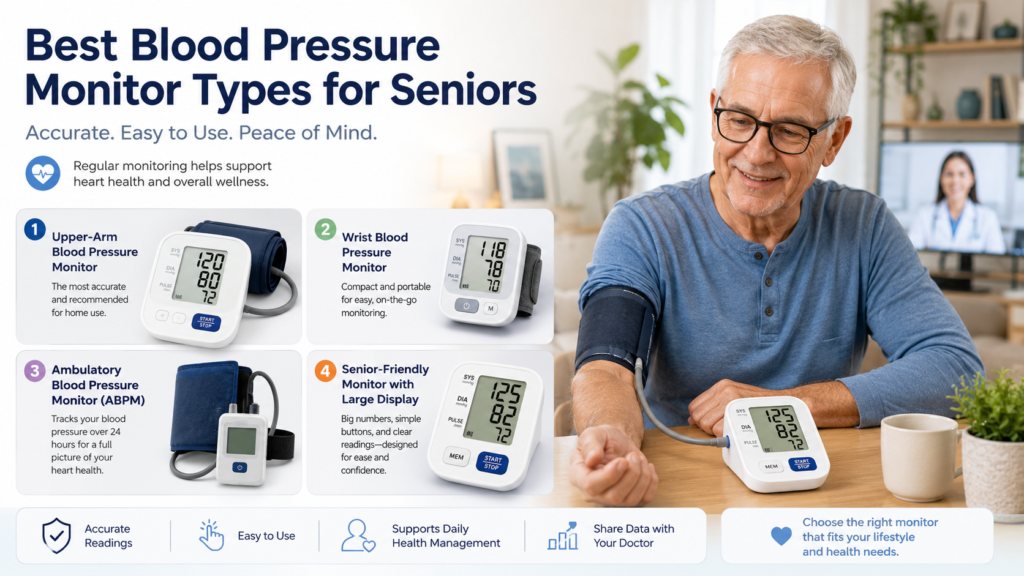
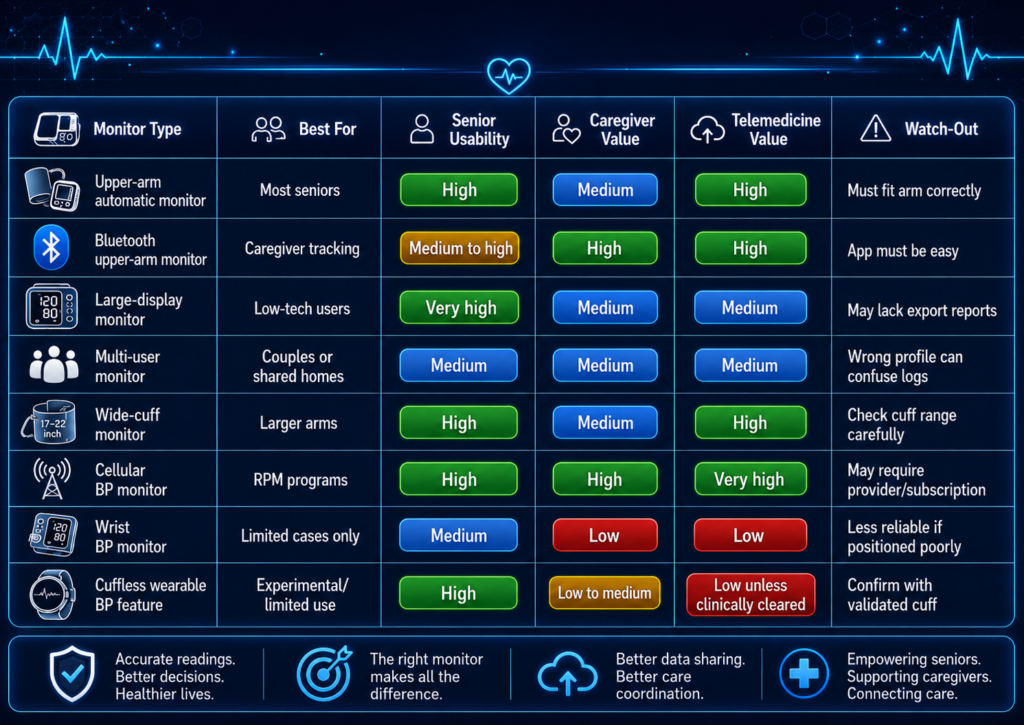
Choosing the best blood pressure monitor type for seniors starts with comfort, accuracy, and ease of daily use. Some older adults need a simple upper-arm monitor with large numbers, while others benefit from Bluetooth syncing, multi-user memory, wide cuffs, or caregiver-friendly reporting features. The right device should make home readings feel less confusing and more consistent, especially when blood pressure is being followed between doctor visits. For a practical routine, see this guide on how to monitor blood pressure at home.
1. Upper Arm Blood Pressure Monitors
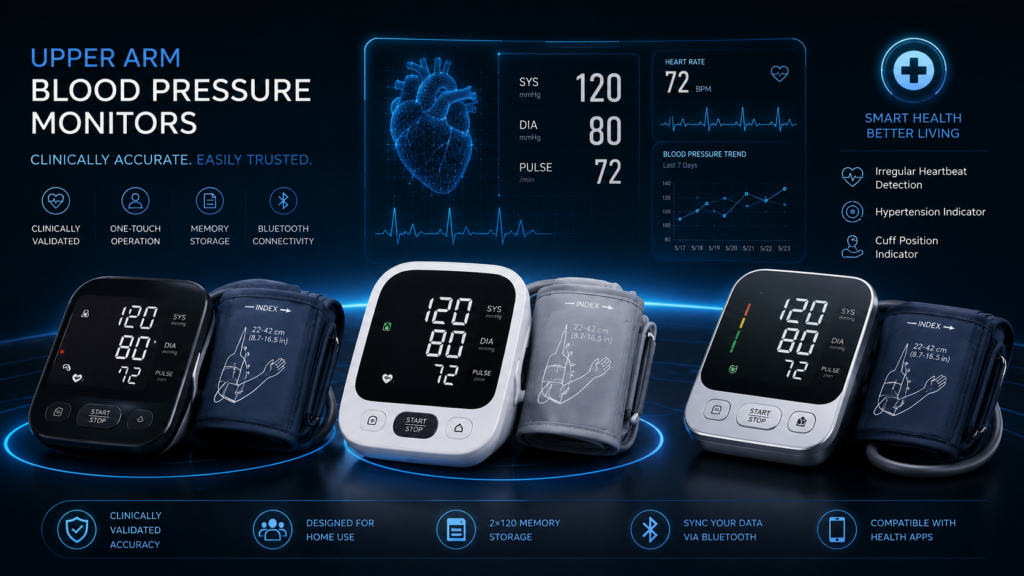
An upper arm blood pressure monitor is the best starting point for most seniors. These devices use a cuff placed around the upper arm and are generally easier to position correctly than wrist monitors.
The American Heart Association advises using a validated monitor and specifically notes that wrist and finger monitors are not recommended because they may give less reliable readings. (www.heart.org)
Best For
- Most older adults.
- Hypertension management.
- Telemedicine follow-up.
- Medication adjustment logs.
- Seniors who can sit at a table and position the arm correctly.
What to Look For
- Validated clinical accuracy.
- Proper cuff size.
- Large display.
- One-button start.
- Memory storage.
- Irregular heartbeat indicator.
- Average reading feature.
- Easy-to-read systolic, diastolic, and pulse display.
Senior Buying Tip
Do not buy based only on brand name. Measure the upper arm first. A monitor with the wrong cuff size can produce misleading readings even if the device itself is well-made.
2. Bluetooth Blood Pressure Monitors for Seniors
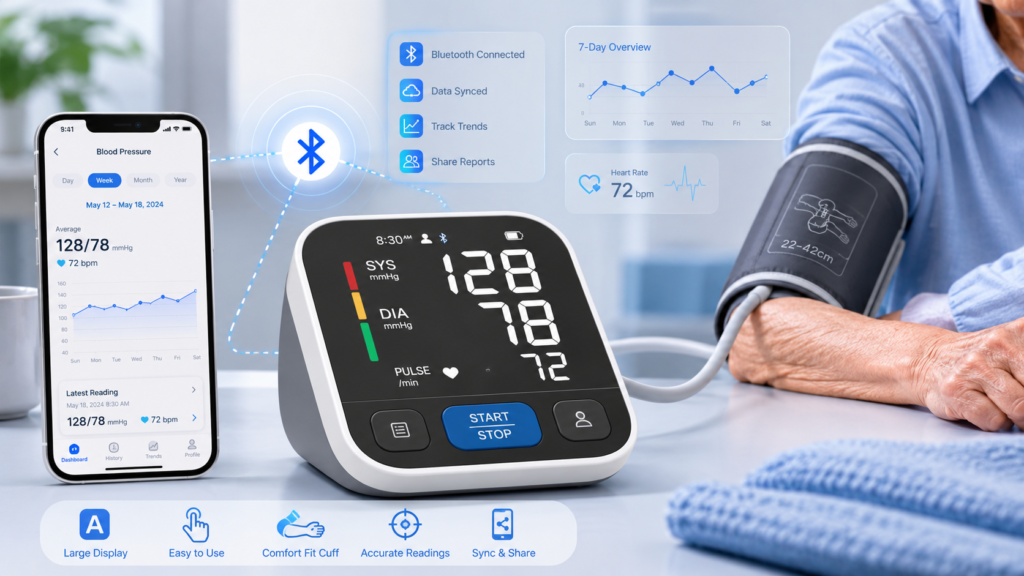
A Bluetooth blood pressure monitor for seniors sends readings to a smartphone or tablet. This can be useful when the senior, caregiver, or clinician wants a clean log rather than handwritten numbers.
Bluetooth is most helpful when it reduces work. It is less useful if the app requires repeated logins, confusing permissions, or frequent re-pairing.
Best For
- Caregiver sharing.
- Telehealth follow-ups.
- Seniors who already use a smartphone or tablet.
- Families tracking readings over weeks.
- Patients who need downloadable reports.
What to Look For
- Automatic syncing.
- Clean app interface.
- Multiple-user support.
- Exportable PDF or CSV reports.
- Caregiver sharing.
- Cloud backup.
- Low-battery alerts.
- No confusing subscription traps.
Editorial Note
Bluetooth should be treated as a convenience layer, not the main reason to buy. Accuracy, cuff fit, and ease of use still come first.
3. Large-Display Blood Pressure Monitors
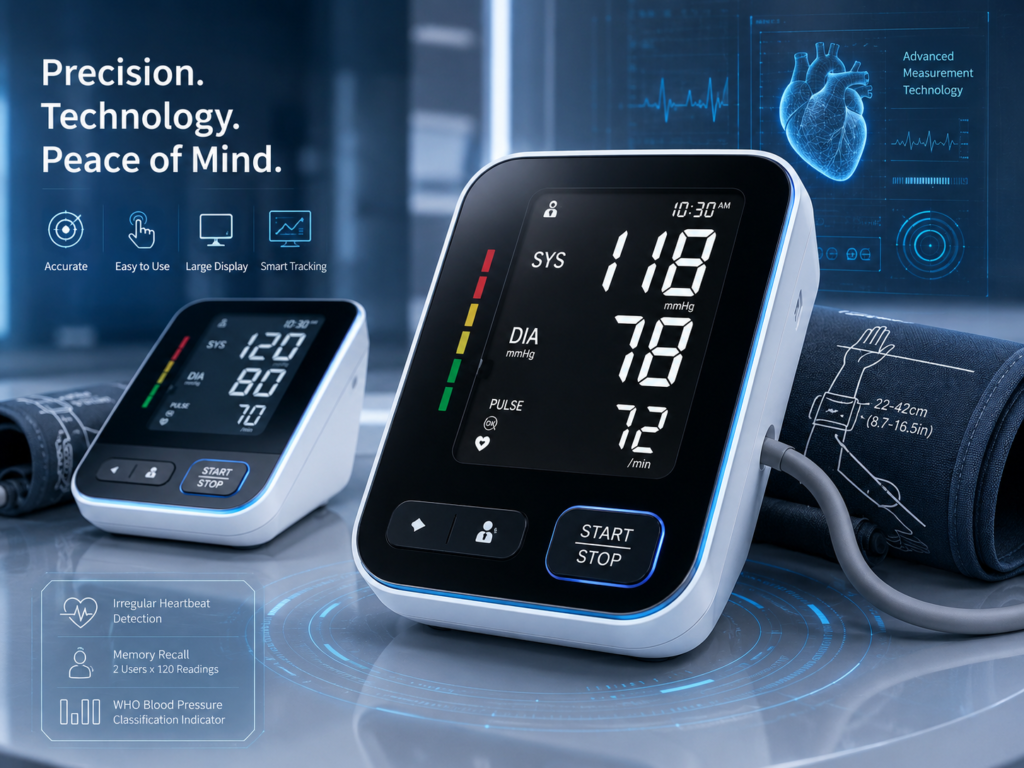
A large-display monitor is often the best choice for seniors who want independence without managing an app.
These monitors usually show large systolic, diastolic, and pulse readings on the device itself. Some also use color-coded indicators, backlit screens, or oversized buttons.
Best For
- Seniors with low vision.
- Seniors who dislike apps.
- Older adults with mild cognitive difficulty.
- Care homes or shared households.
- Simple daily tracking.
What to Look For
- Backlit screen.
- Large numbers.
- Minimal buttons.
- Clear cuff placement label.
- Reading memory.
- Easy battery replacement.
- AC adapter option if available.
Practical Takeaway
For many older adults, a large-display monitor will be used more consistently than a “smarter” monitor with a frustrating app.
4. Multi-User Blood Pressure Monitors
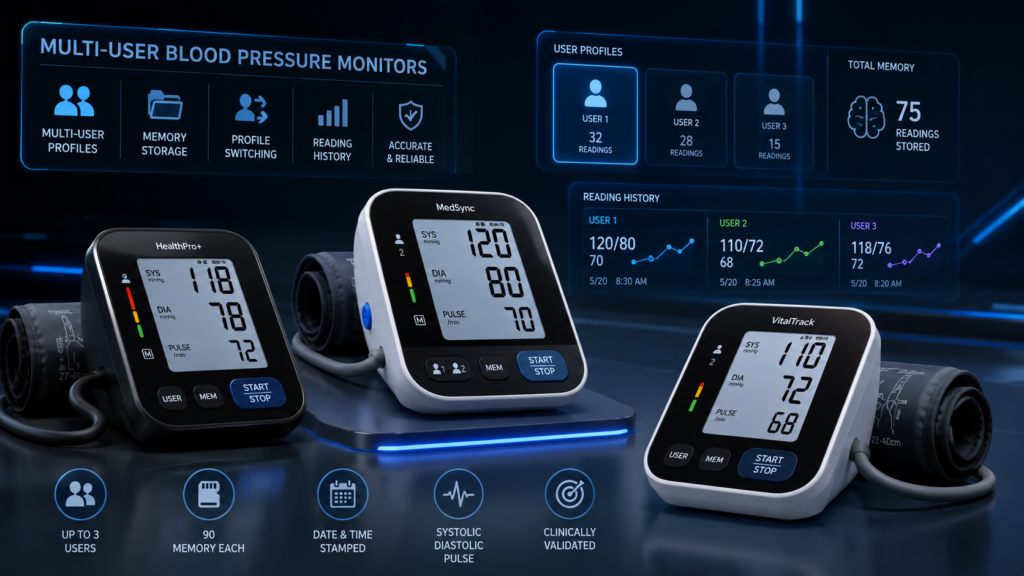
A multi-user monitor stores readings separately for two or more people. This is useful when spouses, siblings, or caregivers share the same device.
Best For
- Couples.
- Senior households.
- Adult children checking their own BP too.
- Multi-generational homes.
- Caregiver-assisted routines.
What to Look For
- Separate user profiles.
- Enough memory per user.
- Easy user switching.
- Clear display of selected profile.
- Optional guest mode.
Risk to Avoid
If the senior forgets to select the correct profile, the log becomes messy. Choose a device with obvious user buttons or app-based profile separation.
5. Wide-Cuff Blood Pressure Monitors
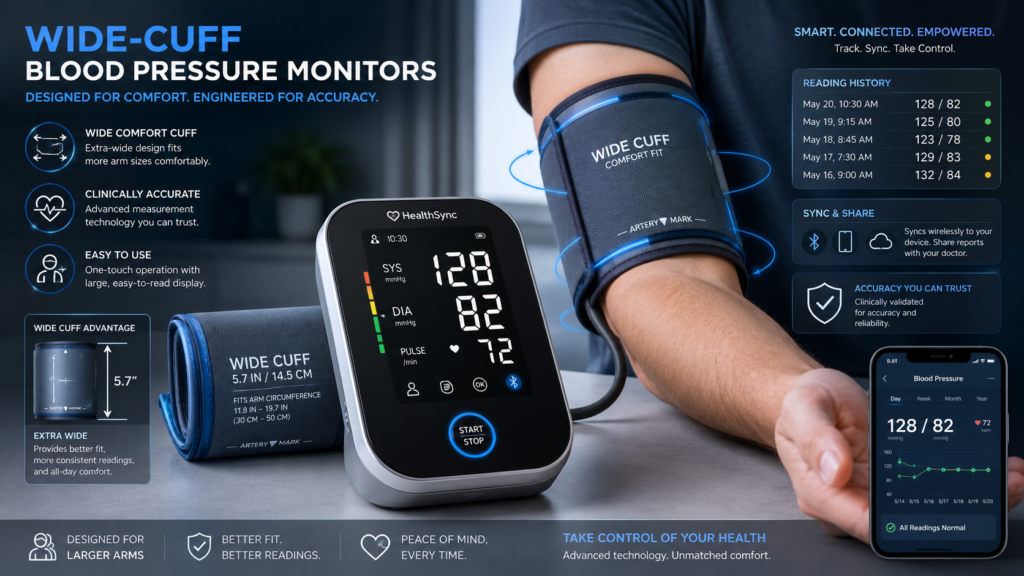
Cuff size is one of the most overlooked issues in home blood pressure monitoring. In 2024, the American Heart Association highlighted research showing that popular home blood pressure monitor cuffs may not properly fit some adults, which can lead to inaccurate readings. (American Heart Association)
Best For
- Seniors with larger arms.
- Seniors with obesity.
- Users who find standard cuffs too tight.
- Caregivers buying for someone without exact measurements.
What to Look For
- Wide-range cuff.
- Clear arm circumference range.
- Replacement cuff availability.
- Comfortable cuff material.
- Easy self-wrapping design.
Senior Buying Tip
Before purchasing, measure the midpoint of the upper arm. Then match that number to the cuff range listed by the manufacturer.
6. Cellular Remote Blood Pressure Monitors
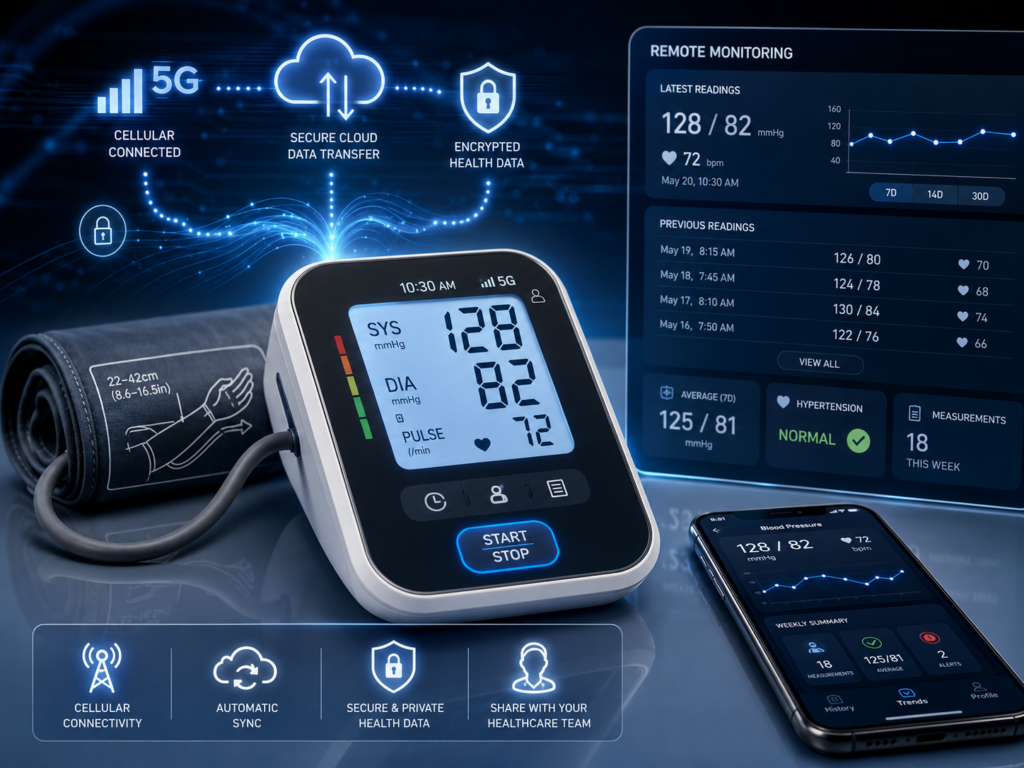
Cellular monitors transmit readings without requiring the senior to pair Bluetooth manually. These are often used in structured remote patient monitoring programs.
CareSimple describes cellular remote BP monitoring as a way to transmit readings through cellular networks without the technical pitfalls of Bluetooth pairing or hub-based systems. (CareSimple)
Best For
- Telehealth programs.
- Seniors without smartphones.
- Patients who struggle with app setup.
- Clinician-supervised remote monitoring.
- High-risk hypertension management.
What to Look For
- Provider compatibility.
- Data plan or subscription details.
- Automatic upload.
- Simple one-button use.
- Care team access.
- Clear privacy policy.
Editorial Note
Cellular BP monitors are excellent when integrated into a care program, but they may be overkill for a senior who only needs a simple home log.
Best Blood Pressure Monitors for Seniors
Best Overall Blood Pressure Monitor for Seniors
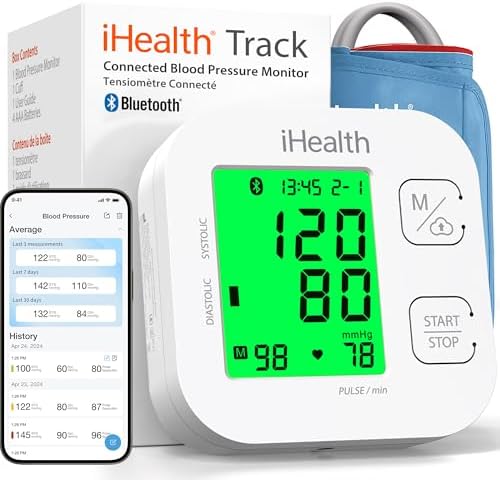
- Clinically Accurate: Easy Operation by two buttons, Advanced Accuracy, No Calibration required.
- Large Multi-Color Backlit Display: The large, oversized numbers make reading the results from this upper arm blood press…
- Easy Management: Manage and track up to 99 readings on your blood pressure monitor and unlimited readings on your smartp…
Best For: Most older adults who need reliable home monitoring.
Recommended Type: Validated upper-arm automatic monitor with large display and comfortable cuff.
Buying Angle: Accuracy first, then ease of use.
Look for a monitor listed on a validation registry such as ValidateBP, which says its device listing is designed to help patients and physicians find blood pressure devices validated for clinical accuracy. (validatebp.org)
Best Bluetooth Blood Pressure Monitor for Seniors
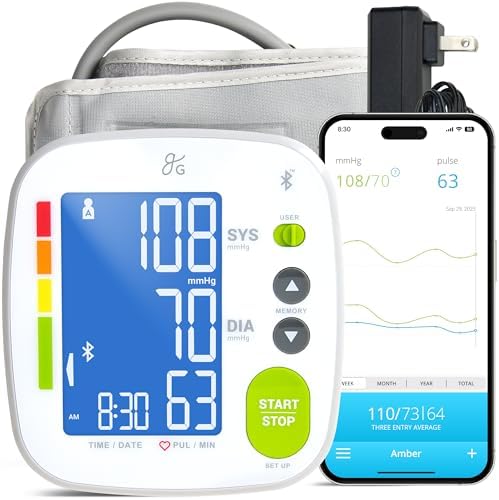
- Wirecutter Top Pick: Recognized five times by The New York Times Wirecutter—including 2026—for its accuracy, consistency…
- Smart App & Memory Tracking: Sync to the Balance Health app on iOS and Android to store unlimited readings, track averag…
- Easy Cuff Placement, Clear Results: The adjustable 8.7–16.5 in (22–42 cm) upper arm cuff features an artery alignment gu…
Best For: Caregiver tracking and telemedicine follow-up.
Recommended Type: Upper-arm Bluetooth monitor with app syncing, reading history, and exportable reports.
Buying Angle: Best for families who want organized readings without manual logs.
Best Large-Display Blood Pressure Monitor for Elderly Users

- 【Accurate Blood Pressure Monitor】: LIVAROCI digital automatic blood pressure monitor xl cuff with 2024 version smart chi…
- 【2 Large Adjustable BP Cuffs】:M/L cuff (9″-17″) and X-large cuffs (13″-21″) are included in the package. Suitable for mo…
- 【Extra Large Led Color Backlit Screen】:This blood pressure monitor is equipped with customized extra large led screen, c…
Best For: Seniors with vision issues, low tech confidence, or mild memory difficulty.
Recommended Type: One-button upper-arm monitor with oversized readings and simple controls.
Buying Angle: Best for independent daily use.
Best Professional Blood Pressure Monitor for Caregivers

- NEW IMPROVED DESIGN & HIGHLY ACCURATE – Ergonomically shaped with back-Lit LCD screen color-coded blood pressure level i…
- SMART MANAGEMENT – Bluetooth connectivity lets you store and track all your readings in the Dario App. Easily share with…
- LARGE MEMORY – Blood pressure meter saves up to 400 memory records with dates and times, and the app has unlimited readi…
Best For: Adult children managing a parent’s BP log.
Recommended Type: Bluetooth or cellular monitor with shared app access, trend reports, and multi-user support.
Buying Angle: Best when the caregiver needs organized readings over time.
Best Budget Blood Pressure Monitor for Seniors
- 【Accurate Blood Pressure Monitor】: LIVAROCI digital automatic blood pressure monitor xl cuff with 2024 version smart chi…
- 【2 Large Adjustable BP Cuffs】:M/L cuff (9″-17″) and X-large cuffs (13″-21″) are included in the package. Suitable for mo…
- 【Extra Large Led Color Backlit Screen】:This blood pressure monitor is equipped with customized extra large led screen, c…
Best For: Seniors who need a dependable monitor without advanced app features.
Recommended Type: Validated upper-arm monitor with memory storage and correct cuff size.
Buying Angle: Avoid paying for features the senior will not use.
AARP’s 2026 testing guidance notes that many people can find simple home monitors with good cuffs in a general range of about $50 to $100, though prices and availability change by retailer. (AARP)
Blood Pressure Monitor Comparison Chart
How to Choose the Best Blood Pressure Monitor for Seniors
Choosing the best blood pressure monitor for seniors is not simply a matter of finding the device with the largest number of features. A home monitor must combine clinically credible measurement technology with the physical usability required by the individual who will operate it.
For one older adult, that may mean a large screen and a single start button. For another, it may mean a preformed cuff that can be applied with one hand. A caregiver supporting a parent remotely may need Bluetooth history, while a structured telemedicine program may require automatic cellular transmission.
The strongest device is therefore the one that satisfies three requirements simultaneously:
- It has been validated for clinical accuracy.
- Its cuff correctly fits the senior’s arm.
- Its operating workflow matches the way readings will actually be taken, recorded and shared.
1. Choose a Validated Blood Pressure Monitor
The first filter should be clinical validation, not price, star ratings or claims such as “hospital grade.”
A validated blood pressure monitor has undergone testing against an accepted measurement protocol. ValidateBP maintains a device listing intended to help individuals and healthcare professionals identify monitors that have been tested for clinical accuracy. Documentation for listed devices is reviewed by an independent committee and must satisfy the program’s established criteria. (Validate BP)
Validation matters because an attractive screen cannot compensate for an unreliable measurement. A monitor that regularly reads too high can create unnecessary concern and potentially contribute to overtreatment. A monitor that reads too low can create false reassurance while hypertension remains uncontrolled.
Before purchasing a home blood pressure monitor, search for the exact model number, not only the brand name. One manufacturer may sell several visually similar monitors, but validation generally applies to a specific device model rather than every product carrying the same logo.
The American Heart Association also advises ensuring that a monitor intended for a senior has been validated for the population in which it will be used. After purchase, it recommends taking the monitor to a medical appointment so the healthcare professional can check the technique and compare its results with office equipment. (www.heart.org)
Validation and FDA Authorization Are Related but Different
Clinical validation and FDA marketing authorization are not identical concepts.
A validation listing indicates that accuracy documentation has satisfied an independent review process. FDA authorization addresses whether a blood pressure device has been evaluated for lawful medical-device marketing in the United States.
For a medical-adjacent purchase, the safest approach is to look for a device that is:
- Appropriate for home blood pressure monitoring
- Listed as validated for clinical accuracy
- FDA-authorized where required
- Sold with a cuff covering the senior’s measured arm circumference
- Recommended or accepted by the senior’s healthcare professional
The FDA advises individuals whose medical care depends on accurate blood pressure measurements to discuss an appropriate authorized device with their healthcare provider. (U.S. Food and Drug Administration)
2. Prefer an Automatic Upper-Arm Blood Pressure Monitor
For most older adults, an automatic upper-arm blood pressure monitor is the strongest default choice.
The American Heart Association recommends an automatic, cuff-style monitor that measures at the upper arm. It does not generally recommend wrist or finger devices because their readings are less reliable. (www.heart.org)
Upper-arm monitors measure over the brachial artery and are usually easier to position consistently. Once the cuff is applied correctly, the senior can rest the arm on a table and allow the device to inflate automatically.
Wrist monitors are compact and may appear easier to use, but they introduce an additional positioning requirement: the wrist must remain at heart level throughout the reading. A wrist that is held too high, too low or at an incorrect angle can affect the result.
A wrist monitor may still be considered when an upper-arm cuff cannot be used comfortably or properly because of arm size, limited mobility, pain, surgery or another physical restriction. In that situation, the device should be selected with professional guidance, and the senior should receive clear positioning instructions.
Finger blood pressure monitors should not be confused with fingertip pulse oximeters. A pulse oximeter measures oxygen saturation and pulse; it does not provide a conventional cuff-based blood pressure measurement.
3. Measure the Upper Arm Before Purchasing the Monitor
The best home blood pressure monitor can still produce misleading readings when its cuff does not fit.
Measure the circumference of the bare upper arm with a flexible measuring tape and compare the result with the manufacturer’s published cuff range. Do not assume that a cuff described as “universal” will fit every senior.
A cuff that is too small can bias the reading upward, while a cuff that is too large can bias it downward. Research highlighted by the American Heart Association has shown that incorrect cuff sizing can produce clinically meaningful errors and may contribute to misclassification of blood pressure status. (www.heart.org)
This issue is especially important for:
- Seniors with very slender arms
- Individuals with larger upper arms
- People who have lost substantial weight
- Seniors with swelling or changing arm circumference
- Households planning to share one monitor
- Individuals purchasing a replacement cuff from another seller
The cuff range should be checked in centimeters or inches rather than relying only on labels such as small, standard, large or extra-large.
Cuff-Fit Buying Check
| Question | What to confirm before ordering |
|---|---|
| What is the upper-arm circumference? | Measure the bare arm with a flexible tape |
| Does the included cuff cover that measurement? | Check the exact minimum and maximum range |
| Is another cuff size available? | Confirm compatibility with the exact monitor model |
| Will two people share the device? | Both individuals must fit within the supported range |
| Can the senior apply the cuff independently? | Consider a preformed or wide-range cuff |
| Is the cuff painful at full inflation? | Discuss persistent discomfort with a healthcare professional |
4. Match the Device to the Senior’s Vision, Dexterity and Mobility
Specifications rarely capture how a monitor feels in daily use.
An older adult with arthritis may struggle to pull a soft cuff tightly around the upper arm. A person with tremor may find a small power button difficult to press. Someone with reduced vision may confuse the systolic result with the diastolic result when both appear in small numerals.
For independent use, prioritize:
- A large, high-contrast display
- Clearly labeled systolic, diastolic and pulse values
- A large start button
- Minimal menu navigation
- A cuff that can be applied with one hand
- A visible cuff-position guide
- Automatic shut-off
- A stable tabletop base
- Easy battery replacement
- An optional AC adapter if the monitor will remain in one location
A voice-reading function may help some individuals with low vision, although it may be undesirable in a shared living environment. The device should therefore allow audio to be turned off.
A monitor with many advanced controls may look more capable, but every extra menu adds another opportunity for confusion. For a senior who measures alone each morning, a reliable one-button monitor may be more useful than an app-dependent model with several profiles and settings.
5. Decide Whether Internal Memory Is Enough
A blood pressure reading becomes more useful when it can be reviewed as part of a pattern.
At minimum, a digital blood pressure monitor for elderly home use should retain enough readings to show changes over several days. Date and time stamps are important because a list of unlabeled numbers cannot reveal whether a reading was taken before medication, after activity or at a different time of day.
Look for:
- Automatic date and time stamping
- Storage for at least several weeks of readings
- Separate profiles for two users
- A guest mode that does not mix temporary readings into the main history
- Morning and evening averages
- An easy way to scroll through previous results
- A clear indication of which user profile is active
The American Heart Association recommends taking multiple readings and recording the results. It notes that some monitors provide internal memory or allow readings to be uploaded for review. (www.heart.org)
Internal memory is usually sufficient when the senior attends appointments in person and can take the device or a written record along.
6. Choose Bluetooth When It Solves a Real Caregiving Problem
A Bluetooth blood pressure monitor for seniors can automatically send readings to a smartphone application. This may be valuable when an adult child, home nurse or clinician needs an organized history.
Bluetooth is most useful when it reduces work. It can prevent mistakes caused by manually copying values and can organize morning, evening and medication-related readings into a more readable timeline.
Before selecting a Bluetooth model, examine the complete workflow:
| Connectivity question | Why it matters |
|---|---|
| Does the monitor work without the app? | The senior should still be able to see a reading when the phone is unavailable |
| Is pairing required every time? | Repeated reconnection can discourage routine use |
| Can reports be exported? | PDF or CSV reports may simplify telemedicine review |
| Are separate users supported? | Shared household readings should not be mixed |
| Is a subscription required? | Some features may be restricted after purchase |
| Can a caregiver access the history remotely? | Local Bluetooth syncing alone may not provide remote access |
| Is the app compatible with the senior’s phone? | Operating-system support can change |
| Can readings be corrected or annotated? | Context such as medication timing may be important |
| What information is stored online? | Health-data privacy should be reviewed before connecting |
Bluetooth and remote monitoring are not the same thing. Bluetooth usually transfers information to a nearby phone. A remote caregiver will only see the readings if the application supports account sharing, cloud synchronization or report export.
7. Consider Cellular Transmission for Structured Telemedicine Care
A cellular blood pressure monitor sends data through a built-in mobile connection rather than depending on the senior’s phone or home Wi-Fi.
This can be useful in formal remote patient monitoring programs because the individual generally needs to apply the cuff and press the start button; the result is transmitted in the background.
Cellular capability is most valuable when:
- A healthcare organization supplies or supports the monitor
- The senior does not use a smartphone
- Bluetooth pairing would create a barrier
- Readings must enter a clinical dashboard automatically
- A designated team is responsible for reviewing the information
- The program provides technical assistance
Cellular transmission should not be purchased solely because it sounds more advanced. A connected reading has limited value unless someone is responsible for reviewing it and acting when necessary.
8. Treat Averaging Features as More Useful Than Decorative Scores
A single blood pressure reading is a snapshot. A series taken under consistent conditions provides more useful information about direction and control.
A monitor that automatically averages two or three readings may therefore be more practical than one that produces a proprietary “vascular age,” wellness score or animated risk gauge.
Useful measurement features include:
- Automatic two- or three-reading mode
- Morning and evening averages
- Detection of excessive movement during measurement
- A cuff-wrap indicator
- Date- and time-based history
- A clear pulse display
- A visible error message when the reading fails
These features support better measurement behavior. They should not be confused with diagnosis. A warning symbol or irregular-pulse icon is a reason to review the reading or discuss a repeated pattern with a healthcare professional, not proof of a specific heart condition.
9. Avoid Unauthorized Smartwatch and Smart-Ring Blood Pressure Claims
Cuffless blood pressure technology is developing quickly, but convenience should not be mistaken for proven clinical reliability.
In September 2025, the FDA warned against unauthorized devices and software features—including some smartwatch and smart-ring functions—that claim to measure or estimate blood pressure. The agency stated that the safety and effectiveness of unauthorized products had not been reviewed and that inaccurate measurements could delay treatment, trigger unnecessary intervention or contribute to inappropriate medication changes. (U.S. Food and Drug Administration)
The American Heart Association has likewise stated that cuffless devices may offer convenience, but stronger accuracy and clinical-outcome evidence is still needed to interpret the large amount of data they generate. (AHA Journals)
A wearable may provide a reminder to perform a conventional measurement. It should not replace a validated upper-arm monitor when readings are being used to:
- Evaluate hypertension control
- Guide a telemedicine appointment
- Assess a medication change
- Decide whether to contact a clinician
- Respond to symptoms
- Support treatment decisions
10. Bring the Monitor to a Medical Appointment
A home monitor should not remain completely separate from clinical care.
The American Heart Association recommends taking a newly purchased monitor to an appointment so a healthcare professional can check the senior’s technique and compare its readings with office equipment. It also advises bringing the device back approximately once a year, or according to the manufacturer’s directions, to confirm continued reliability. (www.heart.org)
This appointment can identify errors that product instructions may not reveal, such as:
- Placing the cuff too low
- Applying the cuff over clothing
- Using the wrong arm
- Allowing the arm to hang
- Crossing the legs
- Talking during inflation
- Selecting the wrong user profile
- Recording the first unstable result
- Using a cuff outside its supported range
The clinician can also specify which arm to use and when readings should be taken relative to medication.
11. Evaluate the Complete Cost, Not Only the Monitor Price
The purchase price may not reflect the long-term cost of a home blood pressure monitor.
Before ordering, check whether the device requires:
- A separately purchased larger cuff
- A proprietary AC adapter
- Regular battery replacement
- A paid app subscription
- Cloud-storage fees
- Cellular service
- Replacement cuffs that are difficult to obtain
Also review the return policy. A monitor may be technically appropriate but unsuitable if the senior cannot apply the cuff independently or read the display comfortably.
Best Blood Pressure Monitor Features by Senior Use Case
| Senior-care situation | Most useful monitor configuration |
|---|---|
| Simple independent morning checks | Validated upper-arm monitor with one-button operation |
| Low vision | Large high-contrast display or optional voice output |
| Arthritis or reduced hand strength | Preformed cuff and large start button |
| Two-person household | Dual-user memory with separate profiles |
| Recent medication change | Date-stamped memory and automatic averaging |
| Remote family caregiver | Bluetooth syncing with exportable reports |
| No smartphone or Wi-Fi | Standalone monitor or program-supported cellular model |
| Formal telemedicine monitoring | Automatic transmission to a clinician dashboard |
| Very small or large upper arm | Device with a separately validated compatible cuff |
| Frequent travel | Compact upper-arm monitor with protective case |
| Anxiety about single readings | Automatic multi-reading average |
| Concern about wearable claims | Validated cuff-based upper-arm monitor |
How Seniors Should Use a Home Blood Pressure Monitor
Even the best home blood pressure monitor cannot compensate for inconsistent technique. Blood pressure changes with activity, posture, stress, caffeine, smoking and the conditions under which the reading is taken. The purpose of a home routine is therefore not to capture the lowest possible result. It is to create measurements that can be compared fairly over time.
The CDC describes home measurement as self-measured blood pressure monitoring and recommends combining it with support from the healthcare team. It advises taking measurements at consistent times and obtaining at least two readings separated by one or two minutes. (CDC)
Before the Reading
Follow the Prescribed Schedule
Measure at the times recommended by the clinician. Many monitoring plans use morning and evening readings, but the appropriate schedule depends on the reason for monitoring.
A senior starting a new medication may receive different instructions from a person whose hypertension has been stable for years.
Whenever possible, take readings under similar conditions each day. A resting morning measurement should not be directly compared with one taken immediately after walking upstairs unless the difference in circumstances is recorded.
Avoid Temporary Influences
The American Heart Association advises avoiding smoking, caffeinated drinks and exercise during the 30 minutes before a blood pressure measurement. Its home-measurement instructions also advise avoiding alcohol during that period. (www.heart.org)
The senior should use the bathroom before sitting down. A full bladder can interfere with obtaining a representative resting measurement.
Rest Quietly for at Least Five Minutes
Sit in the measurement chair before applying or starting the monitor. Use this period to let breathing, pulse and circulation settle after walking or household activity.
Do not use the five-minute rest period to answer messages, discuss a stressful issue or speak on the phone. The American Heart Association recommends at least five minutes of quiet rest without talking or phone use. (www.heart.org)
Prepare the Arm
Remove clothing from the upper arm. Do not place the cuff over a shirt, sweater or rolled-up sleeve that tightly constricts the arm.
Use the arm selected by the healthcare professional. Once an arm has been designated for routine monitoring, using the same arm improves comparability between readings.
Correct Sitting Position
The chair and table are part of the measurement system.
The senior should sit:
- With the back supported
- With both feet flat on the floor
- With the legs uncrossed
- With the arm resting on a table
- With the middle of the cuff at heart level
- With the hand open and relaxed
The cuff should be snug against bare skin, with its lower edge positioned according to the manufacturer’s instructions above the elbow bend. The CDC and American Heart Association both emphasize supported posture, flat feet, an uncrossed seated position, a bare upper arm and arm support at heart or chest height. (CDC)
If the table is too low, use a folded towel or pillow beneath the forearm. Do not actively hold the arm in the air; the muscles should remain relaxed.
During the Reading
Press the start button and allow the monitor to complete its inflation and deflation cycle.
During this time:
- Do not talk.
- Do not text or use the phone.
- Do not move the hand or arm.
- Do not cross or reposition the legs.
- Keep the back supported.
- Allow the cuff to deflate fully before removing it.
Talking, moving or supporting the arm incorrectly can distort the result. The CDC specifically advises against talking and recommends resting the cuffed arm on a table at chest height. (CDC)
Take Two Readings, Not Repeated Readings Until One Looks Better
The American Heart Association recommends taking two measurements approximately one minute apart and recording both. (www.heart.org)
A practical routine is:
- Take the first reading.
- Remain seated and quiet.
- Wait one minute.
- Take the second reading.
- Record both results or the monitor-generated average.
Do not continue measuring repeatedly until a preferred number appears. That practice produces a selective log rather than a representative record.
When the clinician requests three readings, follow that specific protocol.
After the Reading
Record enough information to make the result interpretable.
A useful home blood pressure log includes:
| Information to record | Example |
|---|---|
| Date | August 2 |
| Time | 8:10 a.m. |
| Systolic pressure | 136 mm Hg |
| Diastolic pressure | 78 mm Hg |
| Pulse rate | 72 BPM |
| Reading number | First or second |
| Medication timing | Before morning dose |
| Body position | Seated |
| Symptoms | Mild dizziness on standing |
| Relevant context | Poor sleep, no caffeine |
| Repeat result | 132/76 after one minute |
Symptoms worth noting include dizziness, weakness, headache, chest discomfort, shortness of breath, visual changes or unusual fatigue.
A Bluetooth monitor may save the numerical values automatically, but symptoms and medication context often still need to be entered manually.
Review Trends Rather Than Isolated Fluctuations
Blood pressure naturally varies. A single result may be affected by movement, stress, pain, recent activity or incorrect positioning.
The more useful questions are:
- Is the weekly average increasing?
- Are morning readings consistently higher?
- Did values change after a medication adjustment?
- Are unusually low readings associated with dizziness?
- Is one arm producing consistently different results?
- Are elevated results appearing under correct resting conditions?
The American Heart Association describes one measurement as a snapshot and notes that a record collected over time provides a more complete picture of whether treatment is working. (www.heart.org)
What to Do When a Reading Looks Wrong
| Problem | Practical response |
|---|---|
| Error message | Recheck cuff placement, tubing and battery power |
| Reading changes dramatically | Rest quietly and repeat after one minute |
| Cuff repeatedly slips | Confirm size and wrap direction |
| Result is unexpectedly high | Remain seated, check technique and take the scheduled repeat |
| Result is unexpectedly low | Repeat correctly and consider symptoms and the usual baseline |
| Bluetooth result does not sync | Keep the on-device result and enter it manually later |
| Two household users are mixed | Correct the user profile before the next measurement |
| Cuff becomes painful | Stop the cycle if needed and check fit before retrying |
| Values remain inconsistent | Take the monitor to a healthcare appointment for comparison |
Do Not Change Medication Based on a Single Home Reading
Home monitoring helps a clinician evaluate treatment, but it does not replace medical oversight.
The American Heart Association specifically advises not stopping blood pressure medication without consulting the healthcare professional, regardless of home readings. (www.heart.org)
The same principle applies to changing the dose, skipping a dose or taking an extra tablet. Unless the senior has a written clinician-directed plan for a particular situation, medication decisions should not be based on one reading.
When a High Blood Pressure Reading Requires Urgent Action
A single higher-than-usual result is generally repeated after the senior remains seated and confirms that technique was correct.
The American Heart Association advises that when blood pressure is suddenly above 180/120 mm Hg, the person should wait at least one minute and measure again. When the second reading remains that high, the healthcare professional should be contacted immediately. (www.heart.org)
A reading above 180/120 mm Hg accompanied by symptoms such as chest pain, shortness of breath, back pain, numbness, weakness, visual change or difficulty speaking may represent a hypertensive emergency. Emergency services should be contacted immediately—911 in the United States—and the person should not wait at home to see whether the reading falls. (www.heart.org)
Severe symptoms can require emergency evaluation even when the monitor does not display an extreme number. A home device should never delay help when the senior appears acutely unwell.
Senior Home Blood Pressure Measurement Checklist
| Stage | Correct action |
|---|---|
| 30 minutes before | Avoid smoking, caffeine, alcohol and exercise |
| Before sitting | Empty the bladder and uncover the upper arm |
| Rest period | Sit quietly for at least five minutes |
| Posture | Back supported, feet flat and legs uncrossed |
| Arm position | Arm relaxed and supported at heart level |
| Cuff | Correct size, snug and placed on bare skin |
| Measurement | Remain still and do not talk |
| Repeat | Take a second reading after one minute |
| Documentation | Record BP, pulse, date, time, medication context and symptoms |
| Follow-up | Share sustained changes or symptomatic readings with the care team |
| Medication | Do not change treatment independently |
| Emergency | Seek immediate help for severe readings accompanied by concerning symptoms |
Best Blood Pressure Monitor Features for Elderly Users
| Feature | Why It Matters for Seniors |
|---|---|
| Large display | Easier reading for low vision |
| One-button operation | Reduces confusion |
| Comfortable cuff | Improves adherence |
| Wide cuff range | Prevents sizing errors |
| Memory storage | Helps track patterns |
| Irregular heartbeat indicator | Flags possible rhythm irregularity for discussion |
| Bluetooth syncing | Helps caregivers and telehealth teams review logs |
| Average reading feature | Reduces overreaction to one reading |
| AC adapter option | Useful for seniors who forget batteries |
| Carry case | Helpful for travel and appointments |
Costs: How Much Should Seniors Spend?
Blood pressure monitor pricing depends on validation, cuff quality, Bluetooth features, app design, display size, memory, and whether the device is part of a remote monitoring program.
| Price Tier | What to Expect | Best For |
|---|---|---|
| Budget | Basic upper-arm monitor, simple memory, no app | Seniors needing simple daily tracking |
| Mid-range | Better cuff, larger display, multi-user memory | Most households |
| Premium | Bluetooth app, trend reports, advanced averaging | Caregiver tracking and telemedicine |
| Clinical/RPM | Cellular transmission, provider dashboard | High-risk patients in structured care programs |
For most families, the best value is usually a validated upper-arm monitor with the right cuff size and easy display. Paying more makes sense when Bluetooth sharing, app reports, or cellular upload will actually be used.
Risks and Limitations
Incorrect Cuff Size
Cuff fit is one of the biggest causes of bad readings. Always match the cuff to arm circumference.
Poor Positioning
A wrist monitor below heart level, an unsupported arm, crossed legs, or talking during measurement can distort readings.
Overchecking
Some seniors become anxious and check repeatedly. This can make blood pressure rise further. A clinician should help define how often to measure.
Ignoring Symptoms
A normal reading does not rule out medical trouble. Chest pain, severe shortness of breath, fainting, confusion, weakness on one side, or severe headache requires urgent medical attention.
Treating Wearable Estimates Like Medical Readings
A smartwatch notification or cuffless estimate should not replace a validated blood pressure cuff unless specifically cleared and clinically appropriate for that use.
Trends & Latest Tech in Blood Pressure Monitoring
Bluetooth BP Syncing for Caregivers
Bluetooth monitors are becoming more useful because families want shared data. A senior can take readings at home while an adult child reviews trends remotely.
Cellular BP Monitors for Remote Patient Monitoring
Cellular monitors reduce setup friction by sending readings without smartphone pairing. This matters for older adults who struggle with apps.
Better Cuff Design
Wide-range cuffs, easier wrapping, and clearer placement markings are becoming more important as manufacturers respond to real-world fit issues.
App-Based Trend Reports
Newer monitors increasingly focus on trends, averages, and exportable reports rather than isolated numbers.
Cuffless BP Research and Wearable Alerts
Cuffless blood pressure technology is developing quickly, but buyers should remain cautious. The FDA’s 2025 warning about unauthorized BP measurement claims shows why validated devices still matter. (U.S. Food and Drug Administration)
Upcoming Models and Future Direction
Senior-First BP Monitors
Expect more devices designed around aging hands, larger displays, voice prompts, easier cuff wrapping, and caregiver-first interfaces.
Integrated Telemedicine Dashboards
The next step is not only better BP measurement. It is better BP interpretation. Future systems will combine readings with medication logs, symptoms, weight, sleep, and activity.
Automatic Clinical Escalation
Remote monitoring systems may increasingly flag patterns for care teams, such as repeated morning hypertension, sudden drops, or missed readings.
Smarter Cuff Detection
Future monitors may better detect cuff fit, arm position, movement, and measurement error before saving the reading.
More Validation Transparency
As consumers become more aware of accuracy issues, validation registries such as ValidateBP and STRIDE BP will likely become more important in buying decisions. STRIDE BP describes preferred home devices as upper-arm cuff devices with approved validation studies and either automated storage or connectivity for data transfer. (Stride BP)
FAQ: Best Blood Pressure Monitors for Seniors
What is the best blood pressure monitor for seniors with large arms?
The best blood pressure monitor for seniors with large arms is usually a validated upper-arm monitor that includes a wide-range cuff or offers a compatible large cuff. The cuff should match the user’s measured upper-arm circumference. A monitor can be accurate in general but still give poor readings if the cuff does not fit. Before buying, measure the midpoint of the upper arm and compare it with the cuff range listed by the manufacturer.
Is a Bluetooth blood pressure monitor worth it for elderly parents?
A Bluetooth blood pressure monitor is worth it when readings need to be shared with a caregiver, stored automatically, or reviewed during telemedicine visits. It may not be necessary for a senior who dislikes apps or only needs a simple paper log. The best Bluetooth monitor for elderly parents should sync automatically, show readings clearly on the device, and allow easy caregiver access without complicated setup.
Are wrist blood pressure monitors accurate for seniors?
Wrist blood pressure monitors can be accurate only when used very carefully, but they are more sensitive to positioning errors. The wrist must be held at heart level, and movement can affect results. For most seniors, an upper-arm blood pressure monitor is the safer choice because it is generally more reliable for routine home use. Wrist monitors may be considered only when an upper-arm cuff is not practical.
How often should seniors check blood pressure at home?
The right schedule depends on the senior’s diagnosis, medication plan, and clinician advice. Many older adults check once or twice daily during medication changes, then less often once readings stabilize. Some may check several days per week. The important point is consistency: same time of day, same posture, same arm, and proper technique. Seniors should not change medication based only on home readings unless their clinician has given clear instructions.
What features should caregivers look for in a blood pressure monitor for elderly parents?
Caregivers should look for a validated upper-arm monitor, correct cuff size, large display, memory storage, easy operation, irregular heartbeat indicator, and Bluetooth or report-sharing features if remote tracking is needed. A good caregiver-friendly monitor should make readings easy to review over time. The goal is not to collect more numbers, but to identify useful patterns that can be shared with a healthcare professional.
People Also Ask: Home Blood Pressure Monitors for Elderly Care
Which is better for seniors, upper arm or wrist blood pressure monitor?
An upper-arm blood pressure monitor is better for most seniors because it is generally easier to use correctly and less sensitive to positioning errors. Wrist monitors require the wrist to be held exactly at heart level, which can be difficult for older adults with tremor, arthritis, weakness, or memory issues. A validated upper-arm monitor with the right cuff size should be the default choice for home blood pressure tracking.
Do blood pressure monitors need to be FDA approved?
Blood pressure monitors intended for medical use are regulated medical devices, but consumers will often see terms such as FDA-cleared, validated, clinically tested, or approved used inconsistently. For home use, the practical buying step is to choose a validated monitor from a reliable registry or reputable manufacturer and avoid unauthorized devices that claim to measure BP without proper review. Validation matters because inaccurate readings can affect medical decisions.
Can a smartwatch replace a blood pressure monitor?
A smartwatch should not replace a validated blood pressure monitor for seniors unless the specific feature is clinically appropriate, cleared for that purpose, and confirmed by a healthcare professional. Some watches may detect hypertension patterns or provide alerts, but they usually do not function like a traditional cuff. A smartwatch can be a useful signal to check blood pressure properly, but a validated cuff remains the better tool for home BP logs.
What is the easiest blood pressure monitor for seniors to use?
The easiest blood pressure monitor for seniors is usually a one-button upper-arm monitor with a large display, clear cuff markings, memory storage, and minimal app dependency. For seniors with low vision, choose a backlit display and large numbers. For seniors with dexterity issues, choose a cuff that is easy to wrap and secure. Simplicity is often more important than advanced features.
How do I know if my home blood pressure monitor is accurate?
You can improve confidence by choosing a validated monitor, using the correct cuff size, following proper measurement technique, and bringing the monitor to a medical appointment to compare readings with a clinic device. If readings vary widely, the cause may be poor cuff placement, wrong cuff size, movement, talking, anxiety, low battery, or device error. Accuracy depends on both the monitor and how it is used.
Editorial Perspective: The Best Monitor Is the One That Produces Trustworthy Patterns
The best blood pressure monitor for seniors is not always the most advanced model. It is the monitor that produces reliable readings, fits the arm properly, is easy to use, and supports the care routine already in place.
For an independent senior, that may be a large-display upper-arm cuff. For a caregiver-supported parent, it may be a Bluetooth monitor with shared reports. For a high-risk patient in a telemedicine program, it may be a cellular remote BP monitor connected directly to a care team.
In geriatric telemedicine, the real value is not the number on the screen. It is the pattern over time, the confidence it gives caregivers, and the better conversation it creates between home and clinician.