Glucose Monitoring for Seniors: Best Devices, CGM Options, Costs, Risks & Telemedicine Support
Amazon Affiliate Disclosure
TeleGeriatric.com may earn a commission from qualifying purchases made through product links on this page. This does not increase your cost. Our goal is to help families compare glucose monitoring tools, remote care options, and senior-friendly diabetes technology more confidently.
Updated July, 2026.
Why Glucose Monitoring for Seniors Is No Longer Just a Diabetes Task
Glucose monitoring for seniors has moved far beyond the old routine of pricking a finger, writing a number in a notebook, and waiting until the next clinic visit to discuss it. For older adults, blood sugar is not just a diabetes metric. It is tied to falls, confusion, dehydration, poor sleep, medication timing, appetite changes, infection risk, wound healing, and emergency hospital visits.
A younger adult may feel an early low blood sugar episode as shakiness, sweating, or hunger. A senior may only appear tired, irritable, dizzy, weak, or unusually confused. In someone living alone, those signs can be missed. In someone with memory decline, the problem can repeat for days before anyone notices. That is why home glucose monitoring has become one of the most important parts of remote patient monitoring for elderly care.
Modern glucose tools now fit directly into geriatric telemedicine workflows. A basic blood glucose meter gives single readings. A continuous glucose monitor, often called a CGM, shows patterns throughout the day and night. Some systems alert caregivers when glucose drops too low or rises too high. Others integrate with smartphones, remote dashboards, or clinician platforms, helping families and providers act earlier instead of reacting after a crisis.
This page belongs to the Remote Patient Monitoring section of our website. For families building a broader home-care system, glucose tracking works best when paired with blood pressure monitoring at home, oxygen saturation monitoring and weight and fluid tracking for heart failure patients.
Current diabetes standards recognize glucose monitoring, including blood glucose meters and CGMs, as a way for people with diabetes to understand therapy response and assess whether glycemic goals are being met. Continuous glucose monitoring is also now specifically supported in older adults with diabetes, especially where insulin use or hypoglycemia risk makes real-time data clinically valuable. (Diabetes Journals)
Quick Picks: Jump to the Section You Need
| Visitor Concern | Best Section |
|---|---|
| “Which glucose monitor is easiest for my parent?” | Best Glucose Monitor for Seniors |
| “Should we buy a CGM or finger stick meter?” | CGM vs Finger Stick Glucose Meter for Seniors |
| “What if my father lives alone?” | Caregiver Alerts and Remote Glucose Monitoring |
| “How much does glucose monitoring cost?” | Costs of Glucose Monitoring for Seniors |
| “Is Medicare likely to cover a CGM?” | Insurance, Medicare, and Prescription Access |
| “What are the risks of glucose monitoring?” | Risks, Accuracy Problems, and Safety Mistakes |
| “Which readings matter most?” | How Seniors and Caregivers Should Interpret Glucose Data |
| “What new technology is coming?” | Trends, Latest Tech and Upcoming Models |
| “How does this connect with telemedicine?” | Glucose Monitoring Inside a Geriatric Telemedicine Plan |
What This Guide Is For
This guide is written for families, caregivers, older adults, home health teams, and geriatric care coordinators who need a practical, clinically aware way to choose and use glucose monitoring at home.
It explains:
- how glucose monitoring works in older adults
- when a simple blood sugar meter is enough
- when a continuous glucose monitor may be safer
- how caregiver alerts help prevent missed lows
- what costs families should expect
- what risks to watch for
- how glucose monitoring fits into telemedicine and remote patient monitoring
- which device features matter most for seniors with vision, dexterity, memory, or mobility limitations
This is not a substitute for medical advice. Glucose targets, medication changes, insulin doses, and hypoglycemia plans should always be individualized by a licensed clinician.
Who Needs Glucose Monitoring at Home?
Glucose monitoring at home is most relevant for seniors who have diabetes, prediabetes with rising risk, unexplained dizziness after meals, medication-related glucose swings, or a history of low blood sugar. Combined with Telemedicine for Seniors remote logging helps providers track these trends effectively. It is especially important when an older adult takes insulin, sulfonylureas, or multiple diabetes medications, because these can increase the risk of hypoglycemia.
A senior may need structured blood sugar monitoring if they have:
- Type 1 diabetes
- Type 2 diabetes treated with insulin
- Type 2 diabetes with repeated low glucose episodes
- Diabetes plus chronic kidney disease
- Diabetes plus dementia or cognitive decline
- Diabetes plus falls, dizziness, or fainting episodes
- Irregular eating patterns
- Poor appetite or unintended weight loss
- Recent hospitalization or medication changes
- A caregiver who needs remote visibility
- A history of emergency visits related to glucose instability
Older adults with diabetes are not one uniform group. A physically active 68-year-old and a frail 87-year-old with memory decline may need very different monitoring plans. In Geriatric Care, the best glucose monitor is not always the most advanced device. It is the device the senior can actually use correctly, consistently, and safely.
Benefits of Glucose Monitoring for Seniors
Better Detection of Low Blood Sugar
Low blood sugar can be more dangerous than high blood sugar in the short term, especially in older adults. Hypoglycemia can cause confusion, weakness, sweating, shakiness, poor coordination, blurred vision, falls, seizures, or loss of consciousness.
In seniors, the warning signs may be subtle. Some older adults develop hypoglycemia unawareness, meaning they do not feel symptoms until glucose is already dangerously low. A continuous glucose monitor can help by showing trends and sending alerts before the situation becomes urgent.
Medicare’s public coverage information states that CGMs may be covered for people with diabetes when ordered by a clinician if the person uses insulin or has a history of hypoglycemia problems, and the user or caregiver has been trained to use the device. (Medicare)
Safer Medication Decisions
Many diabetes medications are adjusted based on patterns, not isolated readings. A single high number after dinner may look alarming, but a clinician needs context: Was the meal high in carbohydrates? Was medication missed? Was there an infection? Did glucose fall overnight afterward?
Glucose monitoring helps clinicians see whether a treatment plan is too weak, too aggressive, or poorly timed. This is where telemedicine becomes powerful. Instead of bringing a paper log to an appointment once every few months, the patient or caregiver can share readings during a virtual visit through TeleGeriatric-style remote care workflows.
Fewer Emergency Surprises
For families, the most frightening diabetes events are often the ones that appear sudden: a parent found confused in the morning, a fall after skipping lunch, a hospitalization after days of uncontrolled glucose during infection.
Remote glucose monitoring can reveal early warning patterns. Repeated overnight lows, large post-meal spikes, or morning glucose that stays elevated for days may signal that the care plan needs attention.
More Independence for Older Adults
The goal of glucose monitoring is not to turn seniors into full-time patients. The goal is to help them live with more confidence. A well-chosen device can reduce guesswork, reassure caregivers, and support safer daily routines.
For a senior living alone, a glucose alert shared with a daughter or caregiver can provide a safety net. For a senior in assisted living, structured readings can improve communication between family, facility staff, and clinicians.
Better Telemedicine Visits
A remote diabetes visit is only as useful as the data behind it. Glucose readings help clinicians answer practical questions:
- Are morning readings consistently high?
- Is glucose dropping after lunch?
- Are overnight lows happening?
- Did a medication change help or cause instability?
- Is a caregiver seeing the same pattern at home?
- Is the patient’s diet, hydration, or activity affecting readings?
That is why glucose monitoring is one of the strongest entry points into remote monitoring in elderly care.
Best Glucose Monitor for Seniors: What Actually Matters
The best glucose monitor for seniors is not simply the newest model. It should match the senior’s physical ability, cognitive status, treatment plan, caregiver support, and comfort with technology.
Senior-Friendly Features to Prioritize
| Feature | Why It Matters for Older Adults |
|---|---|
| Large display | Easier for seniors with reduced vision |
| Simple strip insertion | Helpful for arthritis or hand tremor |
| Small blood sample requirement | Reduces frustration and repeated finger sticks |
| Backlit screen | Useful at night or in low light |
| Audio prompts | Helpful for visual impairment |
| Memory storage | Allows caregivers to review past readings |
| Bluetooth syncing | Useful for telemedicine and caregiver tracking |
| Low/high alerts | Important for seniors at risk of hypoglycemia |
| Easy app interface | Prevents abandonment of connected devices |
| Caregiver sharing | Essential for seniors living alone |
| Affordable supplies | Long-term cost matters more than device price |
A senior-friendly monitor should reduce friction. If every test feels like a small battle, the device will end up in a drawer.
Types of Glucose Monitoring for Seniors
1. Traditional Finger Stick Blood Glucose Meters
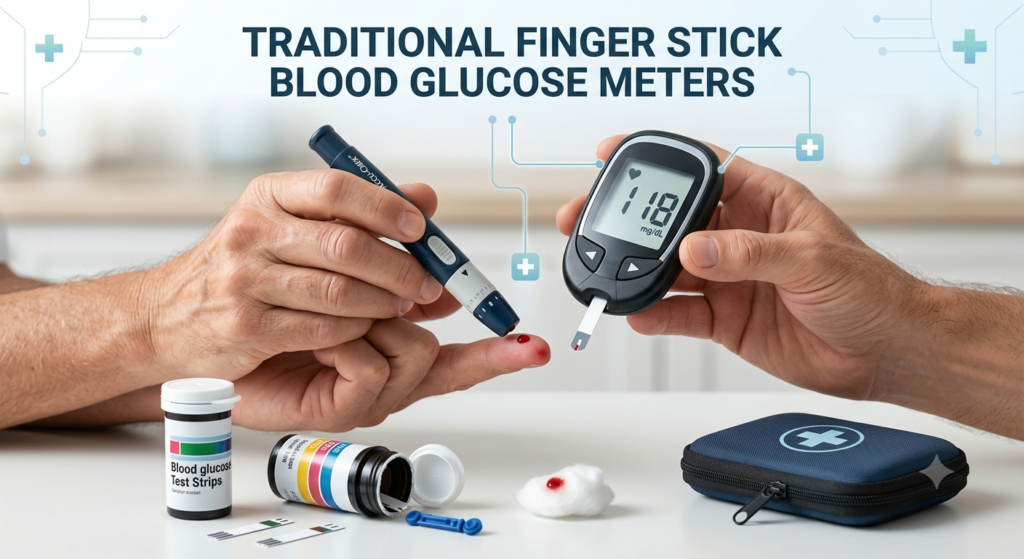
A finger stick glucose meter measures blood glucose at one moment in time. The user pricks a finger with a lancet, places a drop of blood on a test strip, and inserts the strip into a meter.
Best For
Traditional meters are often best for seniors who:
- check glucose once or twice daily
- do not need real-time alerts
- are not at high risk of sudden lows
- prefer simple, familiar tools
- need an affordable option
- do not use smartphones
- want backup testing for a CGM
Advantages
Finger stick meters are widely available, inexpensive compared with CGMs, and familiar to many older adults. They are useful for fasting readings, pre-meal checks, post-meal checks, and confirming symptoms.
Limitations
A meter only shows one reading at one moment. It does not show what happened overnight. It does not warn the caregiver during a low. It does not reveal whether glucose is rising quickly or falling sharply.
For older adults with unstable glucose, insulin use, cognitive decline, or repeated lows, a meter may not provide enough visibility.
2. Continuous Glucose Monitor for Elderly Patients
A continuous glucose monitor for elderly patients uses a small sensor worn on the skin, usually on the back of the upper arm or abdomen depending on the device. It measures glucose in interstitial fluid and sends readings to a receiver or smartphone.
A CGM can show current glucose, trend direction, time in range, overnight patterns, and alerts for high or low glucose. This is particularly useful for older adults whose symptoms are subtle or delayed.
Best For
A CGM may be appropriate for seniors who:
- use insulin
- have a history of hypoglycemia
- live alone
- have overnight lows
- have glucose swings after meals
- have memory issues and need caregiver support
- need remote monitoring by family or clinicians
- have repeated hospital or emergency visits related to diabetes
The American Diabetes Association’s 2026 older-adult standards state that CGM devices have been shown to improve glycemic management and are acceptable to people across age groups, with particular relevance for older adults on insulin therapy. (Diabetes Journals)
Advantages
CGMs can reduce the blind spots that come with occasional finger stick testing. They may show that glucose drops at 3 a.m., spikes after breakfast, or stays elevated after dinner. These patterns are often more clinically useful than isolated readings.
Limitations
CGMs cost more than standard meters, require sensor replacement, may need smartphone compatibility, and can create alarm fatigue if alerts are poorly configured. Some seniors also need help applying sensors or interpreting trend arrows.
Mayo Clinic’s glucose meter guidance notes that CGMs send readings to a smartphone, smartwatch, or receiver and can alert users to high or low glucose, but they are more expensive and require sensor replacement every 10 to 15 days depending on the brand. (Mayo Clinic)
3. Over-the-Counter CGM Devices
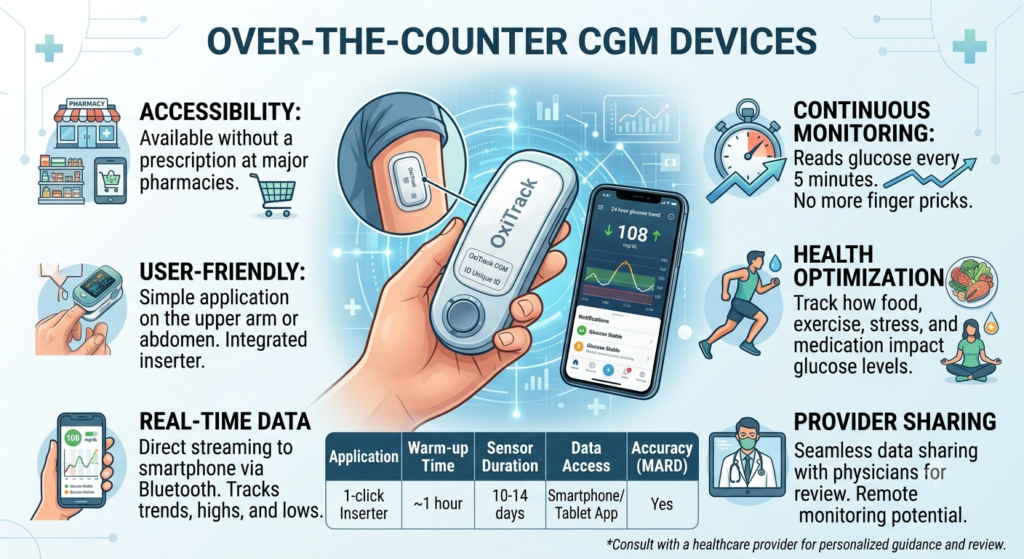
Over-the-counter CGMs are a newer category. They are designed for adults who do not use insulin and want more insight into glucose patterns. The FDA cleared Dexcom Stelo as the first over-the-counter integrated CGM for adults 18 and older who do not use insulin, including people with diabetes treated with oral medications and people without diabetes who want to understand glucose responses to food and activity. It is not intended for people with problematic hypoglycemia. (U.S. Food and Drug Administration)
Abbott’s Lingo is another over-the-counter biosensor positioned for everyday glucose insights and habit tracking, with glucose data shown through an app. (Hello Lingo)
Best For
OTC glucose biosensors may be useful for:
- seniors with prediabetes
- older adults with diet-related glucose concerns
- people not using insulin
- family members who want lifestyle feedback
- seniors who want to understand meals, walking, sleep, and glucose response
Not Best For
OTC CGMs are not ideal for seniors who need insulin dosing decisions, emergency hypoglycemia alerts, or clinician-managed diabetes treatment unless the device is specifically appropriate for that medical use and approved by the clinician.
4. Remote Patient Monitoring Glucose Systems
Some glucose devices connect to clinical RPM platforms. These systems may send readings to a provider dashboard, flag abnormal patterns, or combine glucose data with blood pressure, oxygen saturation, weight, and medication adherence.
This is where glucose monitoring becomes part of a broader geriatric telemedicine model instead of a standalone gadget.
Best For
Remote glucose monitoring is especially useful for:
- seniors with multiple chronic conditions
- patients recently discharged from hospital
- older adults with caregiver involvement
- assisted living or home health settings
- high-risk diabetes patients
- seniors with both diabetes and heart failure
- medication review programs
- geriatric care management
For more advanced setups, families can also explore Advanced RPM Systems.
CGM vs Finger Stick Glucose Meter for Seniors
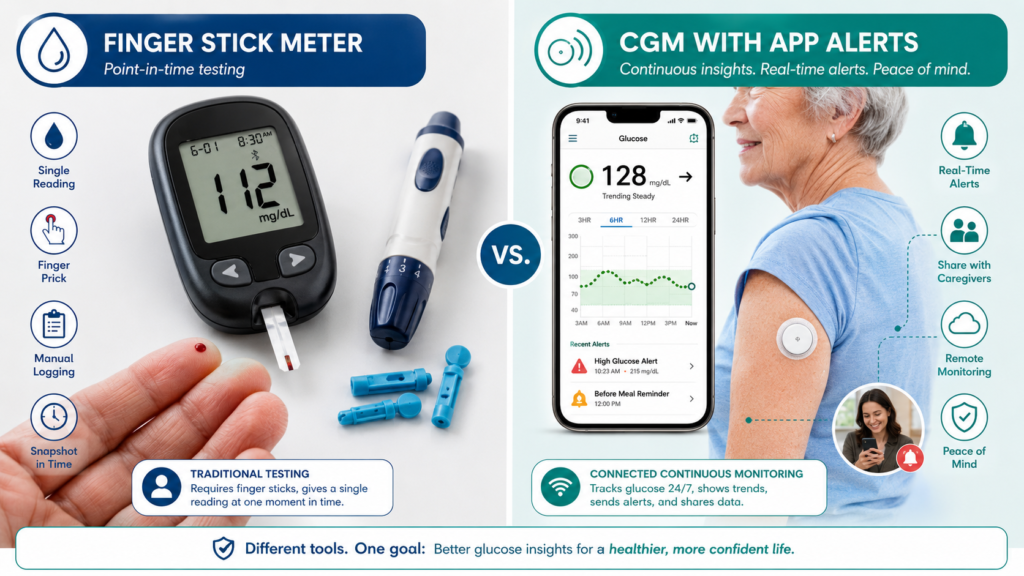
The CGM vs finger stick glucose meter for seniors decision should be based on risk, not fashion. A standard meter may be enough for a stable senior who checks occasionally. A CGM may be safer for someone with insulin use, overnight lows, erratic meals, or caregiver monitoring needs.
| Comparison Point | Finger Stick Glucose Meter | Continuous Glucose Monitor |
|---|---|---|
| Reading style | Single point-in-time reading | Ongoing glucose trend |
| Finger pricks | Required for each test | Usually fewer, but sometimes needed for confirmation |
| Overnight data | Usually missed | Captures nighttime patterns |
| Low glucose alerts | Usually no | Yes, depending on device |
| Caregiver sharing | Limited unless manually shared | Often available through apps |
| Cost | Lower upfront and ongoing | Higher ongoing sensor cost |
| Ease for tech-averse seniors | Often easier | May require app/receiver setup |
| Best use case | Stable diabetes, occasional checks | Insulin use, hypoglycemia risk, remote monitoring |
| Telemedicine value | Useful if logged consistently | Stronger pattern-based clinical data |
| Backup role | Primary device or CGM backup | Primary trend device |
Editorial Insight
A finger stick meter tells you what glucose is right now. A CGM tells you where glucose has been, where it is heading, and whether danger may be developing. For geriatric care, that difference matters most when symptoms are unreliable.
Glucose Monitoring Options for Seniors
| Monitoring Option | Best For | Senior-Friendly Strength | Main Weakness | Approximate Cost Pattern |
|---|---|---|---|---|
| Basic glucose meter | Stable diabetes, occasional checks | Simple and familiar | No automatic alerts | Low device cost, ongoing strip cost |
| Bluetooth glucose meter | Seniors with caregiver help | Syncs readings to app | App setup may confuse some users | Low to moderate |
| CGM with receiver | Seniors who do not use smartphones | Real-time trends without phone dependence | Sensor changes required | Moderate to high ongoing cost |
| CGM with smartphone app | Seniors with caregiver sharing needs | Alerts and remote visibility | Requires compatible phone/app comfort | Moderate to high ongoing cost |
| OTC CGM biosensor | Lifestyle glucose insight, non-insulin users | No prescription in some cases | Not for insulin dosing or serious hypoglycemia management | Subscription or sensor-based cost |
| Clinical RPM glucose system | High-risk seniors in remote care programs | Provider/caregiver dashboard | Requires care-team setup | Varies by program/coverage |
How Seniors and Caregivers Should Interpret Glucose Data
Glucose monitoring is not about chasing perfect numbers all day. In older adults, interpretation must be careful. Overcorrecting can be dangerous, especially when multiple medications are involved.
Look for Patterns, Not Panic Readings
One high reading after dessert is different from repeated morning highs for two weeks. One low reading after skipping lunch is different from repeated overnight lows. Caregivers should track context:
- meal timing
- medication timing
- missed meals
- infection symptoms
- dehydration
- steroid use
- exercise or unusual activity
- poor sleep
- alcohol intake
- weight change
- recent medication changes
Pay Special Attention to Overnight Lows
Overnight hypoglycemia is easy to miss. A senior may wake up sweaty, confused, weak, or with a headache and never connect it to glucose. CGMs are valuable because they can show nighttime patterns that finger stick testing usually misses.
Watch Post-Meal Spikes
Post-meal glucose spikes may reflect meal composition, timing, medication mismatch, or reduced insulin sensitivity. For seniors, the goal is not to eliminate all rise after meals. The goal is to identify repeated patterns that may need dietary adjustment, walking after meals, medication review, or clinician guidance.
If glucose levels rise after meals or drop when appetite is poor, families may need to review diet quality, protein distribution, hydration and supplement safety through our geronutrition guide.
Use Glucose Data During Telemedicine Visits
Families should prepare a short glucose summary before a virtual visit:
- average morning readings
- lowest readings and timing
- highest readings and timing
- repeated patterns
- symptoms during abnormal readings
- missed meals or skipped medications
- caregiver concerns
- device problems
This makes the appointment more useful and helps the clinician avoid decisions based on scattered numbers.
Glucose Monitoring Inside a Geriatric Telemedicine Plan
Glucose monitoring becomes more powerful when it is connected to a care pathway. A reading alone is information. A reading connected to a plan becomes prevention.
A strong geriatric telemedicine plan may include:
- Device selection based on dexterity, vision, cognition, insulin use, and caregiver involvement.
- Training for the senior and caregiver.
- Target range review by a clinician.
- Low-glucose action plan written in plain language.
- Escalation rules for when to call the doctor, caregiver, or emergency services.
- Medication review to reduce avoidable hypoglycemia.
- Monthly or quarterly virtual reviews using glucose patterns.
- Integration with other home readings, such as blood pressure, oxygen saturation, and weight.
For seniors with complex chronic disease, this model can sit inside a broader remote patient monitoring program and link naturally to AI-based elderly monitoring systems when families need predictive alerts or multi-device dashboards.
Caregiver Alerts and Remote Glucose Monitoring
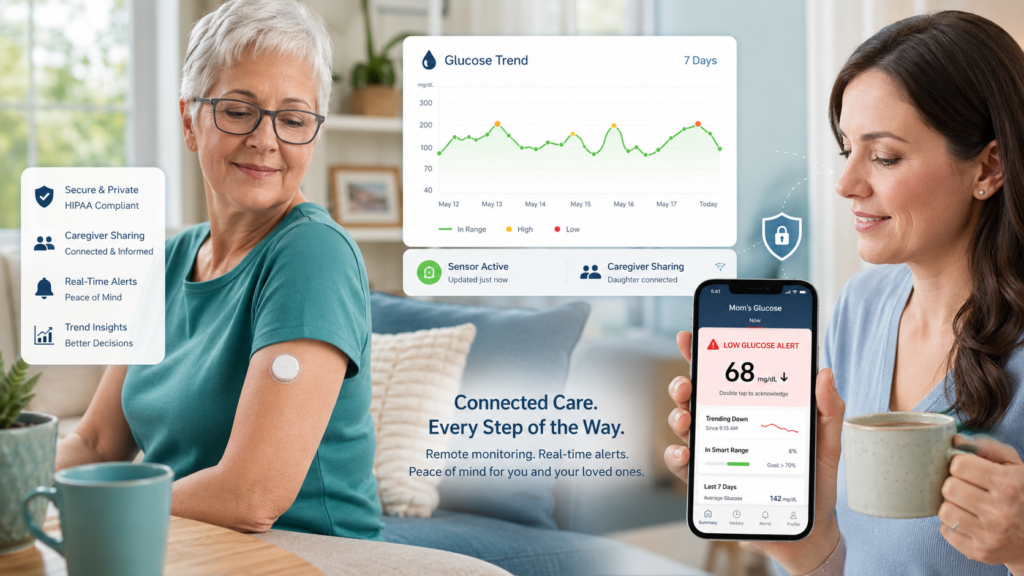
Caregiver sharing is one of the strongest reasons to consider a connected glucose monitor for an older adult. Many seniors do not want constant supervision, but families still need a way to know when a serious glucose event may be developing.
When Caregiver Alerts Are Especially Useful
Caregiver alerts are valuable when a senior:
- lives alone
- has memory decline
- forgets meals or medication
- has had falls
- uses insulin
- has nighttime lows
- has poor symptom awareness
- lives far from adult children
- has repeated emergency visits
- receives part-time home care
What Alerts Should Cover
A good remote glucose monitoring plan should define:
- low glucose alert threshold
- urgent low threshold
- high glucose alert threshold
- who receives alerts
- who responds first
- what action to take
- when to call emergency services
- when to contact the clinician
Without this plan, alerts can become noise. With a plan, alerts can become a safety system.
Costs of Glucose Monitoring for Seniors
The cost of glucose monitoring for seniors depends on the device type, insurance coverage, prescription status, supply needs, and whether remote monitoring is included.
Typical Costs
| Cost Item | Applies To | Notes |
|---|---|---|
| Meter purchase | Finger stick meters | Often low cost; sometimes bundled with starter supplies |
| Test strips | Finger stick meters | Ongoing cost; brand-specific |
| Lancets | Finger stick meters | Low cost but recurring |
| Control solution | Some meters | Used to check meter/test strip performance |
| CGM reader | Some CGMs | Needed if no compatible smartphone is used |
| CGM sensors | CGMs | Replaced every 10–15 days depending on device |
| CGM transmitter | Some CGMs | Some systems integrate transmitter into sensor |
| App subscription | Some wellness platforms | May apply to lifestyle programs |
| RPM service fee | Clinical monitoring programs | Varies by provider and coverage |
| Caregiver setup help | Optional | May be needed for older adults with tech barriers |
Cost Strategy for Families
A low-cost meter may be enough if diabetes is stable and the senior can test reliably. A CGM may cost more, but can be worth considering when the cost of missed lows, falls, ER visits, or caregiver anxiety is high.
In geriatric care, value should be judged by safety, usability, and clinical relevance — not only device price.
Insurance, Medicare and Prescription Access
Coverage rules can change, and families should confirm eligibility with the clinician, supplier, and insurance plan before buying.
Medicare states that CGMs and related supplies may be covered for people with diabetes when ordered by a doctor or other provider if the person uses insulin or has a history of hypoglycemia problems and the patient or caregiver has received training. (Medicare)
The American Diabetes Association explains that Medicare coverage expanded so people with diabetes treated with any insulin may qualify, and people who do not take insulin may qualify if they have a history of problematic hypoglycemia. (American Diabetes Association)
Practical Coverage Checklist
Before choosing a CGM, families should ask:
- Does the senior have a documented diabetes diagnosis?
- Is insulin being used?
- Is there a history of hypoglycemia?
- Has the clinician documented medical necessity?
- Is the device covered under pharmacy or durable medical equipment benefits?
- Does the plan require prior authorization?
- Which suppliers are in network?
- Are sensors affordable after coverage?
- Is a receiver covered if the senior does not use a smartphone?
Risks, Accuracy Problems and Safety Mistakes
Glucose monitoring improves visibility, but it can also create risk if misunderstood.
Risk 1: Treating a Sensor Reading Without Context
CGMs measure interstitial glucose, not direct blood glucose. During rapid changes, sensor glucose may lag behind blood glucose. If symptoms do not match the device reading, users may need a finger stick confirmation depending on device instructions and clinician guidance.
Risk 2: Alarm Fatigue
Too many alerts can cause seniors and caregivers to ignore alarms. Alert thresholds should be individualized. A frail older adult may need a different safety strategy than a younger adult aiming for tighter glycemic control.
Risk 3: Skin Irritation
CGM adhesives can irritate older skin, especially in seniors with fragile skin, allergies, poor circulation, or frequent sensor changes. Families should watch for redness, itching, blistering, bleeding, or skin breakdown.
Risk 4: Device Recall or Sensor Accuracy Issues
Glucose devices are medical tools, and families should pay attention to manufacturer notices and FDA safety updates. In late 2025, reports described a correction involving certain FreeStyle Libre 3 and Libre 3 Plus sensors due to possible inaccurate low readings; the issue was linked to serious adverse events and users were advised to check affected sensor serial numbers and discontinue affected sensors. (AP News)
Risk 5: Overcorrecting Highs and Lows
Repeatedly eating sugar for borderline lows or taking extra medication for highs without clinician guidance can cause dangerous swings. Seniors need a written action plan.
Risk 6: Unapproved “No-Needle” Watch Claims
Families should be cautious about smartwatches or rings that claim to measure glucose without a sensor inserted under the skin. The FDA has warned against using unauthorized smartwatches or smart rings for glucose measurement because inaccurate readings can lead to harmful treatment decisions. (Verywell Health)
Trends and Latest Technology in Glucose Monitoring for Seniors
Glucose monitoring is entering a new phase. The most important trend is not smaller sensors alone; it is the shift from isolated readings to connected decision support.
1. Wider Use of CGM in Older Adults
CGM use is expanding beyond younger Type 1 diabetes populations. Older adults with Type 2 diabetes on insulin are increasingly recognized as candidates because hypoglycemia prevention and treatment-burden reduction matter deeply in geriatric care. (AAFP)
2. Over-the-Counter Glucose Biosensors
OTC glucose biosensors are making glucose pattern tracking available to adults who do not use insulin. These tools are not replacements for clinician-managed diabetes devices, but they are changing consumer awareness around meals, walking, sleep, and glucose response. (U.S. Food and Drug Administration)
3. Caregiver Data Sharing
For seniors, caregiver sharing may be more important than the app’s design. Families want to know: Did glucose drop overnight? Did Dad scan the sensor? Did Mom’s readings stay high during an infection? The next wave of senior-focused glucose monitoring will compete on caregiver clarity.
4. Integration With Wearables
Some wellness platforms are beginning to combine glucose trends with sleep, activity, meals, and recovery data. Oura, for example, introduced glucose-related features through Dexcom Stelo integration for metabolic health tracking in the U.S. (The Verge)
5. Smarter Telemedicine Dashboards
The future is not just “more readings.” It is fewer, clearer signals: repeated lows, rising fasting glucose, missed sensor activity, post-meal spikes, and abnormal patterns combined with other vital signs.
Upcoming Models and Where the Category Is Heading
The next generation of glucose monitoring for seniors will likely develop in five directions:
Longer Sensor Wear
Sensor replacement is a barrier for older adults with arthritis, tremor, or caregiver dependence. Longer wear times reduce handling, cost friction, and training burden.
Better Receiver Options
Not every senior wants a smartphone-based system. More senior-friendly receivers with large fonts, loud alerts, simple buttons, and caregiver setup modes would make CGM easier for older adults.
Simpler Caregiver Enrollment
Remote sharing should not require a long app maze. The best future systems will let families add caregivers with clear permission controls and simple alert settings.
Multi-Condition Monitoring
Diabetes rarely travels alone in older adults. Future platforms will combine glucose with blood pressure, oxygen saturation, weight, activity, sleep, medication adherence, and fall-risk signals.
Clinician-Filtered Alerts
Doctors do not need every reading. They need clinically meaningful patterns. Upcoming RPM dashboards will likely focus on risk signals rather than raw data overload.
Choosing a Glucose Monitoring Setup by Senior Profile
Find the Best Glucose Monitoring Approach for a Senior
Choose the profile that best matches the older adult’s situation. The tool will suggest a practical glucose monitoring option, explain why it fits, and show what caregivers should consider before buying a device.
This selector is for educational guidance only. Glucose targets, insulin decisions, hypoglycemia treatment, and medication changes should always be discussed with a licensed clinician.
Basic or Bluetooth meter
Affordable and usually sufficient for stable Type 2 diabetes when the senior does not use insulin and does not have frequent low-glucose episodes.
Practical Home Setup: What Families Should Prepare
A glucose monitoring station should be simple and consistent.
For Finger Stick Testing
Keep these in one place:
- glucose meter
- test strips
- lancets
- lancing device
- alcohol wipes if advised
- sharps container
- logbook or app
- reading glasses
- written instructions
- clinician contact information
- hypoglycemia action plan
For CGM Use
Prepare:
- sensors
- receiver or compatible phone
- charger
- app login details
- caregiver sharing setup
- adhesive patches if needed
- skin barrier supplies if approved
- backup glucose meter
- low-glucose treatment supplies
- manufacturer support contact
- serial number tracking for safety notices
Home glucose monitoring should be simple, just like learning How to monitor blood pressure at home, mastering your routine with the right equipment makes all the difference. A home setup should feel like a daily routine, not a medical project.
Best Product Categories to Consider
This section can support commercial intent without turning the article into a thin product list.
1. Best Glucose Monitor for Seniors With Large Display
Look for a meter with a bright screen, large numbers, simple strip insertion, and minimal button steps. This is ideal for seniors who do not need CGM-level data but want a reliable home testing device.
2. Best Bluetooth Glucose Monitor for Seniors and Caregivers
A Bluetooth meter can sync readings into an app. This helps adult children, caregivers, or telemedicine providers review patterns without relying on handwritten logs.
3. Best Continuous Glucose Monitor for Elderly Patients on Insulin
For seniors on insulin, a CGM can help detect highs, lows, and overnight patterns. The clinician should help choose the device based on coverage, alerts, smartphone use, and caregiver needs.
4. Best CGM Receiver Setup for Seniors Without Smartphones
Some older adults do better with a dedicated receiver than a phone app. A receiver can reduce confusion and make readings easier to access.
5. Best OTC Glucose Sensor for Lifestyle Tracking
For older adults not using insulin, an OTC biosensor may help identify how meals, walking, sleep, and timing affect glucose. It should not replace medical advice for diabetes treatment.
Clinical Decision Framework: Meter, CGM, or Remote Monitoring?
| Decision Question | Choose Meter | Choose CGM | Choose RPM-Integrated Monitoring |
|---|---|---|---|
| Does the senior use insulin? | Sometimes | Often | Often if high risk |
| Are there repeated lows? | Limited value | Strong fit | Strong fit |
| Does the senior live alone? | Possible | Better | Best if clinically supported |
| Is the senior tech-comfortable? | Easy | Depends | Needs setup support |
| Is caregiver visibility needed? | Limited | Strong | Strongest |
| Are costs a major barrier? | Best | Higher | Varies |
| Is telemedicine involved? | Useful | Very useful | Designed for it |
| Is dementia present? | May be hard | Useful if caregiver manages | Useful if care team involved |
When to Call a Clinician
Families should ask the clinician for personalized thresholds, but urgent communication may be needed when:
- low glucose episodes repeat
- severe low glucose symptoms occur
- glucose remains high despite medication
- the senior becomes confused, weak, or unusually sleepy
- readings change after new medication
- infection symptoms appear
- the device reading does not match symptoms
- the senior cannot eat or drink normally
- sensor problems keep happening
- caregivers are unsure how to respond
For frail seniors, glucose plans should be conservative, clear, and written down.
Glucose Monitoring Is Becoming a Senior Safety System
Glucose monitoring for seniors is no longer just a diabetes chore. It is becoming part of a broader home safety network. A finger stick meter can still be the right tool for many older adults. A CGM can be life-changing for seniors with insulin use, hidden lows, nighttime risk, or caregiver monitoring needs. Remote patient monitoring can connect those readings to a clinical team, turning scattered numbers into earlier action.
The best choice depends on the person, not the product category. Vision, memory, dexterity, living situation, medication risk, caregiver support, insurance coverage, and comfort with technology all matter.
For families building a safer aging-in-place plan, glucose monitoring sits beside home blood pressure monitoring, oxygen saturation tracking and weight monitoring for heart failure. Together, these tools make geriatric telemedicine more precise, more preventive and more useful for real life at home.
FAQs: Glucose Monitoring for Seniors
What is the best glucose monitor for seniors with diabetes?
The best glucose monitor for seniors with diabetes is the one that matches the person’s risk level and ability to use the device correctly. For a senior with stable Type 2 diabetes who checks occasionally, a large-display blood glucose meter may be enough. For a senior using insulin, having nighttime lows, living alone, or needing caregiver support, a continuous glucose monitor may be more useful because it shows trends and can provide alerts. The best choice should consider vision, hand strength, memory, smartphone comfort, insurance coverage, and whether a caregiver needs access to readings.
Is a continuous glucose monitor better than a finger stick meter for elderly patients?
A continuous glucose monitor can be better for elderly patients who need trend data, low-glucose alerts, overnight monitoring, or caregiver sharing. A finger stick meter is still useful, affordable, and often simpler for stable diabetes. The key difference is that a finger stick meter gives one reading at one moment, while a CGM shows glucose movement over time. For seniors at risk of hypoglycemia, falls, confusion, or insulin-related glucose swings, CGM data can be more protective.
Can seniors use glucose monitoring at home without a smartphone?
Yes. Many seniors can use standard blood glucose meters without a smartphone. Some CGM systems also offer dedicated receivers, which may be easier for older adults who do not want to manage apps, passwords, notifications, or phone compatibility. Families should ask whether the device works with a receiver, whether the display is easy to read, and whether caregiver sharing requires a smartphone. For some seniors, a receiver-based CGM setup is more practical than a phone-based system.
How often should seniors check blood sugar at home?
The right testing schedule depends on the senior’s diagnosis, medications, risk of low blood sugar, and clinician instructions. A stable senior not using insulin may need less frequent checks, while someone using insulin may need structured monitoring around meals, bedtime, symptoms, or medication changes. Seniors using CGMs may review trends throughout the day but should avoid overreacting to every fluctuation. The safest approach is to have a written plan that states when to check, what numbers require action, and when to call the clinician.
Are glucose monitors covered by Medicare for seniors?
Medicare may cover continuous glucose monitors for eligible people with diabetes when ordered by a clinician. Public Medicare guidance says eligibility includes insulin use or a history of hypoglycemia problems, along with training for the patient or caregiver. Coverage details can vary by plan, supplier, documentation, and whether the device is handled through pharmacy or durable medical equipment benefits. Families should confirm eligibility before purchasing sensors out of pocket. (Medicare)
People Also Ask
What is the easiest glucose monitor for elderly people with poor eyesight?
The easiest glucose monitor for elderly people with poor eyesight is usually one with a large backlit display, bold numbers, simple strip placement, minimal button steps, and audible prompts if available. For seniors with severe vision impairment, caregiver-assisted testing or a CGM with a receiver and alert system may be safer. The device should be tested in the actual home environment, not judged only by packaging. Lighting, hand tremor, reading glasses, and strip handling all affect real usability.
Do seniors with Type 2 diabetes need a continuous glucose monitor?
Not every senior with Type 2 diabetes needs a continuous glucose monitor. A CGM is most useful when the senior uses insulin, has repeated lows, has hypoglycemia unawareness, experiences unexplained falls or confusion, or needs caregiver monitoring. For stable Type 2 diabetes managed with diet or low-risk oral medication, a standard meter may be enough. The decision should be based on safety risk, treatment complexity, and whether CGM data will actually change care decisions.
Can a caregiver monitor a senior’s blood sugar remotely?
Yes, many connected glucose systems allow caregiver sharing through apps or cloud-based dashboards. This can help adult children, spouses, or home care teams see readings, receive alerts, and notice patterns. Remote monitoring is especially useful for seniors who live alone, forget meals, use insulin, or have nighttime lows. The caregiver should still have a clear action plan, because receiving an alert is only helpful if everyone knows what to do next.
What is the safest blood sugar monitoring routine for seniors living alone?
The safest routine for seniors living alone combines an easy device, consistent testing times, written action steps, and caregiver backup. A senior at low risk may use a simple meter with scheduled checks. A senior at higher risk may benefit from a CGM with low-glucose alerts and caregiver sharing. The home should also have fast-acting carbohydrate available, emergency contacts visible, and a plan for what to do if glucose is too low, too high, or symptoms do not match the reading.
Are non-invasive glucose watches accurate for seniors?
Families should be very cautious with watches or rings claiming to measure glucose without an approved glucose sensor. Unauthorized non-invasive glucose devices can produce inaccurate readings, which is dangerous if a senior uses the number to make food, medication, or insulin decisions. FDA-authorized glucose monitoring devices use validated technology and provide instructions for safe use. For diabetes management, seniors should rely on clinician-recommended meters or CGMs rather than unapproved glucose watch claims. (Verywell Health)