Predictive AI in Geriatric Care: A Smart Buyer’s Guide to Safer Aging, Earlier Risk Detection & Connected Elder Care
Amazon Affiliate Disclosure: TeleGeriatric may earn a commission from qualifying purchases when readers buy products through affiliate links. This does not change our editorial standards, clinical framing, or product selection logic.
Predictive AI in geriatric care is becoming one of the most important technologies for families, caregivers, clinics, and senior-care organizations that want to move from reactive care to earlier, smarter intervention. Instead of waiting for a fall, missed medication, sudden blood pressure change, hydration issue, or hospital readmission, predictive systems analyze patterns and warn care teams when risk begins to rise.
This guide explains what predictive AI means in senior care, who needs it, what buyers should look for, which features matter, where the technology is heading, and how to compare AI elderly care solutions without being distracted by marketing claims.
For families exploring connected aging support, TeleGeriatric’s evidence-based Telemedicine Geriatric Care platform helps frame these tools as part of a broader care model: technology should support older adults, not overwhelm them.
Quick Jump
- What This Guide Is For
- What Predictive AI in Geriatric Care Means
- Who Needs Predictive AI in Elderly Care
- Benefits of Predictive Analytics for Senior Care
- The Predictive Care Framework
- AI vs Traditional Geriatric Care
- Smart Buying Checklist
- Best Use Cases for Predictive AI in Geriatric Care
- Devices and Data Sources That Power Predictive AI
- Practical Predictive Care Setup
- Risks, Privacy and Clinical Safeguards
- Upcoming Trends and Latest Tech
- Editorial Insights
- FAQs
What This Guide Is For
This guide is for people who want to understand predictive AI in geriatric care before buying devices, subscribing to monitoring platforms, choosing a telehealth provider, or building a smarter home-care setup for an older adult.
Modern AI elderly care solutions increasingly integrate with remote patient monitoring platforms, fall detection systems, medication adherence tools, smart home monitoring systems, wearable health trackers, chronic care management platforms, senior safety devices, caregiver dashboards, and telemedicine-supported geriatric care models. Many of these technologies are also becoming part of Smart Home Hospitals, where connected sensors, automation, and remote clinical oversight work together to support safer, more independent aging at home. The main purpose is practical: to help people understand which predictive features are genuinely useful, which claims deserve careful evaluation, and which integrated systems best meet real-world senior care needs.
The main purpose is practical: to help people understand which predictive features are genuinely useful, which claims need caution, and which systems fit real senior-care needs.
A good predictive care system should answer one central question:
Is something changing in the older adult’s daily pattern before it becomes a crisis?
That question matters because geriatric decline is often gradual before it becomes visible. A senior may walk slightly less, sleep poorly for several nights, skip meals, take medication later than usual, or show subtle changes in heart rate, glucose, weight, activity, or bathroom patterns. Individually, these details may look small. Together, they can form an early warning signal.
What Predictive AI in Geriatric Care Means
Predictive AI in geriatric care refers to software systems that analyze health, behavior, device, and environmental data to estimate future risk in older adults.
It does not “replace” a doctor, nurse, caregiver, or family member. Its real value is pattern recognition. It can notice changes that humans may miss because the signals are spread across many days, devices, and routines.
Simple Definition
Predictive AI in elderly care uses data from senior-care devices, medical records, home sensors, wearable trackers, and caregiver inputs to identify risk patterns before a serious event happens.
Common Predictions in Senior Care
Predictive systems may help flag rising risk for:
- Falls
- Missed medication
- Hospital readmission
- Blood pressure instability
- Glucose changes
- Dehydration risk
- Frailty progression
- Sleep disruption
- Reduced mobility
- Wandering risk in cognitive decline
- Caregiver burnout
- Worsening chronic disease patterns
- Social isolation
- Early functional decline
The best systems do not simply create alerts. They help care teams prioritize what needs attention today.
Who Needs Predictive AI in Elderly Care
Predictive analytics for senior care is not necessary for every older adult. It becomes more useful when aging, chronic disease, frailty, memory issues, mobility limitations, or caregiver distance create uncertainty.
1. Families Caring for Older Adults at Home
Families often notice problems only after something visible happens: a fall, confusion, weight loss, missed medicine, a hospitalization, or a call from a neighbor.
Predictive care tools can help families see earlier patterns, such as reduced movement, unusual sleep, or missed daily routines. This is especially useful when adult children live in another city or cannot visit daily.
2. Seniors Aging in Place
Many older adults want independence, privacy, and dignity. Predictive AI can support aging in place by quietly monitoring risk without requiring constant check-ins.
The best systems are not intrusive. They work in the background, giving the older adult more independence while keeping caregivers better informed.
3. Caregivers Managing Multiple Responsibilities
Caregivers often face a difficult problem: too many signals and not enough time. A parent may have blood pressure concerns, mild cognitive impairment, medication changes, poor sleep, appetite loss, and mobility risk at the same time.
Predictive dashboards can help caregivers focus on the highest-risk changes instead of reacting to everything equally.
4. Clinics and Telemedicine Programs
Geriatric telemedicine programs can use predictive AI to identify which patients need earlier outreach, medication review, nutrition support, remote monitoring, or follow-up.
For a broader view of connected senior care models, TeleGeriatric’s Homepage explains how virtual care, monitoring, and intelligent systems are reshaping elder care.
5. Senior Living and Home Care Organizations
Facilities and care agencies can use predictive analytics to reduce avoidable emergencies, improve staffing decisions, identify fall trends, and track changes in resident function.
The most useful platforms help staff act sooner, not just collect more data.
Benefits of Predictive Analytics for Senior Care
Predictive AI in geriatric care has value when it improves timing. In aging care, timing often determines whether a problem remains manageable or becomes expensive, traumatic, and disruptive.
1. Earlier Risk Detection
Many senior-care emergencies are preceded by small changes. A fall may be preceded by reduced balance, slower walking, nighttime wandering, poor sleep, new medication side effects, or dehydration.
Predictive systems can combine these signals into a risk profile.
2. Better Chronic Disease Monitoring
Older adults with hypertension, diabetes, heart disease, COPD, kidney disease, or frailty often need continuous context rather than occasional snapshots.
A single blood pressure reading may not tell the story. But a pattern of rising blood pressure, poor sleep, low activity, and missed medication may suggest a need for earlier intervention.
3. Reduced Caregiver Guesswork
Without data, caregivers often rely on memory, mood, and visible symptoms. Predictive care tools can add structure.
Instead of asking, “Is Dad doing worse?” a caregiver can ask, “What has changed in movement, sleep, medication timing, weight, or vital signs over the last two weeks?”
4. More Personalized Geriatric Care
Older adults do not decline in the same way. One person may show risk through sleep changes. Another through reduced walking. Another through medication inconsistency or appetite loss.
Predictive AI can build a personal baseline and watch for deviations from that person’s normal pattern.
5. Smarter Use of Telemedicine
Predictive analytics can help telemedicine teams prioritize appointments. A stable patient may only need routine follow-up, while someone showing rapid change may need earlier review.
This is where predictive AI becomes less like a gadget and more like a triage layer.
6. Support for Independent Living
The goal is not surveillance. The goal is confidence. When technology works properly, older adults may remain at home longer because families and clinicians have better visibility into risk.
The Predictive AI Geriatric Care Framework
A practical buying framework for predictive AI in geriatric care can be built around five questions.
1. What Data Does the System Collect?
Predictive tools are only as strong as their inputs. Common data sources include:
- Blood pressure
- Heart rate
- Weight
- Blood glucose
- Oxygen saturation
- Sleep patterns
- Step count
- Gait speed
- Medication activity
- Fall detection data
- Room movement
- Door activity
- Bathroom frequency
- Caregiver notes
- Telemedicine visit history
A system that only tracks one signal may still be useful, but it should not claim to understand the full health picture.
2. Does It Create a Personal Baseline?
A major weakness in basic alert systems is that they use fixed thresholds. For example, “alert when activity drops below a certain number.”
Older adults vary widely. One person’s normal movement level may be another person’s warning sign.
Better systems compare the older adult to their own baseline.
3. Does It Predict Risk or Only Report Events?
A fall alarm reports after something happens. A predictive fall-risk system tries to detect patterns that may increase the chance of a fall.
Both can be useful, but they are not the same.
4. Who Receives the Alert?
An alert is only valuable if the right person receives it and knows what to do.
Before buying, ask:
- Does the alert go to family?
- Does it go to a caregiver?
- Does it connect to a clinician?
- Is there an escalation pathway?
- Can alert levels be customized?
- Are alerts prioritized by severity?
5. What Action Does the System Recommend?
Weak systems generate noise. Strong systems help guide action.
A useful alert might say:
“Activity has dropped 35% from baseline for three days, sleep has worsened, and medication timing has become inconsistent. Consider caregiver check-in or clinical review.”
That is more valuable than a vague notification that says, “Possible health risk detected.”
AI vs Traditional Geriatric Care
Traditional geriatric care relies on clinical assessment, patient history, caregiver reports, medication review, physical examination, lab testing, and follow-up visits. Predictive AI adds continuous pattern recognition between visits.
It should not replace geriatric medicine. It should strengthen it.
| Category | Traditional Geriatric Care | Predictive AI in Geriatric Care |
|---|---|---|
| Timing | Often visit-based or event-based | Continuous or near-continuous monitoring |
| Data Source | Clinical history, exam, labs, caregiver reports | Devices, wearables, sensors, records, routines |
| Strength | Human judgment and clinical context | Pattern detection across time |
| Weakness | May miss changes between visits | May create false alerts without context |
| Best Use | Diagnosis, care planning, treatment decisions | Early warning, triage, monitoring, risk ranking |
| Buyer Takeaway | Essential for medical care | Valuable when connected to real action |
The smartest approach is not AI vs traditional geriatric care. It is AI-supported geriatric care, where technology detects patterns and clinicians interpret them.
Smart Buying Checklist
Before buying any AI elderly care solution, use this checklist.
| Buying Question | Why It Matters | Better Answer |
|---|---|---|
| What risk does it predict? | “AI-powered” is too broad | Falls, readmission, medication risk, chronic disease change |
| What data does it use? | Better inputs create better context | Wearables, RPM devices, home sensors, caregiver notes |
| Does it learn the senior’s baseline? | Fixed thresholds can be misleading | Personalized baseline tracking |
| Who gets alerts? | Alerts need human follow-up | Family, caregiver, clinician, monitoring team |
| Can alerts be customized? | Seniors have different risk profiles | Adjustable sensitivity and severity levels |
| Is the device senior-friendly? | Complex systems fail in real homes | Easy setup, simple charging, low maintenance |
| Does it integrate with care? | Data without action creates anxiety | Telemedicine, caregiver dashboard, clinical review |
| What happens during false alerts? | Too many alerts cause fatigue | Clear alert logic and escalation settings |
| Is privacy explained clearly? | Home and health data are sensitive | Transparent data policy and consent controls |
| Is there human oversight? | AI should not make clinical decisions alone | Clinician or caregiver review pathway |
Best Use Cases for Predictive AI Geriatric Care
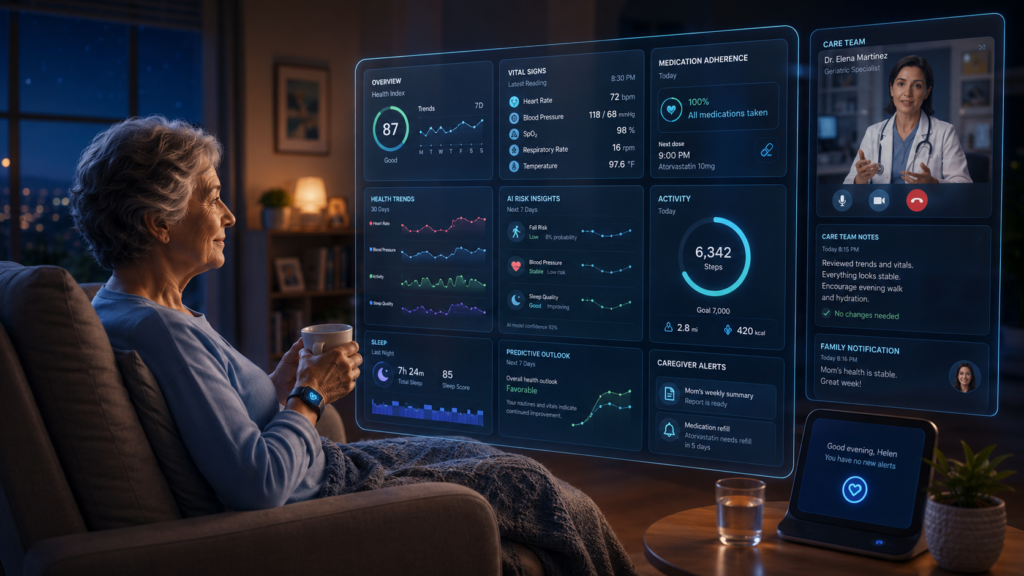
Fall Risk Prediction
Falls are one of the most important use cases for predictive analytics in senior care. Fall detection tells you when a fall happens. Fall prediction tries to identify rising risk before the fall.
Inputs may include:
- Walking speed
- Balance changes
- Nighttime movement
- Medication changes
- Prior fall history
- Sleep disruption
- Room-to-room movement
- Inactivity patterns
For buyers, the key question is whether the system only detects falls or also identifies risk trends.
Medication Adherence Risk
Medication errors are common in older adults, especially when multiple prescriptions are involved.
Predictive medication tools may track:
- Missed doses
- Delayed doses
- Refill gaps
- Confusing schedules
- Side effect patterns
- Medication changes after hospitalization
A stronger system can help identify when missed medication is part of a broader decline, such as cognitive change, depression, poor appetite, or caregiver overload.
Hospital Readmission Risk
After discharge, older adults are vulnerable. A small change in weight, breathing, blood pressure, glucose, sleep, or mobility can signal trouble.
Predictive platforms can help families and care teams monitor the transition from hospital to home.
Chronic Disease Escalation
Predictive AI can support seniors with:
- Hypertension
- Diabetes
- Heart failure
- COPD
- Kidney disease
- Obesity
- Frailty
- Cognitive impairment
The goal is not to diagnose from device data. The goal is to identify patterns that deserve clinical attention.
Cognitive and Behavioral Change
For older adults with mild cognitive impairment, dementia, or confusion risk, predictive systems may observe changes in routine.
Examples include:
- Unusual nighttime activity
- Missed meals
- Leaving home at unusual times
- Reduced hygiene routines
- Repeated medication delays
- Longer periods of inactivity
- Increased caregiver check-ins
These signals require careful interpretation. The system should support caregivers without turning the home into a stressful monitoring zone.
Nutrition, Frailty and Functional Decline
Predictive geriatric care is not only about emergencies. It can also help identify slow decline.
Signals may include:
- Reduced meal activity
- Weight loss
- Lower movement
- Poor sleep
- Declining strength
- Lower engagement
- Medication side effects
- Appetite changes
Some families also explore cognitive and nutrition-related support. TeleGeriatric’s Nootropics resource can help readers understand how nutrition, supplementation, and cognitive-support topics fit into broader geriatric care discussions.
Devices and Data Sources That Power Predictive AI
Predictive AI depends on connected data. The device is not the whole system; it is one input into a larger care picture.
For buyers comparing home monitoring tools, TeleGeriatric’s guide to Latest Geriatric Care Devices is a useful starting point.
Common Device Categories
| Device Type | Data Collected | Predictive Use |
|---|---|---|
| Smartwatch | Heart rate, activity, sleep, fall events | Fall risk, mobility change, sleep disruption |
| Blood pressure monitor | BP trends | Hypertension instability, medication response |
| Glucose monitor | Blood sugar patterns | Diabetes risk, hypoglycemia patterns |
| Smart scale | Weight changes | Heart failure risk, nutrition decline |
| Pulse oximeter | Oxygen saturation | Respiratory change, COPD monitoring |
| Medication dispenser | Dose timing | Adherence risk, cognitive support |
| Motion sensors | Movement patterns | Inactivity, wandering, routine change |
| Bed sensors | Sleep, restlessness | Sleep disruption, nighttime risk |
| Door sensors | Exit patterns | Wandering risk, daily routine change |
| Caregiver app | Notes and observations | Contextual risk interpretation |
What Buyers Should Understand
The most expensive device is not always the best. A simple connected blood pressure monitor may be more useful for one senior than a premium wearable. A medication dispenser may matter more than a smart home sensor system if the main risk is missed medication.
The best purchase depends on the older adult’s actual risk profile.
How Predictive AI Fits into Telemedicine
Predictive AI becomes more powerful when connected to telemedicine, because the data can lead to timely care.
A practical model looks like this:
- Device collects home data
- System compares data to personal baseline
- Predictive model flags rising risk
- Caregiver or clinician reviews the alert
- Telemedicine visit is scheduled if needed
- Care plan is adjusted
- Monitoring continues
This creates a loop: observe, predict, review, intervene, monitor again.
In geriatric care, that loop is especially important because older adults often have overlapping issues. A fall risk may be connected to medication, sleep, hydration, blood pressure, vision, home layout, and muscle weakness. Predictive AI can flag the pattern, but geriatric review gives it meaning.
Buyer Personas: Which Predictive AI Setup Fits Best?
| Buyer Type | Main Concern | Best Direction |
|---|---|---|
| Adult child caregiver | Parent lives alone | Wearable + fall detection + caregiver app |
| Senior with hypertension | BP instability | Connected BP monitor + telemedicine review |
| Senior with diabetes | Glucose swings | Glucose tracking + medication support |
| Post-hospital patient | Readmission risk | RPM bundle + clinical monitoring |
| Dementia caregiver | Wandering or routine disruption | Motion sensors + door sensors + caregiver alerts |
| Frailty risk | Weight loss and weakness | Smart scale + activity tracking + nutrition review |
| Senior living operator | Many residents | Dashboard-based predictive analytics |
| Home care agency | Visit prioritization | Caregiver notes + sensor trends + risk scoring |
Risks, Privacy and Clinical Safeguards
Predictive AI in geriatric care should be adopted carefully. The technology can be helpful, but it can also create anxiety, false confidence, privacy concerns, or alert fatigue if poorly designed.
False Alerts
A system may flag risk when no serious issue exists. This can worry families and overload caregivers.
Buyers should look for adjustable alert settings and clear explanations of why alerts happen.
Missed Alerts
No system catches every problem. A normal device reading does not guarantee safety.
Predictive tools should be treated as support, not a substitute for medical evaluation.
Data Privacy
Senior-care data can include movement, sleep, medication, bathroom patterns, health readings, and home behavior. That information is sensitive.
Before buying, review:
- What data is collected
- Who can access it
- Whether data is shared
- How consent is handled
- How family access works
- Whether the older adult can control visibility
Over-Monitoring
Some seniors may feel watched. The best setup balances safety with dignity.
A system should support independence, not make the older adult feel like a patient inside their own home.
Lack of Clinical Integration
Many products produce alerts but do not connect to a care pathway. This leaves families with more data but no guidance.
A better system should connect alerts to caregiver action, telemedicine review, or clinician oversight.
Upcoming Trends and Latest Tech
Predictive AI in geriatric care is moving quickly. The next stage will not be defined by one device. It will be defined by connected systems that combine home data, clinical context, and personalized risk modeling.
1. Multi-Sensor Aging-in-Place Systems
Future senior-care homes will use several quiet data sources rather than one wearable.
Examples include:
- Motion sensors
- Bed sensors
- Smart medication tools
- Connected scales
- Blood pressure monitors
- Door sensors
- Wearables
- Voice-based check-ins
- Environmental sensors
The technology will become less visible while the care intelligence becomes stronger.
2. Digital Twin Models for Older Adults
A digital twin is a virtual model of a person’s health patterns. In geriatric care, this could mean a system that simulates how changes in medication, mobility, sleep, nutrition, or chronic disease may affect future risk.
For people, this is still an emerging area. The practical question is whether the system can create a useful personal baseline and update it over time.
3. Predictive Medication Safety
Medication risk is one of the most important areas for older adults. Upcoming systems may connect pharmacy data, adherence patterns, side effect reports, fall risk, blood pressure trends, and cognitive changes.
This could help flag when a medication change is followed by dizziness, confusion, poor sleep, appetite loss, or reduced mobility.
4. AI-Supported Caregiver Dashboards
Caregiver dashboards will become more important as families manage care from a distance.
A strong dashboard should not show endless charts. It should answer:
- What changed?
- How serious is it?
- What should we do next?
- Who needs to be notified?
- Is this trend improving or worsening?
5. Voice and Conversational Monitoring
Voice-based systems may help older adults check in without opening apps or wearing devices all day.
Potential uses include:
- Daily wellness check-ins
- Medication reminders
- Mood screening
- Appointment reminders
- Caregiver alerts
- Symptom logging
The challenge will be accuracy, privacy, consent, and avoiding over-reliance on automated conversation.
6. Predictive Nutrition and Frailty Monitoring
Frailty prediction will likely become a larger part of geriatric AI. Instead of focusing only on emergencies, systems may track slow functional decline.
Signals may include:
- Weight changes
- Appetite changes
- walking reduction
- Reduced grip or movement patterns
- Sleep disruption
- Social withdrawal
- Medication burden
- Recovery after illness
This matters because frailty often develops quietly before it becomes visible.
7. Better Clinical Validation and Regulation
As AI-enabled medical tools become more common, buyers will need to distinguish wellness claims from clinically meaningful systems.
A smart buyer should ask:
- Is this a wellness product or medical device?
- Is it reviewed by clinicians?
- Is there published validation?
- Does it explain its limitations?
- Does it connect to care action?
Buying Guidance: What to Look For Before Purchase
Predictive AI systems are often marketed with impressive language. Buyers should focus on practical performance.
Must-Have Features
- Senior-friendly setup
- Reliable device connectivity
- Clear caregiver alerts
- Personal baseline tracking
- Easy-to-read dashboard
- Privacy controls
- Clinician or caregiver review pathway
- Adjustable alert sensitivity
- Integration with telemedicine or care management
- Transparent explanation of what the system can and cannot do
Nice-to-Have Features
- Medication integration
- Fall-risk scoring
- Sleep trend analysis
- Nutrition or weight trend alerts
- Multi-user caregiver access
- Emergency escalation
- Voice check-ins
- Smart home sensor compatibility
- Clinical report exports
Red Flags
- Vague “AI-powered” claims
- No explanation of what is predicted
- No caregiver workflow
- No privacy details
- Too many alerts
- No baseline personalization
- No human oversight
- Complex setup for an older adult
- No clear cancellation or support policy
- Claims that sound like diagnosis without clinical review
Predictive AI in Geriatric Care: Decision Table
| Situation | Recommended Setup | Why |
|---|---|---|
| Senior lives alone | Fall detection + activity monitoring + caregiver alerts | Supports safety without daily intrusion |
| Multiple chronic diseases | RPM devices + telemedicine review | Tracks health changes between visits |
| Mild cognitive impairment | Medication dispenser + motion/door sensors | Supports routine and wandering awareness |
| Post-hospital recovery | Smart scale + BP monitor + pulse oximeter + clinical dashboard | Helps detect early deterioration |
| Frailty or weight loss | Smart scale + nutrition review + activity tracking | Watches slow functional decline |
| Caregiver lives far away | Dashboard + alerts + scheduled virtual check-ins | Reduces uncertainty and improves response |
| Senior dislikes wearables | Room sensors + connected medical devices | Lower burden and easier adherence |
How to Build a Practical Predictive Care Setup
Step 1: Identify the Main Risk
Do not start with the product. Start with the problem.
Ask:
- Is the main concern falls?
- Medication?
- Blood pressure?
- Diabetes?
- Wandering?
- Frailty?
- Hospital readmission?
- General safety at home?
Step 2: Choose the Minimum Useful Device Set
More devices can create more data, but also more maintenance.
A simple setup may work better than a complex one.
Step 3: Decide Who Responds
Technology does not provide care by itself. A person must respond to alerts.
That person may be:
- Adult child
- Spouse
- Home caregiver
- Nurse
- Telemedicine team
- Senior living staff
Step 4: Connect Data to Care
Predictive AI works best when data leads to action. A risk alert should trigger a check-in, medication review, nutrition assessment, home safety review, or telemedicine visit.
Step 5: Review Monthly
Senior needs change. A setup that works after surgery may not be enough six months later. Review the system regularly.
FAQs
What is predictive AI in geriatric care?
Predictive AI in geriatric care is the use of data-driven software to identify rising health or safety risks in older adults before a major event happens. It may analyze information from wearables, medical devices, home sensors, medication tools, telemedicine records, and caregiver notes. The goal is not to replace medical judgment. The goal is to notice patterns earlier, such as reduced movement, missed medication, unstable vital signs, or changes in daily routine.
Is predictive AI useful for seniors living alone at home?
Yes, predictive AI can be especially useful for seniors living alone when it is matched to the right risk. A senior with fall risk may benefit from motion tracking and fall detection. A senior with heart failure may benefit from a smart scale and blood pressure monitor. A senior with memory issues may benefit from medication tracking and routine monitoring. The best system is one that supports independence while giving caregivers timely alerts.
What are the best AI elderly care solutions for family caregivers?
The best AI elderly care solutions for family caregivers usually combine three features: simple senior-friendly devices, clear caregiver alerts, and a dashboard that shows changes over time. Families should look for systems that track the specific problem they are worried about, such as falls, medication adherence, blood pressure, glucose, wandering, or frailty. A product with fewer features but better usability is often better than a complicated platform that the older adult will not use.
How does predictive analytics for senior care help prevent falls?
Predictive analytics for senior care may help reduce fall risk by identifying changes that often appear before a fall, such as reduced walking, restless nights, unusual bathroom visits, inactivity, medication timing changes, or balance-related movement patterns. It does not guarantee fall prevention, but it can help caregivers act sooner by reviewing medications, improving hydration, adjusting home safety, adding mobility support, or scheduling clinical evaluation.
Should families choose AI vs traditional geriatric care?
Families should not treat AI vs traditional geriatric care as an either-or decision. Traditional geriatric care provides diagnosis, medical judgment, medication review, and care planning. Predictive AI adds monitoring between visits. The strongest model combines both: AI identifies risk patterns, while clinicians and caregivers interpret the situation and decide what action is needed.
People Also Ask
How is AI used in elderly care today?
AI is used in elderly care to support remote monitoring, fall detection, medication reminders, activity tracking, caregiver alerts, chronic disease monitoring, and risk prediction. In practical terms, it helps connect scattered signals into a clearer picture. For example, a system may notice that an older adult is sleeping poorly, moving less, missing medication, and gaining weight. That combination may suggest a need for caregiver review or telemedicine follow-up.
Can predictive AI detect health problems before symptoms appear?
Predictive AI may detect risk patterns before symptoms are obvious, but it should not be described as a guaranteed early diagnosis tool. It can flag unusual trends, such as rising blood pressure, declining activity, weight change, poor sleep, or missed medication. These signals may appear before a family notices a visible change. A clinician still needs to interpret the pattern in context.
What devices are needed for predictive AI in geriatric care?
The devices depend on the older adult’s risk profile. Common options include smartwatches, blood pressure monitors, glucose monitors, smart scales, pulse oximeters, medication dispensers, bed sensors, motion sensors, and caregiver apps. A senior with hypertension may only need a connected blood pressure monitor and care review. A senior with fall risk may need wearable or motion-based monitoring.
Is predictive AI safe for older adults?
Predictive AI can be safe when used with consent, privacy protection, human oversight, and realistic expectations. The risk comes from over-trusting the system, ignoring false alerts, misunderstanding device readings, or using a product that does not fit the senior’s needs. Families should choose systems that explain their alerts clearly and connect data to caregiver or clinical action.
What should I look for in an AI elderly care platform?
Look for a platform that tracks the right risks, creates a personal baseline, sends clear alerts, protects privacy, allows caregiver access, and connects with telemedicine or clinical review. Avoid platforms that only use vague claims like “smart AI” without explaining what they measure, what they predict, and what users should do when an alert appears.
Editorial Insights
Predictive AI in geriatric care is not important because it sounds advanced. It is important because aging often changes quietly before it changes suddenly.
A fall, hospitalization, medication error, or frailty episode may look sudden from the outside. But in many cases, the body has been giving signals for days or weeks. Less movement. Poor sleep. Missed doses. Weight change. More nighttime activity. Lower appetite. Higher blood pressure. Slower recovery.
The future of geriatric care will not be built around devices alone. It will be built around intelligent care loops: home data, predictive analysis, caregiver response, telemedicine review, and personalized follow-up.
For buyers, the smartest decision is not to chase the most advanced product. It is to choose the system that matches the older adult’s real risk, respects their dignity, protects their data, and connects alerts to meaningful care.
To explore connected aging support in a broader clinical context, visit TeleGeriatric and continue building a safer, smarter, more human-centered approach to senior care.
